Every claim traceable: sources, archives and glossary
These are the sources used in the stories on this site, organized into the same groups as the Hidden Stories. From an article, you can click on a subject term to jump straight to the corresponding source here.
All stories, numbered
Each Hidden Story has a fixed number, so it can be referred to in the Name index and elsewhere.
- Laurens Verniers: the life of our stamvader
- Abraham Verniers and the Middelburg Almanac of 1603
- Abraham Verniers: a life without heirs
- The 1625 will: Grietge Joosten, the Anslos and the almshouse on the Egelantiersstraat
- Grietge Joosten, her daughter and the Anslo family
- Trijntgen Verniers and the link to Weesp
- The Verniers family in Weesp: surgeons, administrators and a bean in the coat of arms
- The Verniers family and the Golden Age: Rembrandt, Vondel and Hooft
- Pieter Vernier: captain, and an "old noble family of Mechelen"?
- The noble family of Pieter Vernier?
- Captain Vernier, side by side with Prince Maurits: the siege of Geertruidenberg, 1593
- Joos Verniers of Hof ter Schoonderhaege — a great-grandfather behind Alva's sentence?
- Pieter Vernier, receiver: money, wine and linen in medieval Ghent
- A family of writers in the 16th and 17th centuries?
- Joris Verniers: a second Antwerp family in Amsterdam
- Scattered traces: the name Vernier(s) across Europe
- Cloth, beer and wedding verses: the Anslos, the Schoutens and the road to Weesp
Sources overview
The source entries below — archival documents, book titles and other citations — are given in their original, most commonly used form (usually Dutch), as is customary in a source list; only the four group headings below have been translated.
The confirmed line
Bronnen over stamvader Laurens Verniers en zijn rechtstreeks bewezen nakomelingen.
- Bron 1GAMEO — Verniers, Laurens (16th century)
- Bron 2Wikipedia — Doopsgezinden
- Bron 3Historiek.net — Raad van Beroerten (Bloedraad van Alva)
- Bron 4Internet Archive — De Doopsgezinden te Antwerpen (Vos)
- Bron 5CBG Familienamen — Verniers
- Bron 6OpenArchieven.nl — archiefstuk
- Bron 7Rutgers van der Loeff — genealogie
- Bron 8Alchetron — Mennonite Church in the Netherlands
- Bron 10Stadsarchief Amsterdam — akte Kalverstraat, 15-05-1585
- Bron 11Stadsarchief Amsterdam — akte "De Oranjeboom", verkocht door Laurens Verniers aan Gerrit Rijckelsma, 03-04-1591
- Bron 12Stadsarchief Amsterdam — begraafakte Oude Kerk, 27-12-1600
- Bron 13Stadsarchief Amsterdam — akte "De Witte Voet", 19-04-1601
- Bron 14J. Marcus, "Sententien en Indagingen van den Hertog van Alba", Amsterdam, by Hendrik Vieroot, Boekverkoper, 1735, blz. 208 (Sententie van Banissement, 26-11-1569) — eigen exemplaar, persoonlijke bibliotheek; geen online link beschikbaar
- Bron 15Amstelodamum, 56e jaargang, nr. 1, januari 1969, blz. 202 — geen online link beschikbaar
- Bron 16Notarieel archief Enkhuizen, No. 902 A 83, 1624 — vermoedelijk betreffende het weesvaderschap van Abraham Verniers (het huwelijk zelf vond pas in 1626 plaats, zie Bron 26)
- Bron 17Notarieel archief Enkhuizen, No. 915 A 172, 5 november 1627 — akte rond het overlijden van Abraham Verniers
- Bron 18PZC, "Geheim 17e-eeuwse boekband onthuld", 22 april 2016 — geen online link beschikbaar
- Bron 19Jeroen Salman, "Populair drukwerk in de Gouden Eeuw: De almanak als lectuur en handelswaar"
- Bron 20Jeroen Salman, "Een handdruk van de tijd: De almanak en het dagelijks leven in de Nederlanden, 1500–1700" — geen online link beschikbaar
- Bron 21Correspondentie met de restaurator van het Zeeuws Archief (foto's en beschrijving van de almanakken), 2013–2016 — geen online link beschikbaar
- Bron 22WieWasWie / Erfgoed Leiden en Omstreken — Poorterboeken, Abraham Vernier, distillateur, herkomst Emden, Leiden 12-05-1608
- Bron 23Archief Amsterdam, poorterboek (MMSAA01_063000069) — Abraham Verniers, kramer, herkomst Emden, 25 april 1606 — geen online link beschikbaar
- Bron 24Rechterlijk Archief Leiderdorp, Transporten inv.nr. 10 (09-04-1611 t/m 05-08-1613), transcriptie H. J. van der Waag — akte nr. 246 (17-09-1612, als "Abraham Warnier") en akte nr. 291 (25-03-1613, als "Abraham Verniers", wonende Haarlem) — geen online link beschikbaar
- Bron 25Rijks Geschiedkundige Publicatiën, nr. 716 (17 september 1621, Not. arch. 287 f. 213, Not. Fr. van Banchem) — verklaring van Jacob Ysbrantsz. Bontekoe en mr. Abraham Verniers, leermeester der groote zeevaart te Enkhuizen; plus personenindex "Verniers, Abraham, zeevaartkundige"
- Bron 26Westfries Archief — Doop-, trouw- en begraafboeken Enkhuizen (1702-09, inv.nr. 45, folio 64): huwelijksafkondiging Abram Vernier & Geertjen Jans, 27-03-1626, huwelijk 30-04-1626
- Bron 27Testament Abraham Verniers — Notarieel Archief Enkhuizen, notaris Olbrant Smetius, archief 905, Akten 13-09-1626 t/m 04-09-1627, blz. 264, gedateerd 29 juni (vermoedelijk 1627); enige woorden nog onzeker door beschadiging van het origineel
- Bron 28Génard, deel XII, blz. 26-27 — brief van Hans Busschaert aan Laurens Verniers, 24 januari 1570, via K. Vos geciteerd — geen online link beschikbaar
- Bron 29J. G. van Dillen — vermelding van Laurens Verniers in Amsterdam, 1585; volledige titel van het werk nog te achterhalen
- Bron 30Veelderhande liedekens, gemaect uut den Ouden ende Nieuwen Testamente, 1582 — bevat een lied over Laurens Verniers; geen online link beschikbaar
- Bron 31Blaupot ten Cate, geciteerd door K. Vos in verband met de identificatie van Hans Busschaert/Hans Bouwens — geen online link beschikbaar
- Bron 32Masterscriptie Stadsgeschiedenis, UvA: "Welvaartsspreiding in Amsterdam ten tijde van de Capitale Impositie, 1585" (31-07-2018) — vermelding CI85 634, OZ Warmoesstraat vanaf de noorderhoek van de St. Annastraat richting de kerk: Laurens Verniers, Q Q 37 Q Q Q Q — geen online link beschikbaar
- Bron 33K. Vos, "Vriesch-Vlaamsche twisten", in: De Zondagsbode (doopsgezind weekblad), 27e jaargang, nr. 43, 23-08-1914 — geen online link beschikbaar
- Bron 34F. C. Wieder, "De Schriftuurlijke Liedekens: Inhoudsbeschrijving en Bibliographie", 's-Gravenhage, 1900, blz. 117 — vermelding van Louwereys Verniers onder de offerliederen — geen online link beschikbaar
- Bron 35K. Vos, "Menno Simons 1496-1561: Zijn leven en werken en zijne reformatorische denkbeelden", Brill, Leiden, 1914, blz. 144, hoofdstuk "Hoyte, Hans en Herman" — geen online link beschikbaar
- Bron 36S. Blaupot ten Cate, "Geschiedenis der Doopsgezinden in Groningen, Overijssel en Oost-Friesland", Eerste deel, met bijlagen en kaarten — geen online link beschikbaar
- Bron 37Doopsgezinde Bijdragen, verzameld en uitgegeven door Dr. J. G. de Hoop Scheffer, Leiden, E. J. Brill, 1893 — "Het Verbond der Vier Steden" — geen online link beschikbaar
- Bron 38Guido Marnef, "Antwerpen in de tijd van de Reformatie: Ondergronds protestantisme in een handelsmetropool 1550–1577", Stichting Gihonbron, Middelburg, 2008 — over de getuigenissen van Jan van de Walle en Herman van den Greyn
- Bron 39Willem Stuve, "Herrie om een huis: de Huiskopertwist kritisch bekeken", in: Doopsgezinde Bijdragen, nieuwe reeks 31, 2005 — geen online link beschikbaar
- Bron 40S. Blaupot ten Cate, "Geschiedenis van de Doopsgezinden: Doopsgezinden in Friesland en Holland, Zeeland, Utrecht", Amsterdam, P. N. van Kampen, 1847 — geen online link beschikbaar
- Bron 41Jan Luyssaert, voordracht "De vervolging van wederdopers in de 16e en de 17e eeuw, in Gent en omstreken", Familiekunde Vlaanderen – regio Gent
- Bron 42Nationaal Archief — vermelding van de vermoedelijke herkomst van Abraham Verniers uit Gent of Antwerpen; exacte vindplaats nog te preciseren — geen online link beschikbaar
- Bron 43Stadsarchief Amsterdam, archief 5075 (Notarieel Archief), inv.nr. 249 — testament van Claes Claesz Anslo en Geert Jansdr., verleden voor notaris Jacob Meerhout, 23 oktober 1625; transcriptie via Transkribus
- Bron 44JordaanWeb — Anslo's hofje, 1ste Egelantiersdwarsstraat
- Bron 45Vereniging Vrienden van de Amsterdamse Binnenstad — Claes Claesz. hofje
- Bron 46CBG Familiewapens — ex libris R.M. Verniers, wapenontwerp Karel van den Sigtenhorst
- Bron 47Stadsarchief Amsterdam, DTB 402, blz. 149 — ondertrouwinschrijving Claes Claesz (Anslo) en Griet Hansdr., 19 december 1582
- Bron 48Testament van Trijntgen Verniers, 22 oktober 1622, notaris Jacobus Westfrisius, Amsterdam (transcriptie via Transkribus, Amsterdam City Archives — voorlopige bronvermelding, definitief archief/inventarisnummer volgt nog)
- Bron 49Akte van overdracht obligatie t.n.v. Maria Verniers tot Weesp, 24 november 1769, notaris Hermanus van Heel, Amsterdam (transcriptie via Transkribus, Amsterdam City Archives — voorlopige bronvermelding, definitief archief/inventarisnummer volgt nog)
- Bron 50Archief Amsterdam, scan-ID KLAG06408000001/002 — "Akte waarbij Pieter (Lourens) Verniers afstand doet van zijn recht op de goederen van wijlen Trijntje Verniers, die onder berusting zijn van zijn zuster Sara", 1656, afschrift, notaris Rombout Noordingh, Weesp
- Bron 51Testament van Claes Dircksz Berckman, chirurgijn, en Trijntgen Verniersdr., 28 oktober 1624, notaris Jacobus Westfrisius, Amsterdam
- Bron 52Stadsarchief Amsterdam, archief 5062 — akte "De Witte Voet", aangekocht door Laurens Verniers van Burchghen Hendricx, 08-05-1592 (Oudezijds Voorburgwal; exact inventarisnummer nog te achterhalen)
- Bron 53Rijksmuseum Amsterdam — portret en biografische gegevens Cornelis Claesz. Anslo (1592-1646)
- Bron 54Wikipedia — Cornelis Claesz Anslo; en GAMEO (Global Anabaptist Mennonite Encyclopedia Online), "Anslo, Cornelis Claesz (1592-1646)"
- Bron 55P.C. Hooft als "hoofdofficier der stad Weesp" (1609-1647), naast drost van Muiden en baljuw van Gooiland — zie o.a. G.P. van der Stroom, 'Eene onafgewerkte teekening' van P.C. Hooft. De drost en zijn slot (dbnl.org); verband met de familie Verniers in Weesp nog nader te documenteren
- Bron 148J.F.M. Sterck, "Het leven van Vondel" I (1587–1620), in: De werken van Vondel, deel 1 (DBNL) — ouders, vlucht uit Antwerpen, Keulen, boete 1595, route naar Utrecht, poortereed 1597, winkel "de Rechtvaerdige Trou" in de Warmoesstraat
- Bron 149KB, nationale bibliotheek — Joost van den Vondel (1587–1679): leven en werk (geboorte in Keulen, doop en diakenschap bij de Waterlandse doopsgezinden, huwelijk 1610, bekering)
- Bron 150Historiek — "Joost van den Vondel, beroemdste dichter van de Gouden Eeuw" (vertrek uit Keulen 1595, Utrecht, vestiging in de Warmoesstraat maart 1597, Brabanders in de Warmoesstraat)
- Bron 151Parenteel van Jan Hooft (J. Zwart), gebaseerd op J.E. Elias, De Vroedschap van Amsterdam 1578–1795 — ambten van Cornelis Pietersz, Pieter Cornelisz, Jan Cornelisz, Willem Jansz en Arnout Hellemans Hooft
- Bron 152Wikipedia — Cornelis Hooft (1547–1626), burgemeester van Amsterdam
- Bron 153Muiderslot, katern 4: "P.C. Hooft, Prins der Poëten" (PDF) — benoeming 1609, verblijf op het slot en aan de Keizersgracht
- Bron 154Wikipedia (Duits) — Henrick Hooft (1617–1678): ouders, ambten (vroedschap 1655, schepen 1656, burgemeester 1662, 1664, 1672, 1677, 1678, Admiraliteit 1666–1669, Gecommitteerde Raad 1669), Rampjaar, kinderen
- Bron 155Greets genealogie — gezinskaart Hendrik Hooft (1617–1678): huwelijken met Agatha Hasselaar (1640) en Maria van Walenburgh (1667), zoon Gerrit Hooft (1649–1717)
- Bron 156Greets genealogie — gezinskaart Gerrit Hooft (1684–1767): ouders Gerrit Hooft en Elisabeth van Gheel, huwelijk met Hester Hinlopen (1707), gedenkpenning 1757
- Bron 157Greets genealogie — gezinskaart Gerrit Corver Hooft (1744–1807): schepen en raad van Amsterdam, baljuw van Naarden en Gooiland, drossaard van Muiden; zie ook Online Museum De Bilt, "Een aristocratisch huwelijk in de Westbroekse kerk"
- Bron 158Historische Kring Diemen, tijdschrift jaargang 11 (2001), nr. 2 — Hoogheemraadschap van de Zeeburg en Diemerdijk: oprichting 1437, tien heemraden (o.a. Weesp, Muiden, Weesperkarspel, Amsterdam), dijkdoorbraak 5 maart 1651, Gemeenlandshuis 1727, paalworm 1735
- Bron 159Archief van het Hoogheemraadschap van de Zeeburg en Diemerdijk (Waterschap Amstel, Gooi en Vecht, toegang 02), inleiding en bijlage: namen van dijkgraven en hoogheemraden met jaar van aantreden en volgnummer, naar de wandborden in het Gemeenlandshuis — o.a. Hooft (Amsterdam, Muiden, Weesperkarspel) en Verniers (Weesp: Cornelis 1694, Pieter 1715, Willem 1721); bestuur, stormvloeden 1675–1677, resolutie 1678, akkoord Weesp 1720, paalworm 1735 en steenglooiing 1737
- Bron 160GAMEO (Global Anabaptist Mennonite Encyclopedia Online) — "Contra-Huiskoopers": partij van Vlaamse doopsgezinden sinds de twist van 1586, later "Zachte Vlamingen" genoemd
- Bron 70Stadsarchief Amsterdam, Archief van het Chirurgijnsgilde, inventarisnummer A13594, register van meesterproeven van chirurgijns — akte van Mr. Pieter Verniers, meesterproef gedaan 3 maart 1648; eigen foto
- Bron 71Stadsarchief Amsterdam — Ondertrouwregister, archief 5001, inventarisnummer 1008 (volgnr. 7), David Langedul x Trijntgen Verniers, geregistreerd 17-11-1621 (huwelijk kerkelijk voltrokken 4-10-1592; aantekening "Disp.verl., M.ovl." — bruidegom op moment van registratie overleden)
- Bron 72Stadsarchief Amsterdam — Ondertrouwregister, archief 5001, inventarisnummer 763 (volgnr. 5), Claes Dirks Berckman (weduwnaar van Trijn Jacobs) x Trijntje Verniers (weduwe van David Langedul), 11-08-1618
- Bron 73Stadsarchief Amsterdam — Ondertrouwregister, archief 5001, inventarisnummer 670 (volgnr. 1), Dirck Dirckss (weduwnaar van Griet Jans) x Trijntje Verniers (weduwe van Claes Dircksz Berckman), 03-04-1627
- Bron 88Zeeuws Archief, jubileumtijdschrift Een Zee van Tijd, 2025, blz. 74–75 — "Archiefstukken vertellen. Onverwachte steuntjes in de rug", over de almanakken van Abraham Verniers (1603) en Ambrosius Germanicus (1604), verstopt in de ruggen van twee rekeningenregisters van de Zeeuwse Rekenkamer
- Bron 122Zeeuws Archief — VOC-dagen in Middelburg: Middelburg als historische wijnstad (met bijdragen van Simone Landman, University College Roosevelt, over de wijnhandel en -vaart tussen La Rochelle en Middelburg 1423-1585, en dr. Gerard van Keken, Bureau Merkwaardige Identiteit)
- Bron 124Wikipedia — algemeen overzicht van de Tachtigjarige Oorlog en aansluitende conflicten (Twaalfjarig Bestand, Vrede van Munster, Engelse Oorlogen, Rampjaar), gebruikt voor de algemene tijdsbeeld-items in de tijdlijn
- Bron 125Tineke Van de Walle, Van twee wallen eten? De stadsrand als overgangszone tussen stad en platteland in de late 15de en 16de eeuw. Casus Oudenaarde, proefschrift, Universiteit Antwerpen, promotoren Peter Stabel & Tim Soens, 2019 — over de Broekstraat op de Eindries en de concentratie van linnenblekerijen aldaar; eigen exemplaar, geen online link beschikbaar
- Bron 126Martayan Lan (antiquariaat) — verkoopbeschrijving van Pierre Vernier, La construction, l'usage, et les proprietez du quadrant nouveau de mathématique, Brussel 1631, eerste en enige editie; prijs $6.500
- Bron 127Dr. William B. Ashworth, Jr., "Pierre Vernier", Scientist of the Day, Linda Hall Library
- Bron 128I.H. van Eeghen, De Amsterdamse boekhandel 1680-1725, deel 4: Gegevens over de vervaardigers, hun internationale relaties en de uitgaven N-W, papierhandel, drukkerijen en boekverkopers in het algemeen, Scheltema & Holkema, Amsterdam 1967 (via dbnl.org) — over letterzetter Philippe Vernier, Waalse Gemeente Amsterdam
- Bron 131Biografisch Portaal van Nederland, personendossier Cornelis Claesz. Anslo (bevat ook de biografische gegevens van zijn vader Claes Claesz. Anslo "de oude", 1555–1632), met verwijzing naar S. Blaupot ten Cate, Geschiedenis der Doopsgezinden in Holland (Amsterdam 1847) I, 65, en C.N. Wybrands, "Iets over het geslacht Anslo", De Zondagsbode (Doopsgezind Weekblad), 1899, nr. 16-21
- Bron 132Lars Roede, "Fra Anslo til Amsterdam" [Van Anslo naar Amsterdam], in: Byminner, Oslo Museum, nr. 1-2015 (Noors) — naar aanleiding van een familieportret (Oslo Museum) van burgemeester Trond Clausson (ca. 1560-1640), zoon van de uit de Nederlanden naar Noorwegen geëmigreerde Claus Hollender; Roede volgt de sporen van deze familie in zowel Noorwegen als Nederland
- Bron 133Amsterdam City Archives (via Transkribus), notarieel archief, notaris Jacob de Winter, akte 2332_NOTD00214, 1688 — erfenisakte van de familie Van Aarden, waarin Pieter Verniers, schepen van Weesp, en zijn (ex-)echtgenotes Hendrickje Geijn en (mogelijk) Ment Dircxsz Witteveenen genoemd worden
- Bron 162Kwartierstaat Zuiderent – van Wijgerden, generatie 13 (nrs. 7038–7039) — Cornelis Claesz Anslo (1592–1646) en Aeltie Gerritsdr Schouten (ca. 1590 – kort voor 20-11-1659), getrouwd Amsterdam 9-1-1611; Claes Claesz Del, brouwer en burgemeester van Weesp, x Ytje Huybertsdr en x Niesje Cornelisdr Schouten
- Bron 163Kwartierstaat Zuiderent – van Wijgerden, generatie 14 (nrs. 14076–14079) — Claes Claessen Anslo x Giert Jansdr; Gerrit Cornelisz Schouten (Weesp 1567 – Amsterdam 1626), lakenkoper, x Aeltgen Gerbrantsdr; Huybert Gysbertsz Gooyer, brouwer te Hoorn, x Jannetje Ansemsdr
- Bron 164Kwartierstaat Zuiderent – van Wijgerden, generatie 15 (nrs. 28156–28157) — Cornelis Govertsz Schouten alias van Cleef (Weesp) x Weyntgen Lap; zoon Laurens de rijkste inwoner van Weesp, getrouwd met "een nicht van Vondel"
- Bron 165Stichting Familiearchief De Clercq — Driemond a/h Gein: Laurens Czn Schouten (1568/9–1642), de Schoutenhof, Abigael Schouten x Gerbrand Anslo (1612–1643), Vingboons 1642, verkoop 1647
- Bron 166Ons Amsterdam — "Eeuwenoude banden. Weesp en Amsterdam delen een lange geschiedenis" (bezoek Frederik Hendrik sept. 1631, Weesper bier en Vechtwater, 23 branderijen in 1667)
- Bron 167Wikidata — Rembrandt, Portret van Cornelis Claesz Anslo en zijn vrouw Aeltje Gerritsdr. Schouten (1641), Gemäldegalerie Berlijn
- Bron 168Wikipedia — Willem Cornelisz Schouten (Hoorn ca. 1567 – 1625), zeevaarder, rondde in 1616 Kaap Hoorn
- Bron 169Kwartierstaat Zuiderent – van Wijgerden, generatie 12 (nrs. 3518–3519) — Jan Claesz Del (Weesp ca. 1611 – Amsterdam 1681) x Teuntie Cornelisdr Anslo (ca. 1616–1648), Amsterdam 12-11-1637
- Bron 170A.M.W. Bulk-Bunschoten en J.C.J. Bunschoten-Wijnants, "Ruim een eeuw nageslacht van Huybert Gysbertsz. Gooyer, een zestiende eeuwse brouwer", in: Gens Nostra 48 (1993), blz. 365–387
- Bron 171Stadsarchief Amsterdam, archief 5075 (Notarieel Archief), inv.nr. 6391, 19 mei 1700 — compromis tussen Pieter Aldenhoven, impostmeester van de bieren over Amsterdam en Amstelland, en Cornelis Verniers als borg voor zijn zoon Laurens Verniers, bierbeschooier te Diemen; gepasseerd aan de Diemerbrug
- Bron 172Stadsarchief Amsterdam, archief 5075 (Notarieel Archief), inv.nr. 435, notaris Palm Mathijsen, 9 juni 1618 — protest van een wisselbrief uit Danzig (14 april 1618, f 140 Vlaams) op verzoek van Jan Visscher van Aecken tegen Laurens Verniers, "sijde Laecken Cooper"
- Bron 173Stichting Familiearchief De Clercq — "Het Vlaamse voorgeslacht van de Hollandse familie de Clercq, eind 13de – begin 17de eeuw" (pdf): biografische schets van Cornelis van Tongerloo (1555–1617) en zijn familie, met verwijzing naar o.a. Van Dillen, Amsterdam in 1585; Sterck, Oorkonden over Vondel en zijn kring (1918)
Mechelen
Bronnen over kapitein Pieter Vernier en de Mechelse archiefstukken — nog niet gekoppeld aan de stamlijn.
- Bron 56M. Balen, Beschryvinge der Stad Dordrecht (Dordrecht, 1677), deel 2, blz. 981, incl. geslachtboom Van Beverwijck / Verniers / Van Aeckerlaecken
- Bron 57"'t Begin van Hollant in Dordrecht", blz. 56 — vermelding van het huwelijk van Joffr. Marie van Beverwijck met kapitein François Venier (Verniers)
- Bron 58E. van Meteren, Historiën, 's Gravenhage 1623/1635, fol. 452-455 — over de Slag bij Nieuwpoort (1600) en ritmeester Pierre Panier (Pagnet)
- Bron 59Verzamelde berigten omtrent de krijgsbevelhebbers bij Nieuwpoort, 2 Julij 1600, Utrecht, N. van der Monde, 1836
- Bron 60Algemene Konst- en Letterbode, Nummer 19, vrijdag 5 mei 1843 — over de nakomelingen Van Akerlaecken
- Bron 61MyHeritage — Maria Pietersdr van Akerlaken (geboren Verniers), 1589-1625
- Bron 62Stadsarchief Breda, DTB Begraven, Hervormde Gemeente Breda Kerkvoogdij, boek 10, blz. 15v — begrafenis Peeter Vernier, 02-09-1593, Breda (Begraafposten in de rekeningen van de Grote Kerk 1593-1594)
- Bron 63Stadsarchief Breda, DTB Begraven, Hervormde Gemeente Breda Kerkvoogdij, boek 8, blz. 13r — begrafenis NN Verniers (kind van Peeter Verniers), 17-11-1591, Breda (Begraafposten in de rekeningen van de Grote Kerk 1591-1592)
- Bron 64Anthony Duyck, Journaal, deel 1, boek 1 (inleiding en aantekeningen door Lodewijk Mulder), verslag van het beleg van Geertruidenberg, april–juli 1593
- Bron 65Register van Holland en Westvriesland, van den jare 1593 en 1594 — "Nominatie van het Capiteinschap van Vernier", 6-18 september 1593
- Bron 66Wikipedia — Beleg van Geertruidenberg (1593); achtergrond bij de val van de stad in 1589 en de herovering door Prins Maurits
- Bron 67Maria Verniers, Dordrecht, weesboek, folio 64, oktober 1625 — extract uit de testamentaire dispositie van François van Akerlaeck en Maria Verniers, gepasseerd voor notaris Sebastiaen van Graeff, Dordrecht, 7 juni 1624, geregistreerd ter weeskamer 19 oktober 1625
- Bron 68Regionaal Archief Dordrecht — Trouwboek, toegang 11 (Doop-, trouw- en begraafboeken van Dordrecht), inventarisnummer 16, Pieter Vernijer, 22-01-1589
- Bron 69WieWasWie — Stadsarchief Breda, DTB Begraven, Hervormde Gemeente Breda Kerkvoogdij, boek 8, blz. 13r, begrafenis kind van Peeter Verniers, 17-11-1591, met de aantekening "Peeter was kapitein"
- Bron 105Resolutiën der Staten-Generaal, Nieuwe Reeks, deel 7 (Huygens Instituut), resolutie nr. 3786: de rekesten van de weduwe van Claes Honne van Venlo (cornet van de graaf van Hoenloo) en van François Vernier worden ter afdoening naar de Raad van State gezonden
- Bron 106Vervolgh tot de Cronycke van Mechelen, ten tyde der Regeringe van Philippus II, Coninck van Spaignien, Leuven: J.B. Vander Haert, "In den Gulden Helm" — over de aanstelling van Carel Vernier als een van de Geswoornen van de Poorterye van Mechelen, augustus 1578
- Bron 107Rijksarchief Zeeland (RAZE), toegang 2039, akte 213, 1 april 1591 (BR00097): procuratie Gillis van Claerout / Matheus Cornelisz Smalleganghe, met verwijzing naar een akkoord van 19 maart 1570 "voir Kaerle Vernijer, Notario binnen Mechelen"
Ghent
Bronnen over de Gentse schoolmeesters, landmeters, priesters en Maria Verniers met de naam Verniers — nog niet gekoppeld aan de stamlijn.
- Bron 89Lisa Michiels, "Naar een gebruiksgeschiedenis van de vroegmoderne Gentse almanak: auteurs, gebruikers", masterscriptie, Universiteit Gent, 2024 (via Scriptiebank)
- Bron 90Nederlandsch Museum, jaargang 8, Hoste, Gent 1881 (via dbnl.org), o.a. over de sluiting van Gilles Verniers' school in 1584 en het Gentse onderwijs onder Spaans gezag — naar Ph. Blommaert, De Nederduitsche schrijvers van Gent
- Bron 91Constant Philippe Serrure, Taelkunde: over de inrigting en samenstelling van een algemeen Nederduitsch woordenboek — noemt het woordenboek van G. Verniers als taalkundige bron, met het voorbeeld "meluwen oft maeyen"
- Bron 92Alisa D. M. van de Haar, The Golden Mean of Languages: Forging Dutch and French in the Early Modern Low Countries (1540–1620), proefschrift, Rijksuniversiteit Groningen, 2018 — over de titelpaginaformule "tres ample et copieux", gebruikt door o.a. Sasbout (1576, 1579), Verniers (1580) en Mellema (1591, 1599)
- Bron 93Willem Bartjens, De cijfferinghe (1604), editie Danny Beckers & Marjolein Kool, Uitgeverij Verloren, Hilversum 2004 (via dbnl.org) — over de galei-deling, met als illustratie fol. 10r van het manuscript van Josse Verniers (hs. 694, 1584, Universiteitsbibliotheek Gent)
- Bron 94De Gulden Passer, jaargang 91, Vereniging van Antwerpse Bibliofielen, Antwerpen 2013 (via dbnl.org) — over de twee in registerbanden van het Zeeuws Archief teruggevonden almanakken van Abraham Verniers (1603) en Ambrosius Germanicus (1604), met speurwerk naar de identiteit van laatstgenoemde en de vraag of Abraham een zoon zou kunnen zijn van Jan Verniers van Gent
- Bron 95Cara Janssen, Over Mars en Venus: Constructie van identiteiten in Brabantse almanakken (1578–1648), masterproef Geschiedenis, KU Leuven, promotor prof. dr. Hans Cools, academiejaar 2012–2013 — gebruikt Jan Verniers' Prognosticatie ofte voorsegginghe (1592) als bron voor de rol van astrologie in de politiek-religieuze berichtgeving over de Opstand; zie ook de gepubliceerde versie, Bron 97
- Bron 96Biekorf: Westvlaams Archief voor Geschiedenis, Oudheidkunde en Folklore, 67e jaargang, afl. 1–2, 1966 — over de titel "ghezworen geometrist", gebruikt door o.a. Pieter de Buck (1563) en Jan Verniers (1589), en over Gentse landmeters/cartografen in de zestiende en zeventiende eeuw
- Bron 97Cara Janssen, "De almanakken van Jan Franco Sr. en de promotie van een katholiek-Habsburgse identiteit in de Zuidelijke Nederlanden (1598–1621)", in: Jaarboek voor Nederlandse Boekgeschiedenis, jaargang 22, Vantilt / Nederlandse Boekhistorische Vereniging, Nijmegen/Leiden 2015 (via dbnl.org) — de gepubliceerde, uitgebreide versie van Janssens onderzoek naar o.a. Jan Verniers' Prognosticatie van 1592
- Bron 98Philippe Marie Blommaert, De Nederduitsche schryvers van Gent, Gent 1862 — de oorspronkelijke bron over Gillis Verniers' woordenboek, de vermoedelijke broer Josse Verniers, en de vrijwel identieke heruitgave van het woordenboek in 1582 onder de naam van Jan Taye
- Bron 99Frans De Potter, Gent van den oudsten tijd tot heden: Geschiedkundige beschrijving der stad, vijfde deel, Gent 1889 — met de Franse school van Jan Tayaert (Jan Taye) op de Kalanderberg, zijn familiegeschiedenis, zijn episode in Lokeren, en de discussie tussen Van der Haeghen en Blommaert over het auteurschap van het woordenboek
- Bron 100Frans De Potter, Gent van den oudsten tijd tot heden: Geschiedkundige beschrijving der stad, vierde deel, Gent 1888 — over "het steen van Papeghem" en het vermoeden dat Jan Verniers daar school hield
- Bron 101Frans De Potter, Huiselijke godsdienst onzer voorvaderen: geschreven naar familiepapieren, wettelijke en andere echte oorkonden van vroegeren tijd, tweede, merkelijk vermeerderde uitgave, Gent: Drukkerij S. Leliaert, A. Siffer & Cie, 1886 — over de Franse devotiespreuk die Gillis Verniers op het Gentse Weezenboek van 1588-1589 schreef
- Bron 102Marjolein Kool, Die conste vanden getale: een studie over Nederlandstalige rekenboeken uit de vijftiende en zestiende eeuw, met een glossarium van rekenkundige termen, Verloren, Hilversum 1999 (via dbnl.org) — over Josse Verniers' rekenmanuscript (hs. 694 / H-GeU-1584) als persoonlijk werkboek, met de eigendomsvermelding "Ceste livre appertient a moy, Josse Verniers, anno 1584"
- Bron 103Erycius Puteanus, Hondert veertien Nederlandse brieven van Erycius Puteanus aan de astronoom Michael Florent van Langren (ed. J.J. Moreau), De Sikkel, Antwerpen / Wereldbibliotheek, Amsterdam 1957 (via dbnl.org) — brief XXIX (fol. 36-37), 24 mei 1631, noemt "een boecksken van Monsieur Vernier"; welke Verniers hier bedoeld wordt is niet vastgesteld
- Bron 104Stadsarchief Gent, "De Zwarte Doos" — Huwelijken Sint-Michiels-Noord-parochie Gent, 1589-1796 (gesorteerd op familienaam en voornaam van de echtgenoot): Gillis Verniers x Catelyne Pyssoens, 19-10-1611, getuigen Jacob de Groote en Jacob de Scheppere fs. Mathys
- Bron 116Bulletin de la Commission royale d'Histoire, 1919 — bespreking van de Sententie van Banissement van 26-11-1569 tegen "Joachim Joesz Vernier", geïdentificeerd als de doopsgezinde oudste Laurens Verniers
- Bron 117Bulletin de la Commission royale d'Histoire, 1981 — index op de verplichte lening van Gent, 1492-1493: "Verniers, Joos (R — f. 11v)"
- Bron 118Lokale toponymische/geschiedkundige studie over Sint-Lievens-Esse (Herzele) — Hof ter Schoonderhaege, met verwijzingen naar Stadsarchief Gent (SAG) 330/41, 301/66, 330/50, 330/55, reeks 28 en 333/10; auteur en volledige titel nog te achterhalen
- Bron 119Stadsarchief Gent, "De Zwarte Doos" — Jaarregister van de Keure, schepenjaar 1405-1406, 301/18: erfrentes en landheerschappen van her Pieter Vernier (ontvanger, Onze-Lieve-Vrouwegilde van Sint-Jacobs), f. 26v/1 e.v.; en de regeling met broeder Jan Verniere over het meten van de wijn van het Sint-Janshuis, f. 67r/7 (3 juli 1406)
- Bron 120Erwin Pairon, Regesten op de jaarregisters van de Keure, schepenjaar 1403-1404, Stad Gent, Inventarissen en Indices gepubliceerd door het Archief, 1983 (D/1983/0341/40) — aankoop door Pieteren Vernier, priester, en Jacoppe den Oesterlinc, 11 februari 1404 (n.s.), fol. 32r/1o
- Bron 121Frans Van De Putte, Het Sint-Jans-ten-Dullen hospitaal in het laatmiddeleeuwse Gent: het vergeten Gentse dulhuis, Band I: Het onderzoek, licentiaatsscriptie Geschiedenis, Universiteit Gent, promotor prof. dr. Marc Boone, academiejaar 2006-2007 — namenlijst broeders/zusters (incl. "Vernier Jan", 15de eeuw) en de economie van de wijnroede, lijnwaadelle en het recht van de speye
- Bron 123Piet de Rooij, "Het gezag van de schoolmeester", Geschiedenis Magazine, jaargang 53 (2018), nummer 4, blz. 40-43; online gepubliceerd 5 september 2024 — over Dirck Adriaensz Valcooch's "De Regel der Duytsche Schoolmeester" (1591) en Willem Bartjens' "De Cyfferinghe" (1604)
- Bron 129A.A. Vorsterman van Oijen, Stam- en wapenboek van aanzienlijke Nederlandsche familiën, met genealogische en heraldische aanteekeningen, deel 2, 1888, blz. 258 (via ULB Düsseldorf) — over Maria Verniers, gehuwd met Jodocus van der Mandere, Gent 1646
Scattered traces (Europe)
Bronnen bij het verhaal over losse Vernier(s)-vondsten door heel Europa — Leuven, Rome, de Franche-Comté, Genève, Normandië en de Berry.
- Bron 108Rijksarchief Leuven, inventaris 749 (archief klooster der dominicanen te Leuven), bestanddeelnr. 14965: akte 1437, Egidius Vernier draagt goederen in Leuven over aan de dominicanen tegen een erfelijke rente
- Bron 109Rijksarchief Kortrijk, fonds Descantons de Montblanc (de Plotho), inventaris 504/1, bestanddeelnr. 470: renteboek van de graaf van Nevers voor de parochie Elsegem, vernieuwd door ontvanger Bertram Verniers in 1576, gecollationneerd 1577
- Bron 110Goetgevonden (Huygens Instituut), resolutie Staten-Generaal 22-9-1611: consultatie door advocaten Van Amstelredam, Berendrecht, Vernier, Van Cuyck en Van Stryen inzake de prinsen van Nassau en de smelterijen van Salm/Solms
- Bron 111Algemeen Rijksarchief, Grote Raad van Mechelen, inventaris I 597 (Dossiers de procès de Luxembourg), bestanddeelnr. 572: Claude d'Argenteau, heer van Ochain, tegen "Vernier (ook: Wernard), comte d'Oostfrize", erfeniszaak, 1611 — waarschijnlijk een andere, onzeker gelezen naam
- Bron 112Algemeen Rijksarchief, Office-Fiscal du Grand Conseil de Malines, inventaris T 318, bestanddeelnr. 648: geschil tussen "sieur Verniers", auditeur van de Rekenkamer, en advocaat Vanderelstraeten over de inning van vervallen goederen, 1700
- Bron 113RKD (Rijksbureau voor Kunsthistorische Documentatie), kunstenaarsdossier Francesco Vernieri / François Verniers (data.rkd.nl/artists/507675)
- Bron 114RKD, kunstenaarsdossier Artus del Monte / Artus van den Berg (data.rkd.nl/artists/430529), met de vermelding van "François Vernier (Francesco Vernieri) from Liège" als huisgenoot in Rome, 1639
- Bron 115Generaal Register der Registers der Heeren Staaten van Holland en Westvriesland, genomen in haar Edele Groot Mogende Vergaderinge, sedert den beginne van den jaare 1701, tot het uiteynde van den jaare 1713, beide incluis: resolutie 6 juni 1710, rappel van kapitein Plato (Regiment van den Kroonprins van Pruissen) en surrogatie van kapitein Vernier (Regiment van Varenne) in diens plaats
- Bron 134M. Babey en A. Dornier, 7E Titres de familles. Inventaire sommaire (7E1174-7E1516) et répertoire supplémentaire (7E2646-7E3666), Archives d'usage, Doubs — inventaris van tientallen vermeldingen van de naam Vernier in de Franche-Comté en Doubs, 1450-1784, incl. de baronstitel van Mathieu de Vernier (1636)
- Bron 135Wikipedia — Vernier (gemeente), kanton Genève, Zwitserland
- Bron 136Officiële website van de gemeente Vernier (kanton Genève)
- Bron 137Wikipedia (FR) — Vernier d'Oberwesel (Sint-Vernier/Sint-Verny), patroonheilige van de wijnbouwers, verering in de Franche-Comté, Bourgondië en Auvergne
- Bron 138Wikipedia — Marais-Vernier (gemeente), departement Eure, Normandië; drooglegging 1599-1633 door Nederlandse dijkenbouwers ("Digue des Hollandais")
- Bron 139Normandie Tourisme — Marais Vernier, beschermd laagveenmoeras van 4.500 hectare in een oude Seine-meander
- Bron 140Desertstarlight.com — over de gemeente Vernier (Genève): de Keltische water-etymologie van "Genève" (gen=mond, ava=water) en "Vernier" (verne=els), en de rivier in het gemeentewapen
- Bron 141Filae.com — herkomst van de naam Vernier: regionale variant van Garnier/Varnier, Germaans Warinhari (warin=bescherming, hari=leger), vooral verspreid in de Doubs en Savoie
- Bron 142Jean Tosti, noms de famille — Vernier: in het oosten van Frankrijk een variant van Garnier, in het westen een toponiem voor een met elzen beplante plek (mogelijk verbastering van het Bretonse "guern")
- Bron 143Wikipedia (FR) — Marais-Vernier (commune): toponymie — "Marescus Warnerii" (12e eeuw), afkomstig van de Germaanse persoonsnaam Warnhari; weerlegt expliciet de els-verklaring (verne) voor deze Normandische plaatsnaam
- Bron 144Ville de Vernier — officiële historique van de gemeente: Romeinse oorsprong, middeleeuwse bezetting, aansluiting bij Zwitserland (1816), industriële opkomst (spoorlijn 1858, centrale van Chèvres 1896) en de naoorlogse stadsontwikkeling
- Bron 145Google Maps — locatie van de Col des Verniers (44,5085 NB, 5,8551 OL), Hautes-Alpes, Frankrijk
- Bron 146Dangerousroads.org — Col des Verniers, bergpas op 1.042 m, weg D149 tussen Saint-Auban-d'Oze en Châteauneuf-d'Oze
- Bron 147Komoot — fietsroute door de Hautes-Alpes met de Col des Verniers als hoogtepunt
- Bron 161Filae — zoekresultaten en interactieve kaart voor de achternaam Verniers (geraadpleegd 27 september 2026)
Glossary
Explanation of 16th- and 17th-century terms that appear in the stories and transcripts on this site — now also including the terms from the Ghent and Mechelen threads. The Dutch/French term itself is kept as the entry heading, as is customary for a glossary; the explanation is given in English.
- Alteratie
- The event in 1578 in which Amsterdam switched from the Catholic to the Protestant camp; the sitting Catholic administrators were removed from office at that time. Appears in: #7
- Auditeur (van de Rekenkamer)
- Financial-legal official who audited the accounts of receivers and crown lands. Appears in: #16 Professions
- Boneloting
- Working hypothesis on this site: the drawing of lots for city magistrates (schepenen/aldermen) using white and black/brown beans — possibly reflected in the three beans in the family coat of arms. Appears in: #7 The coat of arms
- Chirurgijn
- A craftsman-surgeon, trained through a guild (with a master's exam) rather than at a university — as opposed to an academically trained physician. Appears in: #6 #7 #8 #11 #14 Family tree The coat of arms Professions Blog II
- Cotidiane
- The fund from which a church institution paid for the daily ("cotidiane") masses; also used for the fund itself. Appears in: #13
- Doopsgezind(en)
- Adherents of Anabaptism/Mennonitism, a Protestant movement that, among other things, rejected infant baptism. Appears in: #1 #3 #4 #6 #7 #8 #12 #16 Family tree The name The coat of arms Timeline Professions Acknowledgements Blog I Blog II
- Douarie
- The fixed sum of money (a widow's/widower's portion) to which a surviving spouse was entitled, as laid down in the marriage settlement. Appears in: #6
- Erfrente
- A perpetual (non-redeemable) annual payment, purchased as an investment and secured on a house or piece of land. Appears in: #13 Professions
- Extra-ordinaris intekenregister
- A separate, "extraordinary" register for betrothal registrations, alongside the ordinary betrothal register.
- Geswoorne (van de Poorterye)
- A representative of the citizenry (poorterij), sworn in by the city, sitting on the city council. Appears in: #10 Professions
- Gezworen geometrist
- A more pretentious title for a sworn land surveyor, which came into vogue after 1550. Appears in: #13 #14 Professions
- Gildegeld / gerechtigheid
- The amount someone had to pay to their guild to be admitted as a full member (master). Appears in: #7 Family tree
- Fief / leengoed
- Landed property entrusted by a liege lord to a nobleman (the vassal), in exchange for loyalty, service or homage — the basis of the medieval feudal system. The French term "seigneurie" denotes the associated manorial rights. Appears in: #16
- Grondcijns
- A fixed, annual hereditary charge on a piece of land, owed to the original ground lord. Appears in: #13
- Heilige Vernier (Sint-Verny)
- French patron saint of winegrowers, venerated mainly in the Franche-Comté, Burgundy and Auvergne; going back to the German Werner of Oberwesel (1271-1287), canonized in 1429. This may explain why "Vernier" as a baptismal and family name occurred so often specifically in the Franche-Comté. See the story → Appears in: #16
- Jaargetijde
- An annually recurring memorial mass for a deceased person, often funded by an annuity purchased for that purpose. Appears in: #13
- Landheer
- The holder of rights (rents, dues) over a piece of land, without necessarily living on it or working it themselves. Appears in: #13 Professions
- Lijfrente
- A fixed annual payment someone receives for life, often agreed in a marriage or inheritance contract. Appears in: #4 #6 Family tree Professions
- Lijnwaadelle
- The municipal right to measure woven linen, leased out in Ghent by the hospital of Sint-Jans-ten-Dullen. Appears in: #13 Professions
- Meesterproef / proeve
- The practical examination a craftsman — a surgeon, for instance — had to pass to be allowed to work independently as a master. Appears in: #7 Family tree Professions
- Notarieel protocol
- The collection of deeds drawn up and preserved by one particular notary, usually arranged chronologically. Appears in: #4
- Ondertrouw
- The public announcement of an intended marriage, required before the marriage could be solemnized. Appears in: #5 #6 #8 Family tree
- Oranjeboom
- During the Eighty Years' War, a popular political symbol that stood for loyalty to the House of Orange. The flourishing orange tree represented the survival and growth of the house of Orange-Nassau. After the assassination of William of Orange (1584), his son Maurice adopted a felled stump with a young shoot as his emblem, with the motto "Tandem fit surculus arbor" ("At length the shoot becomes a tree"). As a symbol of loyalty to Orange, the tree appeared in pamphlets, prints and poems — outright propaganda for the Orangist cause; especially after Vondel's Geboortklock van Willem van Nassau (1626), written for the birth of William II, it became a fixed image. In everyday life the name adorned the signboards of inns, coffeehouses and dwellings ("In den Oranjeboom"), conveying familiarity and security, and mills, whaling ships, orphanages and breweries were named after it. At celebrations of dynastic events — births, engagements and marriages — and later on national holidays, the orange tree returned on commemorative prints and decorations, right up to twentieth-century postcards and puzzles. Whether the name of Laurens's house "De Oranjeboom" on the Warmoesstraat (sold in 1591) deliberately referred to Orange is not known; in any case the house bore that name before the symbol reached the height of its popularity. Appears in: #1 #8 Family tree Timeline
- Ouderlieden / ouderluyden
- The governing members (elders) of a guild. Appears in: #7 Family tree
- Poorter / poorterboek
- A full, registered citizen of a town (poorter), and the register in which such registrations were kept, respectively. Appears in: #3 #6 #8 #10 #14 Family tree The name Timeline Professions
- Proefmeesters
- The guild members who examined a candidate during his master's exam. Appears in: #7 Family tree
- Rekest
- A written petition addressed to a government authority or governing body. Appears in: #10
- Schepen
- Member of the city council, at the time responsible for both administrative and judicial duties. Appears in: #4 #5 #6 #7 #8 #10 #12 #13 #14 #16 Family tree The name Professions
- Staat van goed
- A notarial or aldermen's deed describing and dividing a deceased person's estate (assets and debts) among the heirs. Appears in: #12
- Surrogatie
- The official appointment of someone as successor in an office or position, for example a military officer. Appears in: #16
- Testament
- A notarial deed in which someone sets out what is to happen to their estate after their death. Appears in: #1 #3 #4 #5 #6 #7 #8 #9 Family tree Timeline
- Universele erfgenaam
- The person who inherits the entire estate, as opposed to a legacy (a specific, defined portion). Appears in: #3 #6 Family tree Timeline
- Vernierschaal (nonius)
- An auxiliary scale that slides along a graduated measuring instrument (caliper, sextant, quadrant), making far more precise readings possible than with the naked eye. Named after the mathematician Pierre Vernier (1580-1637), who described the instrument in 1631; for centuries also called a "nonius" (after Pedro Nunes), until the astronomer Jérôme Lalande showed in the 18th century that that name actually belonged to a different instrument. The name Vernier thus lives on, quite apart from the family, as an ordinary word in metrology and mechanical engineering. Appears in: Professions
- Weesmeester
- Regent of the Orphans' Chamber, responsible for overseeing orphans' estates and finances — an administrative post, to be distinguished from the weesvader (orphanage housefather). Appears in: #3 Family tree The name
- Weesvader
- The live-in head of an orphanage, responsible for the daily care of the orphans. Appears in: #3 Family tree Timeline
- Wijnroede
- The municipal right to measure all wine sold (also called wijnroy or peghel); held in Ghent since 1245 by the hospital of Sint-Jans-ten-Dullen. Appears in: #13 Professions
Almanacs & the dictionary of the Verniers family
Early printed works by 16th-century bearers of the name Verniers, found via the Flemish university catalogue UniCat. The link to our own family tree has not yet been established — for now this is a separate trail, like the story of Pieter Vernier of Mechelen. Titles are given in their original language, as is customary for a bibliography.
-
1582 — Gillis Verniers
Dictionaire François-Flamen, tresample & copieux, augmenté outre les precedentes impressions
Authors: Jean Taye, Jan van Salenson, Gillis Verniers
Year: 1582 — Publisher: A Gand, chez Iean de Salenson
Availability (UniCat) — held at Ghent University - 1584 — Josse Verniers
-
1587 — Jan Verniers
Almanak ende prognosticatie 1587
Author: Jan Verniers
Year: 1587 — Publisher: Ghendt, Gaultier Manilius
Availability (UniCat) — held at Ghent University (STCV 12924598; USTC 413807) -
1589 — Jan Verniers
Almanach ende prognosticatie, vanden jaere ons Heeren M.CCCCC.LXXXIX
Author: Jan Verniers
Year: 1589 — Publisher: Ghendt, Ghileyn Manilius -
1590 — Jan Verniers
Almanach ende prognosticatie, vanden jare ons Heeren M.CCCCC.XC
Author: Jan Verniers
Year: 1590 — Publisher: Ghendt, Ghileyn Manilius -
1592 — Jan Verniers
Prognosticatie ofte voorsegginghe, van dat wonderlycke schrickel jaer onses Heeren, 1592
Author: Jan Verniers
Year: 1592 — Publisher: Hantwerpen, by Joachim Trognesius
Availability (UniCat) — held at Museum Plantin Moretus -
1592 — Jan Verniers
Almanach oft journael, voor t'schrickel-iaer van onsen Heere 1592
Author: Jan Verniers
Year: 1592 — Publisher: Hantwerpen, by Joachim Trognesius
Availability (UniCat) — held at Museum Plantin Moretus -
1603 — Abraham Verniers
Almanac for the year 1603, printed in Middelburg by Barent Langenes — found in the binding of an account book, Archive of the Zeeland Chamber of Accounts, Deposited archives (II), inventory number 134. Bound in behind it is also a prognostication from 1595; these are incomplete copies. In the spine of a second, similar register, another small almanac turned out to be hidden: not by Abraham, but for the year 1604, by Ambrosius Germanicus (Amsterdam: Cornelis Claesz) — see Zeeuws Archief, Een Zee van Tijd, 2025, pp. 74–75 and De Gulden Passer, 2013.
This is the same Abraham Verniers as in the family tree above — read the full story → -
1612 — Jan Verniers
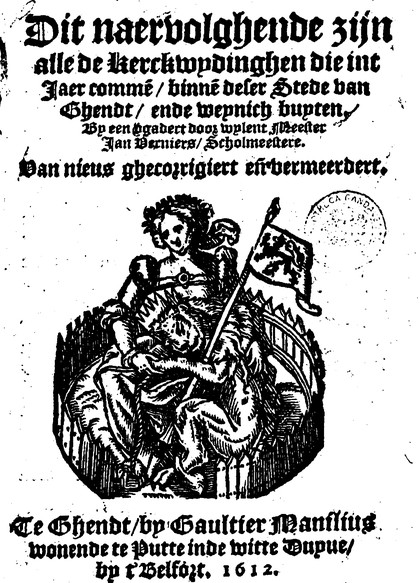 Dit naervolghende zijn alle de kerckwydinghen die int Jaer comme[n], binne[n] deser Stede van Ghendt, ende weynich buyten. By een ghegadert door wylent Meester Jan Verniers, Scholmeestere. Van nieus ghecorrigiert en[de] vermeerdert.
Authors: Jan Verniers (deceased before this edition, "wylent"), Gualterus Manilius
Year: 1612 — Publisher: Te Ghendt, by Gaultier Manilius, wonende te Putte inde Witte Duyve, by 't Belfort
Availability (UniCat) — held at Ghent University -
1622 — Gillis Verniers
Reken-boecxke[n], om te leeren legghen met penninghen, seer proffytelijck voor die ionckheyt, en[de] eenen yeghelicken. Midtsgaders: Die eerste fundamente[n] van arithmetica ...
Authors: Wouter de Costere, Gillis Verniers
Year: 1622 — Publisher: Te Ghendt, by Ian vanden Kerckhove
Availability (UniCat) — held at Ghent University -
1636 — Joos Verniers
Almanach en[de] prognosticatie, vande[n] schrickel-iare ons heere[n] M.DC.XXXVI.
Authors: Joos Verniers, Servaes Manilius
Year: 1636 — Publisher: Te Ghendt [Gent], by Servaes Manilius
Availability (UniCat) — held at Ghent University -
1637 — Joos Verniers
Almanach vanden iaere ons heeren Iesu Christi M.DC.XXXVII.
Author: Joos Verniers
Year: 1637 — Publisher: Ghendt, Servaes Manilius
Availability (UniCat) — held at Short Title Catalogus Vlaanderen (STCV) -
1675 — Gilles Verniers
Reken-boecxke[n], om te leeren legghen met penninghen, seer profijtelijck voor die ionckheyt, ende eenen yeghelijcken. Midtsgaders: Die eerste fundamente[n] van arithmetica ...
Authors: Wouter de Costere, Gillis Verniers
Year: 1675 — Publisher: Te Ghendt, ghedruckt by François d'Ercle
Availability (UniCat) — held at Ghent University -
1624 — Antonius Sanderus
De Gandavensibus eruditionis fama claris libri tres (Ghent, 1624), p. 78 — names "Johannes Vernirius" as a sworn land surveyor and mathematician, alongside three other learned citizens of Ghent: Pieter de Buck, Pieter Cathoir and Lieven van Thuyne. See the story about the Ghent schoolmasters → and Michiels, 2024.
-
1631 — Pierre Vernier
La construction, l'usage, et les proprietez du quadrant nouveau de mathématique, Brussels: François Vivien, 1631 — the book in which the Franche-Comté mathematician and military engineer Pierre Vernier (1580-1637) introduced his famous "nonius" or vernier scale, dedicated to Infanta Isabella Clara Eugenia. Currently for sale at antiquarian booksellers Martayan Lan for $6,500 (Martayan Lan), with background from the Linda Hall Library. Note: Pierre Vernier came from the Franche-Comté (near Ornans), not from Flanders — he does not obviously fit with the Ghent or Mechelen traces elsewhere on this site, and is mentioned here mainly because of the name and the subject (measuring). See also the Professions page.
In 1578, Jan Verniers kept school at the Vierweeghescheede, on the corner of the Brabantstraat in Ghent, where besides land surveying and wine measuring he also taught the drawing of sundials. He was the father of Gillis Verniers and grandfather of Joos Verniers — both likewise schoolmasters, with Joos also an almanac writer. Josse Verniers, possibly a brother of Gillis, was an arithmetic master. A direct family tie between these Ghent schoolmasters and our own family line has not yet been demonstrated.
Verniers worldwide: other families online
Websites by and about other Verniers and Vernier families elsewhere in the world. No link with our own family line has been demonstrated; they are listed here as signposts for anyone researching further. The list will be expanded.
- Belgium · Family associationVerniersblog — “de homepage van alle Verniers-en van deze wereld”
Blog of a Verniers family association, about bearers of the name with roots in East Flanders, with records from Belgium, France and the Netherlands from the 17th century to the present. - FacebookFamilie Verniers op Facebook
Photo on the ‘familieverniers’ Facebook page. A Facebook account may be needed to view it. - Netherlands · Family treeStamboom Rutgers van der Loeff, Schim van der Loeff, Verniers van der Loeff en Van der Loeff
Genealogical database with over 18,600 people. The Verniers van der Loeff branch goes back to, among others, Cornelis Verniers van der Loeff (1776–1828) and Willem Carel Verniers van der Loeff (1795–1852). - United States · MichiganVan Antwerp Family — The Vernier family of Detroit and Grosse Pointe
Blog post (2021) by George Van Antwerp on the Vernier family (‘dit La Douceur’) in Detroit and Grosse Pointe from the early 18th century: land claims, notable family members, place names and cemeteries. - United States · MichiganHigbie Maxon Agney — Historical architecture of Grosse Pointe: the Vernier family
Article by a Grosse Pointe estate agency on the Vernier family: from Grenoble via Canada (Laurent Vernier) to Michigan, with farms, roadhouses and a role in local government, c. 1726–1930.
Verniers in the arts
Artists, actors and actresses, writers and other creators named Verniers or Vernier who have turned up in the research — past and present. Here too, a family tie cannot be assumed.
This list is being built and will be expanded soon. Meanwhile: story #16 mentions, among others, a painter Francesco Vernieri (François Verniers) in Rome.
Recommended reading
For readers who want to explore the world of the Verniers family further: standard works on the Revolt, the Southern Netherlandish refugees and the Mennonites.
- Zuid-Nederlanders in de Republiek 1572-1630J.G.C.A. Briels, 1985Standard work on the Southern Netherlandish immigrants in the Dutch Republic.
- Zuid-Nederlandse kooplieden en de opkomst van de Amsterdamse stapelmarkt (1578-1630)Oscar Gelderblom, 2000How merchants who fled the South helped build Amsterdam’s trade.
- Om de ware gemeente en de oude gronden. Geschiedenis van de dopersen in de Nederlanden 1531-1675S. Zijlstra, 2000Survey of the early Mennonites (doopsgezinden) in the Low Countries.
- The Dutch RevoltGeoffrey Parker, 1977Classic account of the Revolt, from Alva to the Twelve Years’ Truce.
- The Army of Flanders and the Spanish Road, 1567-1659Geoffrey Parker, 1972On the Spanish army in the Low Countries — background to the sieges of the 1590s.
- The Dutch Republic: Its Rise, Greatness, and Fall 1477-1806Jonathan I. Israel, 1995Broad reference work on the Dutch Republic, from Burgundy to the French period.
The links go to WorldCat, where you can see which library holds a copy to borrow or consult.