Een duidelijke kanttekening vooraf: deze Pieter Vernier kan op dit moment niet aan onze eigen stamboom worden gekoppeld. Er is geen document gevonden dat hem verbindt aan stamvader Laurens Verniers of diens bekende kinderen. Dit verhaal staat dan ook bewust apart — als een fascinerende vondst, niet als vastgestelde familiegeschiedenis. Mocht er ooit een link opduiken, dan verhuist dit verhaal naar de hoofdlijn.
Kapitein in dienst van de Republiek
Vanaf 1589 duikt in de bronnen een Pieter Vernier op — voor het eerst in zijn eigen trouwakte — in sommige bronnen ook François Vernier genoemd, en met de achternaam ook wel gespeld als "Vernijer" of "Venier". Hij was kapitein van een compagnie voetknechten in dienst van de Republiek, en commandeur van de garnizoenen van Geertruidenberg en Breda. Een Dordts geschiedwerk uit de zeventiende eeuw omschrijft hem als afkomstig "uyt een Oud-Adelijk-Geslacht van Mechelen" (Balen, Beschryvinge der Stad Dordrecht, 1677, blz. 981) ('t Begin van Hollant in Dordrecht, blz. 56). Mechelen ligt, net als Gent en Antwerpen, in de zuidelijke Nederlanden waar de familie Verniers destijds een aanzienlijke positie bekleedde — wat de vraag oproept of hier een verre tak van dezelfde familie schuilt. Bewijs daarvoor is er vooralsnog niet.
De naamsverwarring tussen "Pieter" en "François" is opvallend. Een aanwijzing komt uit een heel andere hoek: in het Register van Holland en Westvriesland van 1593 staat een nominatie voor het kapiteinschap "in plaetse van Capitein Vernier", met als een van de drie kandidaten een François Vernier — blijkbaar dus een andere persoon dan kapitein Pieter Vernier zelf, wiens overlijden in september 1593 die vacature vermoedelijk veroorzaakte. Mogelijk gaat het om twee verschillende, verwante mannen wier namen in latere bronnen door elkaar zijn gehaald. Het volledige verhaal van dat beleg en die nominatie staat in Kapitein Vernier bij het beleg van Geertruidenberg, 1593 →.
Huwelijk met een Dordtse regentendochter
In 1589 trouwde Pieter Vernier in Dordrecht met Maria van Beverwijck, dochter van Dirk van Beverwijck, burgemeester van Dordrecht en heer van Godschalksoord — geen kleine partij. De Dordtse bron 't Begin van Hollant beschrijft het zo: "Joffr. Marie van Bevervvijck [...] troude eerst capiteyn François Venier, daer nae Pierre Pagnet, Ritmeester van de compagnie van sijn Excellentie t' Amersfoort, vermaert in onse Historien van de slagh by Ostende" (Bron 57).
Het trouwboek van Dordrecht bevestigt dit huwelijk met datum en functie: op 22 januari 1589 trouwden Pieter Vernijer, luitenant van een compagnie voetknechten, wonende in Willemstad, en Marijcken Dircksdr. (Philipsdr.?), van Dordrecht (Bron 68). De bruid is dus, zoals verwacht, een "Dircksdr." — dochter van Dirk (van Beverwijck). Belangrijker nog: in 1589 was Pieter nog geen kapitein, maar luitenant van een compagnie voetknechten (infanterie), gelegerd in de vestingstad Willemstad. De eerste vermelding van hem áls kapitein is te vinden in de begraafakte van één van zijn kinderen op 17 november 1591 in Breda, waar expliciet genoteerd staat: "Peeter was kapitein" (Bron 63) (WieWasWie). Zijn promotie van luitenant tot kapitein vond dus ergens tussen januari 1589 en november 1591 plaats — wat mooi aansluit bij zijn actieve rol als kapitein tijdens het beleg van Geertruidenberg in 1593 →.
A clear caveat up front: this Pieter Vernier cannot, at present, be linked to our own family tree. No document has been found connecting him to stamvader Laurens Verniers or his known children. This story therefore deliberately stands apart — as a fascinating find, not as established family history. Should a link ever turn up, this story will move to the main line.
Captain in the service of the Republic
From 1589 onward a Pieter Vernier appears in the sources — first in his own marriage record — also called François Vernier in some sources, and with the surname also spelled "Vernijer" or "Venier". He was captain of a company of foot soldiers in the service of the Republic, and commander of the garrisons of Geertruidenberg and Breda. A seventeenth-century Dordrecht history describes him as coming "uyt een Oud-Adelijk-Geslacht van Mechelen" (from an old noble family of Mechelen) (Balen, Beschryvinge der Stad Dordrecht, 1677, p. 981) ('t Begin van Hollant in Dordrecht, p. 56). Mechelen, like Ghent and Antwerp, lies in the southern Netherlands where the Verniers family held a notable position at the time — raising the question of whether a distant branch of the same family lies hidden here. There is, as yet, no proof of this.
The name confusion between "Pieter" and "François" is striking. A clue comes from quite a different angle: the 1593 Register of Holland and West Friesland records a nomination for the captaincy "in plaetse van Capitein Vernier" (in place of Captain Vernier), with one of the three candidates being a François Vernier — apparently, then, a different person from captain Pieter Vernier himself, whose death in September 1593 presumably caused that vacancy. Possibly these are two different, related men whose names have been mixed up in later sources. The full story of that siege and that nomination is told in Captain Vernier at the siege of Geertruidenberg, 1593 →.
Marriage to a Dordrecht regent's daughter
In 1589 Pieter Vernier married in Dordrecht Maria van Beverwijck, daughter of Dirk van Beverwijck, burgomaster of Dordrecht and lord of Godschalksoord — no small match. The Dordrecht source 't Begin van Hollant describes it thus: "Joffr. Marie van Bevervvijck [...] troude eerst capiteyn François Venier, daer nae Pierre Pagnet, Ritmeester van de compagnie van sijn Excellentie t' Amersfoort, vermaert in onse Historien van de slagh by Ostende" (Source 57).
Dordrecht's marriage register confirms this marriage with date and office: on 22 January 1589, Pieter Vernijer, lieutenant of a company of foot soldiers, living in Willemstad, and Marijcken Dircksdr. (Philipsdr.?), of Dordrecht married (Source 68). The bride is thus, as expected, a "Dircksdr." — daughter of Dirk (van Beverwijck). More importantly: in 1589 Pieter was not yet a captain, but lieutenant of a company of foot soldiers (infantry), garrisoned in the fortress town of Willemstad. The first mention of him as captain is found in the burial record of one of his children on 17 November 1591 in Breda, where it is explicitly noted: "Peeter was kapitein" (Peeter was captain) (Source 63) (WieWasWie). His promotion from lieutenant to captain thus took place somewhere between January 1589 and November 1591 — which fits neatly with his active role as captain during the siege of Geertruidenberg in 1593 →.

Trouwboek Dordrecht, 22 januari 1589 — Bron 68: Regionaal Archief Dordrecht, toegang 11, inventarisnummer 16Dordrecht marriage register, 22 January 1589 — Source 68: Regional Archives Dordrecht, access 11, inventory no. 16
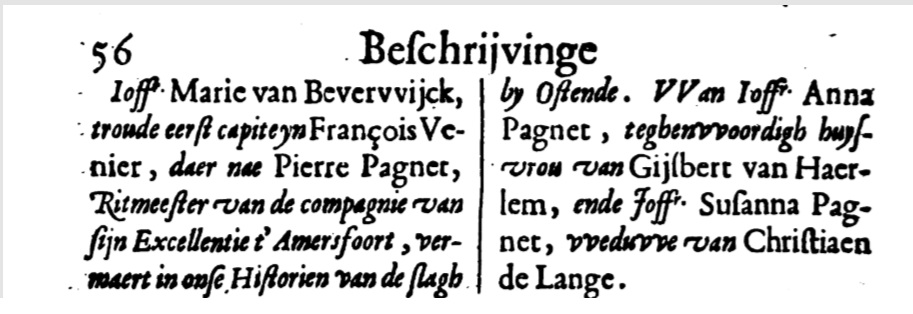
't Begin van Hollant in Dordrecht, blz. 56 — Bron 57't Begin van Hollant in Dordrecht, p. 56 — Source 57
Uit het huwelijk werd in 1589 een dochter geboren: Maria (Pietersdr) Verniers. Zij trouwde later met François (Jansz) van Aeckerlaecken (geboren 29 november 1582 te Dordrecht), zoon van Joan Storm van Akerlaecken en Maria van Alteren — beiden "van hooge geboorte", blijkens twee in 1567 vervaardigde wapenborden verbonden aan de huizen Groeswal, Leeuwerwaert, Blyenburgh, Uytenengh en Bywegen (Balen, blz. 981) (Algemene Konst- en Letterbode, 1843) (MyHeritage). Maria en François kregen op hun beurt een dochter, Maria van Ackerlaecken, die trouwde met Govard Sonnemans, "uytten Achten" (lid van de Achtraad) der stad Dordrecht (1659-1660), zoon van Jacob Sonnemans, heer van Rijsoord, en Elisabeth van Nederhoven (Balen, blz. 981). Via deze lijn liep de familie door in het Dordtse regentenmilieu, met latere vermeldingen van huwelijken met de families Quinjet/Coijet, Van Dongen en Van Merode (Bron 60).
Het weesboek van Dordrecht, oktober 1625
Een extract uit het Dordtse weesboek (het register van de weeskamer, de instantie die toezicht hield op de erfenissen van minderjarige wezen) bevestigt dit huwelijk nog eens rechtstreeks. Het gaat om een uittreksel uit de testamentaire beschikking van François van Akerlaeck en Maria Verniers, gepasseerd voor notaris Sebastiaen van Graeff te Dordrecht op 7 juni 1624, en op 19 oktober 1625 overgeschreven in het weesboek (Bron 67).
A daughter was born from the marriage in 1589: Maria (Pietersdr) Verniers. She later married François (Jansz) van Aeckerlaecken (born 29 November 1582 in Dordrecht), son of Joan Storm van Akerlaecken and Maria van Alteren — both "van hooge geboorte" (of high birth), as shown by two coat-of-arms panels made in 1567 linked to the houses of Groeswal, Leeuwerwaert, Blyenburgh, Uytenengh and Bywegen (Balen, p. 981) (Algemene Konst- en Letterbode, 1843) (MyHeritage). Maria and François in turn had a daughter, Maria van Ackerlaecken, who married Govard Sonnemans, "uytten Achten" (member of the Council of Eight) of the city of Dordrecht (1659-1660), son of Jacob Sonnemans, lord of Rijsoord, and Elisabeth van Nederhoven (Balen, p. 981). Through this line the family continued into Dordrecht's regent circles, with later recorded marriages into the Quinjet/Coijet, Van Dongen and Van Merode families (Source 60).
The Dordrecht orphan-chamber register, October 1625
An extract from the Dordrecht orphan-chamber register (the record of the weeskamer, the body that oversaw the inheritances of minor orphans) directly confirms this marriage once more. It concerns an extract from the testamentary disposition of François van Akerlaeck and Maria Verniers, executed before notary Sebastiaen van Graeff in Dordrecht on 7 June 1624, and copied into the orphan-chamber register on 19 October 1625 (Source 67).
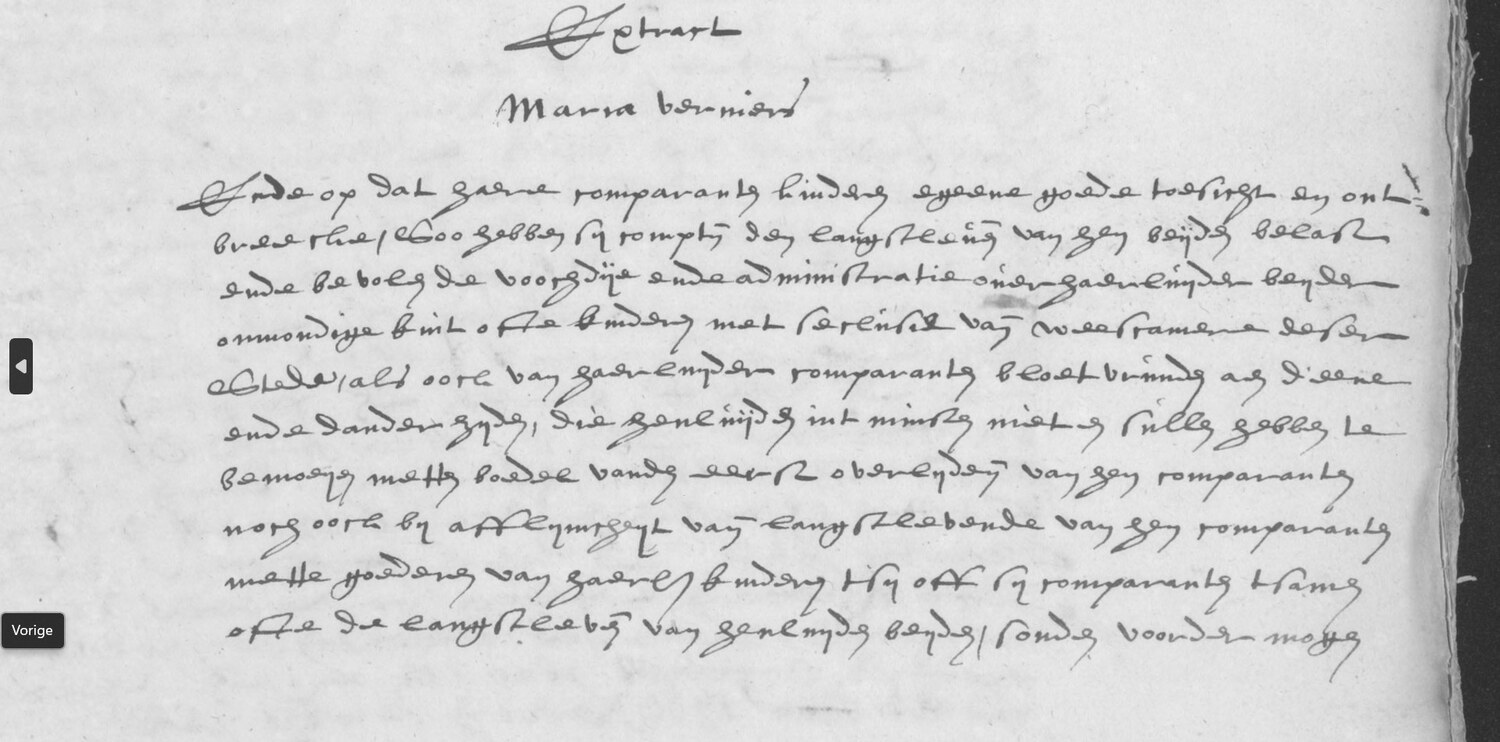
Weesboek Dordrecht, folio 64, oktober 1625, blad 1 — Bron 67: Maria Verniers Dordrecht weesboek folio 64 oktober 1625Dordrecht orphan-chamber register, folio 64, October 1625, sheet 1 — Source 67: Maria Verniers Dordrecht weesboek folio 64 October 1625
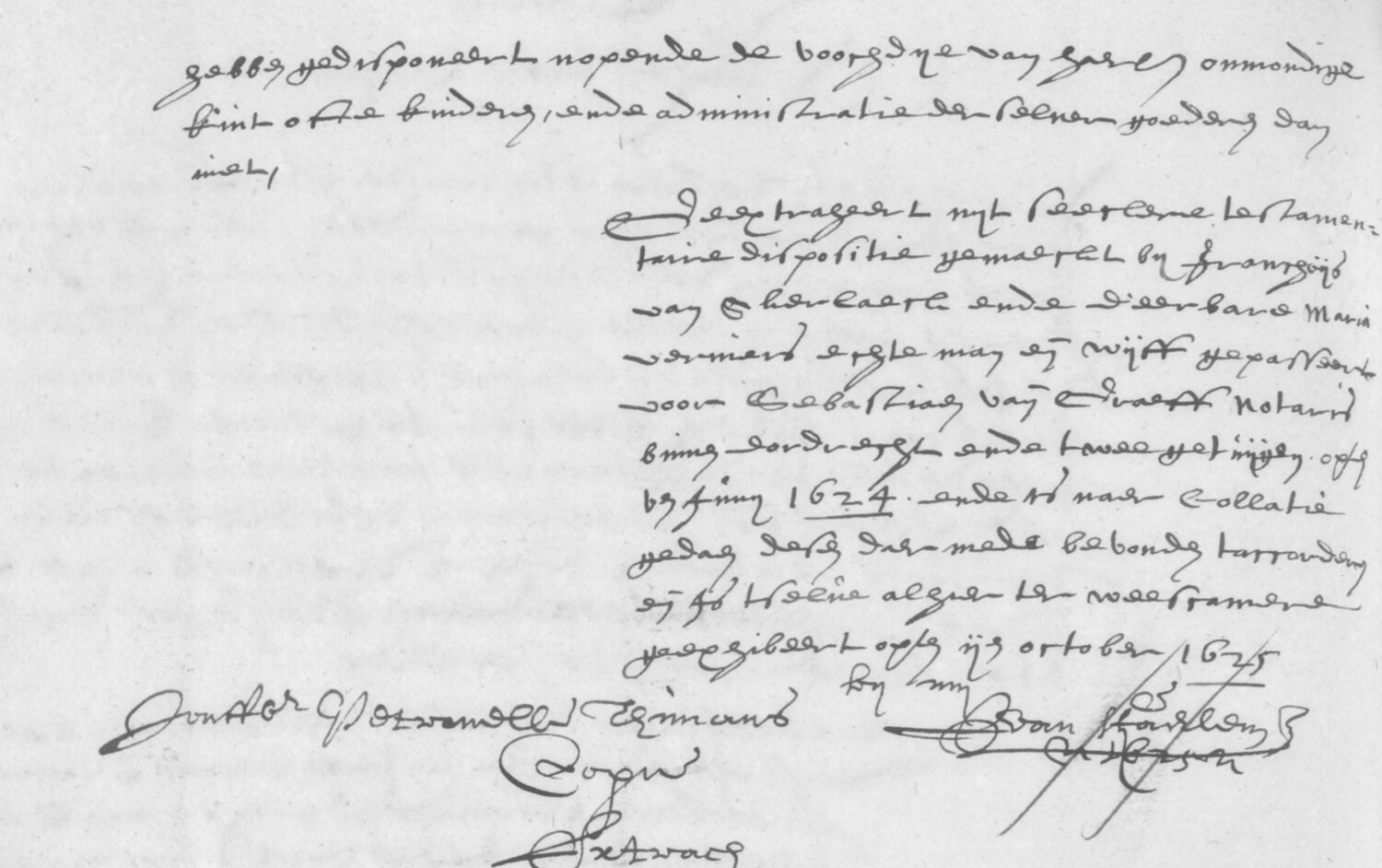
Weesboek Dordrecht, folio 64, oktober 1625, blad 2, met ondertekening — Bron 67: Maria Verniers Dordrecht weesboek folio 64 oktober 1625Dordrecht orphan-chamber register, folio 64, October 1625, sheet 2, with signature — Source 67: Maria Verniers Dordrecht weesboek folio 64 October 1625
Hertaald naar hedendaags Nederlands:
Shown here in the original Dutch, as a primary source, with a modern-Dutch rendering below it:
Extract. Maria Verniers.
Opdat hun comparanten kinderen geen goed toezicht zouden ontberen, hebben zij, comparanten, de langstlevende van hen beiden belast en bevolen met de voogdij en de administratie over hun beider onmondige kind of kinderen, met uitsluiting van de weeskamer dezer stad, alsook van hun beider, comparanten', bloedverwanten aan de ene en de andere zijde — die zich in het minst niet zullen mogen bemoeien met de boedel van de eerststervende van hen, comparanten, noch ook, bij overlijden van de langstlevende van hen, comparanten, met de goederen van hun kinderen; tenzij zij, comparanten, samen, of de langstlevende van hen beiden, verder nog iets zouden hebben beschikt aangaande de voogdij over hun onmondige kind of kinderen en het beheer van diens goederen — en anders niet.
Geëxtraheerd uit een zekere testamentaire dispositie, gemaakt door François van Akerlaeck en de eerbare Maria Verniers, echte man en wijf, gepasseerd voor Sebastiaen van Graeff, notaris binnen Dordrecht, en twee getuigen, op de zevende juni 1624; en is na collatie (vergelijking met het origineel) bevonden hiermee overeen te stemmen. Is hetzelve alhier ter weeskamer ingeschreven op de negentiende oktober 1625, door mij, Jonkvrouwe Petronelle Thimans, en Van Slingelandt.
In gewone taal: François van Akerlaeck en Maria Verniers leggen in hun gezamenlijke testament vast dat, wanneer een van beiden overlijdt, de achterblijvende partner alleen de voogdij krijgt over hun minderjarige kind of kinderen — zonder inmenging van de officiële weeskamer van Dordrecht, en zonder inmenging van familieleden van beide kanten. Dat was in die tijd een uitzonderlijke, welgestelde regeling: normaliter hield de weeskamer standaard toezicht op de erfenis van wezen, juist om misbruik door voogden te voorkomen. Dat dit echtpaar zich daarvan mocht laten vrijstellen, wijst op een aanzienlijke maatschappelijke positie — passend bij de Dordtse regentenfamilies waarmee deze Maria Verniers, dochter van kapitein Pieter Vernier en Maria van Beverwijck, via haar huwelijk verbonden was.
Verlies en overlijden in Breda
Het gezin kende ook verdriet: op 17 november 1591 werd in Breda een ongenoemd kind ("NN Verniers") van Pieter Verniers begraven (Stadsarchief Breda, Bron 63). Iets minder dan twee jaar later, op 2 september 1593, werd Pieter Vernier zelf in Breda begraven (Stadsarchief Breda, Bron 62) — beide begrafenissen opgetekend in de rekeningen van de Grote Kerk van Breda. In de tussenliggende jaren diende hij als kapitein bij het beleg van Geertruidenberg (1593); zie dat verhaal, dag na dag →.
In plain terms: François van Akerlaeck and Maria Verniers record in their joint will that, when one of them dies, the surviving partner receives guardianship of their minor child or children alone — without interference from the official orphan chamber of Dordrecht, and without interference from relatives on either side. This was, at the time, an exceptional, well-to-do arrangement: normally the orphan chamber routinely oversaw orphans' inheritances, precisely to prevent abuse by guardians. That this couple was permitted to be exempted from that points to a considerable social position — fitting for the Dordrecht regent families to which this Maria Verniers, daughter of captain Pieter Vernier and Maria van Beverwijck, was connected through her marriage.
Loss and death in Breda
The family also knew sorrow: on 17 November 1591 an unnamed child ("NN Verniers") of Pieter Verniers was buried in Breda (Breda City Archives, Source 63). Just under two years later, on 2 September 1593, Pieter Vernier himself was buried in Breda (Breda City Archives, Source 62) — both burials recorded in the accounts of the Grote Kerk of Breda. In the intervening years he served as captain at the siege of Geertruidenberg (1593); see that story, day by day →.
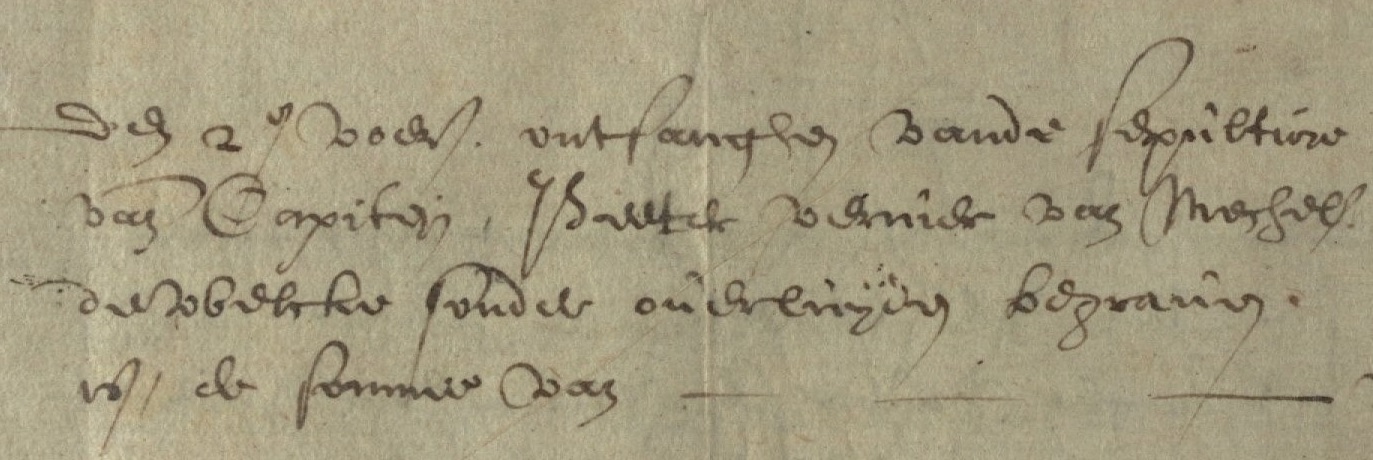
Uitsnede uit het begraafregister van de Grote Kerk, Breda — Bron 62Excerpt from the burial register of the Grote Kerk, Breda — Source 62
De weduwe hertrouwt: een ritmeester met een verhaal
Na Pieters dood hertrouwde Maria van Beverwijck met Pierre Panier, ook wel Pagnet genoemd — een vermaard ritmeester (cavaleriecommandant). Hij vocht mee in de Slag bij Nieuwpoort (2 juli 1600) en werd geroemd omdat het zijn ruiters waren die de vijandelijke veldheer Mendoza van zijn paard wierpen en gevangennamen. Een jaar eerder had hij zich al onderscheiden in een ruitergevecht aan de Maas, tussen graaf Lodewijk en de Spaanse generaal Landriano (Van Meteren, Historiën, 1623/1635) (Verzamelde berigten omtrent de krijgsbevelhebbers bij Nieuwpoort, 1836). Uit dit tweede huwelijk van Maria van Beverwijck kwamen nog twee dochters voort: Anna Pagnet (later huisvrouw van Gijsbert van Haerlem) en Susanna Pagnet (weduwe van Christiaen de Lange) (Bron 57).
Waarom dit verhaal (nog) los staat
Mechelen, net als Gent en Antwerpen, was een centrum waar de naam Verniers voorkwam, en de timing — eind zestiende eeuw, in dezelfde jaren dat stamvader Laurens Verniers actief was in Antwerpen en Amsterdam — maakt een verwantschap denkbaar. Maar "denkbaar" is niet hetzelfde als "bewezen": er is geen akte, testament of ander document gevonden dat Pieter Vernier van Mechelen aan Laurens Verniers of zijn kinderen koppelt. Zolang dat bewijs er niet is, blijft dit een apart, op zichzelf staand verhaal — een verre naamgenoot met een opmerkelijk levensverhaal, geen bevestigde voorvader of neef.
The widow remarries: a cavalry captain with a story
After Pieter's death, Maria van Beverwijck remarried Pierre Panier, also called Pagnet — a renowned ritmeester (cavalry commander). He fought in the Battle of Nieuwpoort (2 July 1600) and was celebrated because it was his horsemen who threw the enemy commander Mendoza from his horse and captured him. A year earlier he had already distinguished himself in a cavalry engagement on the Maas, between Count Lodewijk and the Spanish general Landriano (Van Meteren, Historiën, 1623/1635) (Verzamelde berigten omtrent de krijgsbevelhebbers bij Nieuwpoort, 1836). From this second marriage of Maria van Beverwijck two more daughters were born: Anna Pagnet (later wife of Gijsbert van Haerlem) and Susanna Pagnet (widow of Christiaen de Lange) (Source 57).
Why this story (still) stands apart
Mechelen, like Ghent and Antwerp, was a centre where the name Verniers occurred, and the timing — the late sixteenth century, in the same years that stamvader Laurens Verniers was active in Antwerp and Amsterdam — makes a kinship conceivable. But "conceivable" is not the same as "proven": no deed, will or other document has been found linking Pieter Vernier of Mechelen to Laurens Verniers or his children. Until that proof exists, this remains a separate, self-contained story — a distant namesake with a remarkable life story, not a confirmed ancestor or cousin.