Verhaal #29 · Verborgen VerhaalStory #29 · Hidden Story
Walvissen en ossen: Pieter Verniers als reder en koopman (1711–1717)Whales and oxen: Pieter Verniers as shipowner and merchant (1711–1717)
De Groenlandse rederij van Weesp en een certepartij voor bijna vierhonderd ossen uit JutlandThe Greenland whaling company of Weesp and a charter party for almost four hundred oxen from Jutland
Pieter Verniers kennen we als de secretaris die in 1716 zijn eigen stad voor het Hof van Holland daagde, en won (verhaal #22). Twee andere bronnen laten een heel andere kant van een Pieter Verniers uit Weesp zien: die van koopman en reder. In 1711 was hij een van de acht mannen die in Weesp een rederij voor de walvisvaart oprichtten, en op 20 februari 1717 huurde "d'Heer Pieter Verniers, coopman tot Weesp" in Amsterdam zes schepen om bijna vierhonderd ossen uit Jutland naar Weesp te laten halen.
Welke Pieter Verniers?
Het is Pieter Verniers (1677–1720), de zoon van Mr. Cornelis Verniers: hij was vanaf 1714 secretaris van de vroedschap, volgde in 1715 zijn vader op als heemraad en overleed in 1720 ongetrouwd in Weesp (verhaal #22). Dat dit dezelfde man is als de reder en de koopman, blijkt uit zijn boedelinventaris: daarin staan zijn portie in de Groenlandse rederij, de huur van het Groenlandse schip en de verkoop van zijn vleet (verhaal #30).
Een walvisrederij in Weesp (1711)
Weesp ligt aan het water, maar een havenstad is het nooit geweest. Toch had de stad in de achttiende eeuw een eigen Groenlandse rederij, die op walvissen voer in de noordelijke wateren. In 1711 werd zij opgericht door acht deelgenoten, die elk een achtste deel voor hun rekening namen: Willem Visser, Kors Behoudenrijs, Kors Visser, Hilgert Kramer, Pieter Verniers, Gijsbert Duijs, Cornelis Schouten Goversz en Gerrit Valentijn. Ieder legde 800 gulden in. Met dat geld werd het schip Stadt Weesp uitgerust, met Jacob Los als commandeur. Later kwam er een tweede schip bij, De Weesper Kerk, met Dirk Aarsz Huysman als commandeur (Bron 321).
De schepen gingen één keer per jaar uit: in mei vertrokken ze, in augustus waren ze terug in Weesp. De gevangen walvissen werden verwerkt tot traan, baleinen (walvisbaarden) en andere producten. In het begin leverde dat elke deelgenoot maar liefst 1200 gulden winst op, zodat in november 1714 opdracht kon worden gegeven voor de bouw van een fluitschip van ongeveer 35 meter. Hoe het daarna verder ging, is niet bekend: van de rederij is geen verdere administratie gevonden (Bron 321). De gegevens komen uit De geschiedenis van Weesp van A.J. Zondergeld-Hamer, die de rederij op bladzijde 82 en 83 bespreekt, zoals Cor Draijer in 2010 in het WeesperNieuws navertelde (Bron 321). Bij het bouwrijp maken van de polder Aetsveld vond de amateurarcheoloog H. Weenink later een groot bot, dat van een walvis bleek te zijn; misschien, zo oppert Draijer, van een dier dat door deze rederij was gevangen (Bron 321).
Onder de deelgenoten staat Cornelis Schouten Goversz, met een naam die in Weesp bekend klinkt: de Schoutens waren in de zeventiende eeuw de grote brouwersfamilie van de stad (verhaal #17, verhaal #27). Of hij tot die familie hoorde, is niet uitgezocht.
Directeur van de Groenlandse visserij
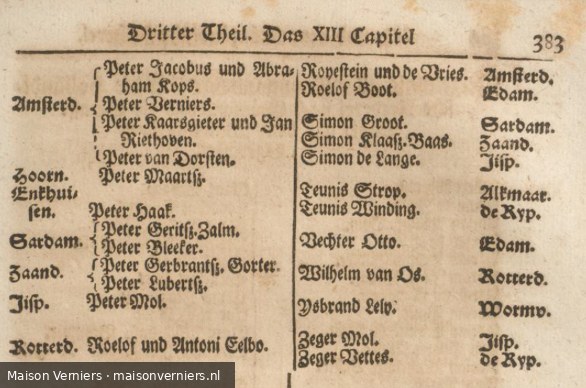
In 1720 verscheen het boek van de commandeur Cornelis Gijsbertsz Zorgdrager over de Groenlandse visserij, dat in 1723 in het Duits en in 1727 in een nieuwe Nederlandse uitgave volgde. Achterin staat een "Naamlyst van alle de Directeurs over de Hollandsche Groenlandsche Visschery": de reders die schepen naar de walvisgronden uitreedden, per stad. Onder Amsterdam staat daar "Pieter Verniers" (Bron 322); in de Duitse uitgave staat hij als "Peter Verniers" links bovenaan de bladzijde, tussen andere Amsterdamse reders (Bron 323). In dezelfde lijst staan reders uit Hoorn, Enkhuizen, Saardam, Zaandam, Jisp, De Rijp, Edam, Alkmaar, Wormer en Rotterdam.
Uit de lijst van directeuren van de Groenlandse visserij in de Duitse uitgave van Zorgdrager (Leipzig 1723), p. 383: links bovenaan, onder Amsterdam, "Peter Verniers". Zentralbibliothek Zürich, NR 522, via e-rara (Bron 323).From the list of directors of the Greenland fishery in the German edition of Zorgdrager (Leipzig 1723), p. 383: top left, under Amsterdam, "Peter Verniers". Zentralbibliothek Zürich, NR 522, via e-rara (Source 323).
Dat de lijst hem onder Amsterdam noemt, is goed te verklaren: hij deed zijn zaken ook in Amsterdam, zoals de akte van 1717 laat zien, en zijn boedel toont dat hij tot zijn dood in 1720 reder in de walvisvaart bleef (verhaal #30). Helemaal zeker is het niet dat de lijst geen Amsterdamse naamgenoot bedoelt, want zij werd na zijn dood gedrukt.
Een certepartij voor ossen (1717)
Op 20 februari 1717 en de dagen daarna kwamen in Amsterdam bij notaris Pieter van der Meulen "d'Heer Pieter Verniers, coopman tot Weesp" en zes schippers bijeen. Zij sloten een certepartij: een bevrachtingscontract, waarin een koopman, de bevrachter, schepen huurt voor een bepaalde lading en reis (Bron 324). De lading was ongewoon: levende ossen, uit Jutland.
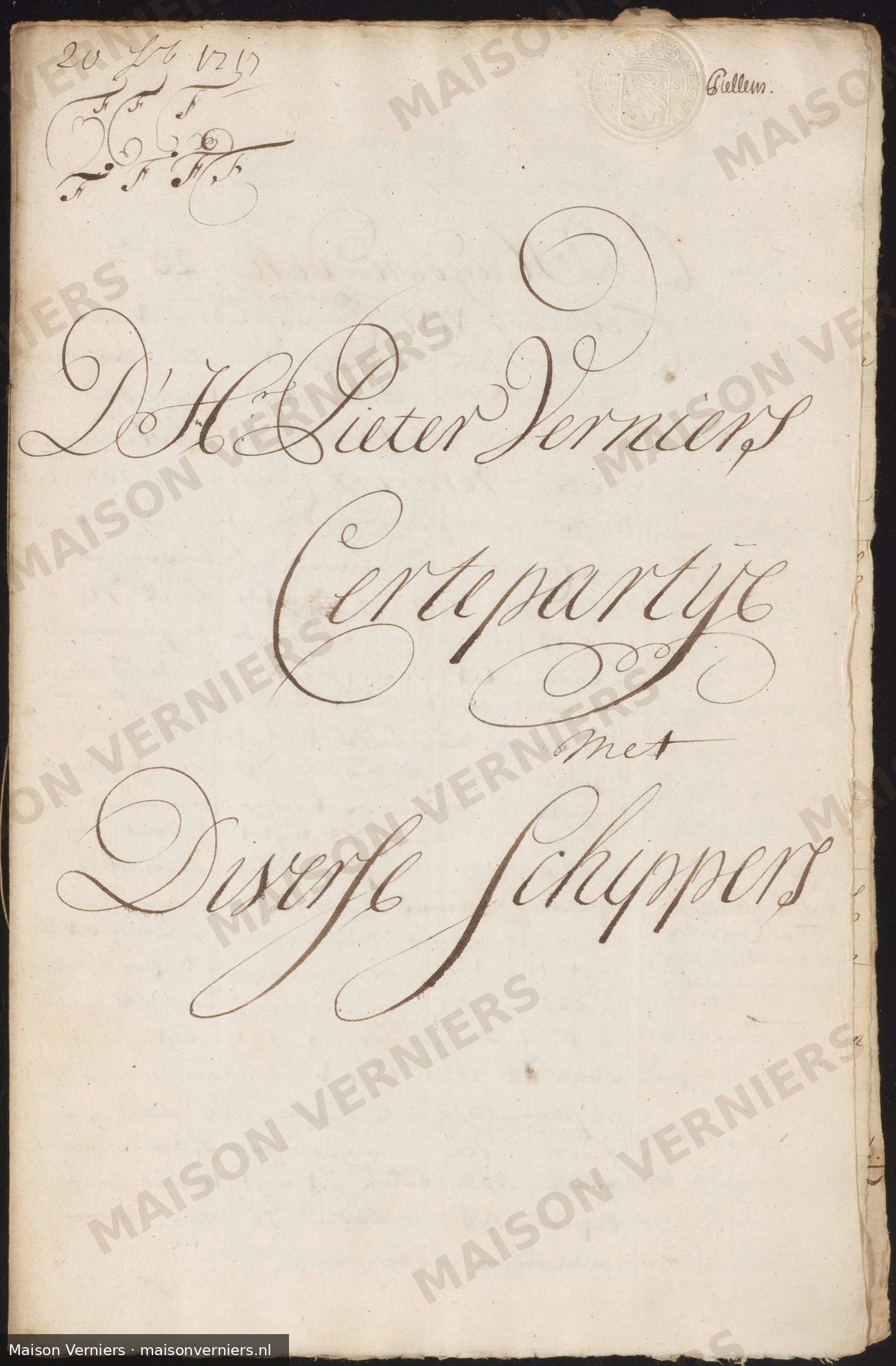
De omslag van de akte: "D'Hr. Pieter Verniers Certepartye met Diverse Schippers", linksboven gedateerd 20 februari 1717. Stadsarchief Amsterdam, Notarieel Archief (5075), inv. 6822, akte 628109, notaris Pieter van der Meulen (Bron 324).The cover of the deed: "D'Hr. Pieter Verniers Certepartye met Diverse Schippers" (Mr Pieter Verniers, charter party with various skippers), dated 20 February 1717 at top left. Amsterdam City Archives, notarial archives (5075), inv. 6822, deed 628109, notary Pieter van der Meulen (Source 324).
De zes schepen, met hun afmetingen in voeten (een Amsterdamse voet is ongeveer 28 centimeter) en het aantal ossen dat elk schip "bequamelyk" kon laden:
Schip
Schipper
Lengte × breedte
Ossen
De Liefde
Cornelis Douwes
70 × 18 voet
64
De Maria
Pieter Jansz Bul
75 × 19 voet
70
De Hoop
Johannes Cornelis
73 × 18½ voet
68
(naam open gelaten)
Tamme Carstens, vertegenwoordigd door Theodorus Fries
64 × 18½ voet
58
De Geregtigheyt
Holle Tites
72 × 18¼ voet
66
De Koningin Scheba (lezing onzeker)
Sierk Jelles
74 × 19 voet
70
Samen
396
De schepen in de certepartij van 20 februari 1717 (Bron 324).
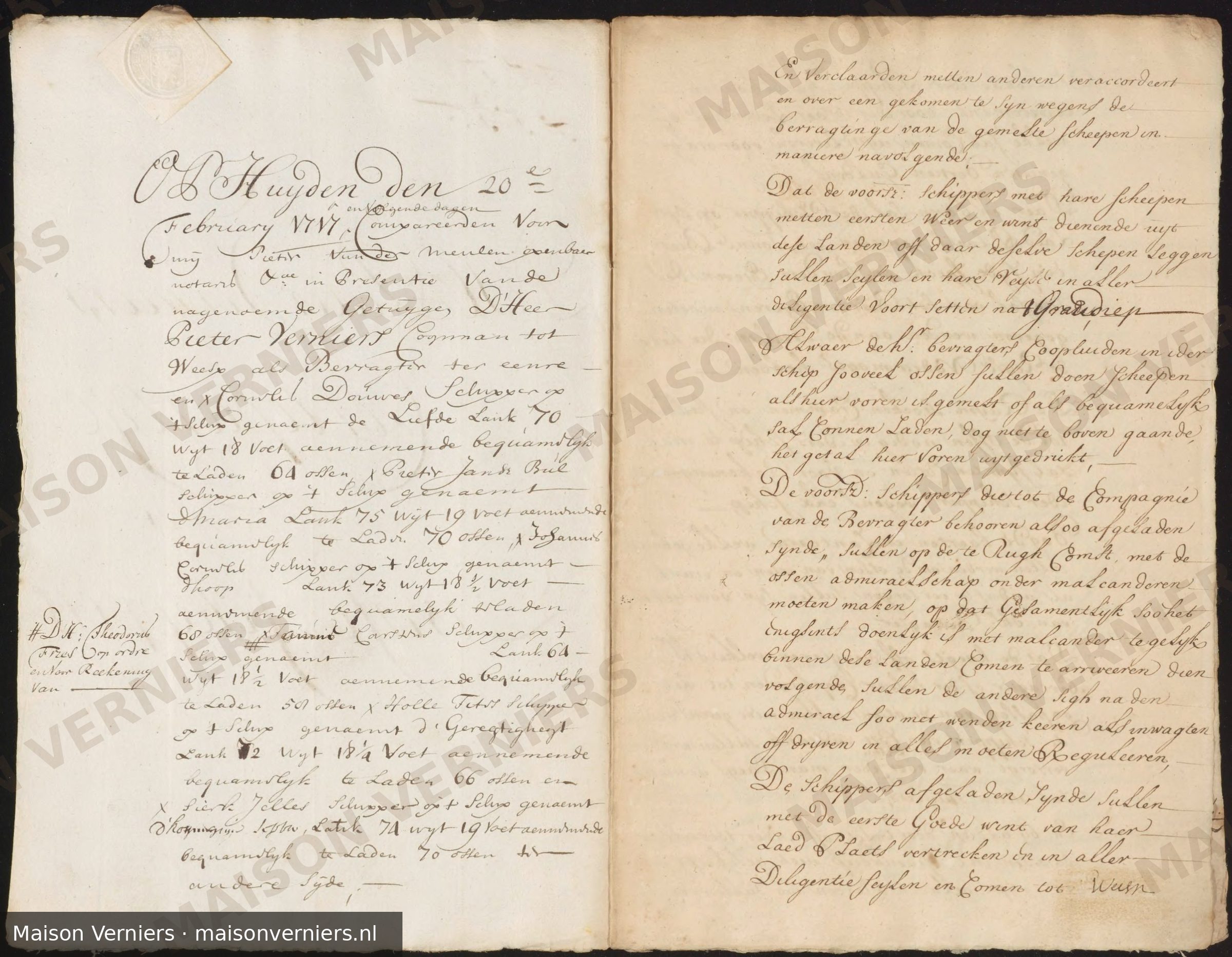
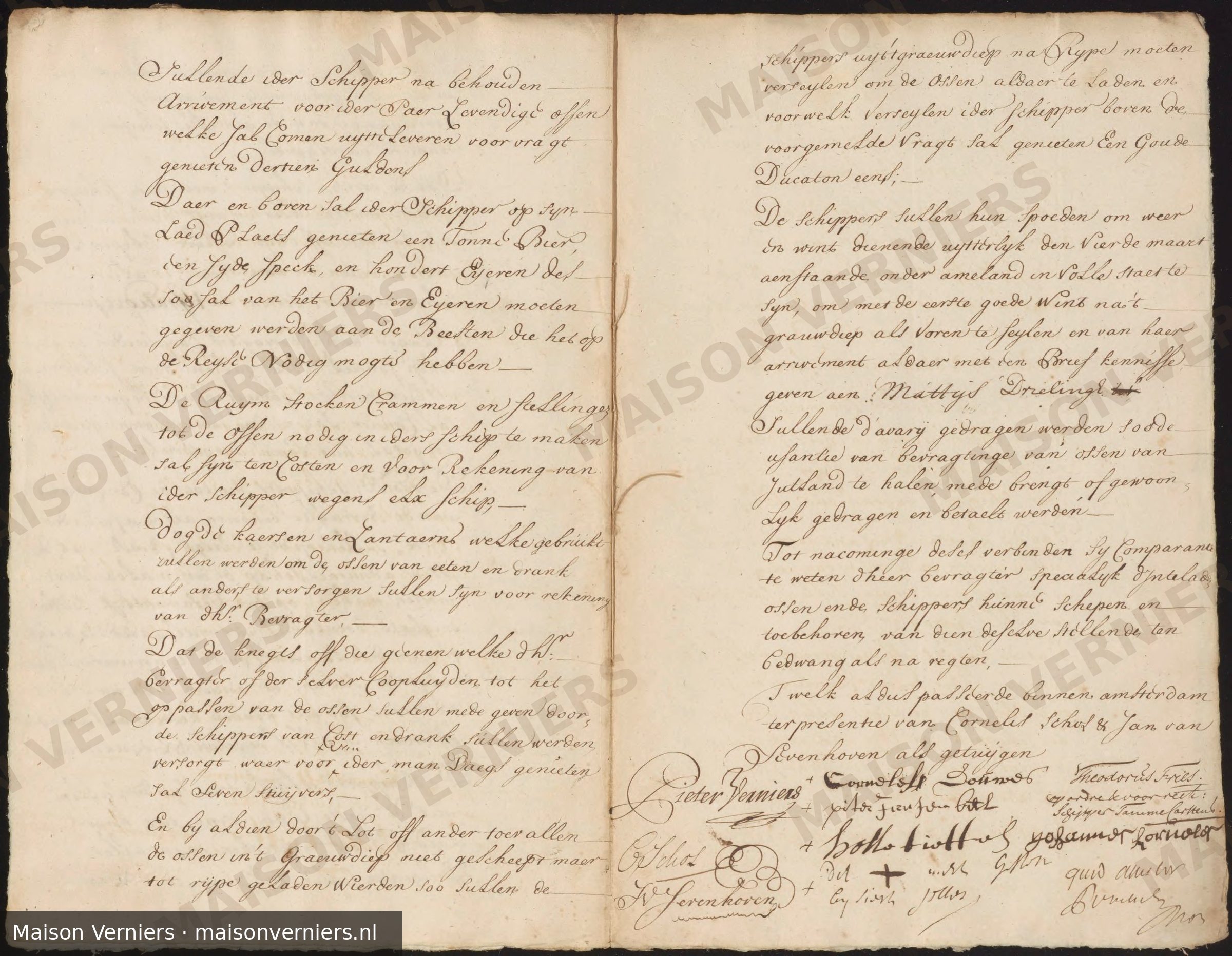
De eerste twee bladzijden: Pieter Verniers en de zes schippers, met de afmetingen van hun schepen en het aantal ossen dat elk schip kan laden; rechts de afspraken over de reis naar het Graudiep (Bron 324).The first two pages: Pieter Verniers and the six skippers, with the dimensions of their ships and the number of oxen each ship can carry; on the right the terms for the voyage to the Graudiep (Source 324).De laatste twee bladzijden, met de vracht van dertien gulden per paar ossen, het bier, het spek en de eieren, en onderaan de handtekening "Pieter Verniers", de schippers, de getuigen en de notaris (Bron 324).The last two pages, with the freight of thirteen guilders per pair of oxen, the beer, the bacon and the eggs, and at the bottom the signature "Pieter Verniers", the skippers, the witnesses and the notary (Source 324).
Wat er in de akte staat
De afspraken laten precies zien hoe zo'n reis verliep.
De heenreis. De schippers moesten zich zo haasten dat zij uiterlijk op 4 maart klaar lagen onder Ameland, om met de eerste goede wind naar het Graudiep te zeilen: het zeegat bij Fanø aan de westkust van Jutland. Bij aankomst moesten zij dat per brief laten weten aan Mattys Dreling (in de archiefindex: Mattijs Drielingh), vermoedelijk de man die daar de ossen voor hen klaarzette. Lukte het laden in het Graudiep niet, "door 't lot of ander toevallen", dan moesten zij doorvaren naar Rype, de stad Ribe, en daarvoor kreeg elke schipper eenmalig een gouden ducaton extra.
Het laden. De kooplieden zouden in elk schip zoveel ossen laten inschepen als was afgesproken of als het schip goed kon laden, maar nooit meer dan het genoemde aantal. De inrichting van het ruim voor de dieren, met stokken, krammen en stellingen, kwam voor rekening van de schippers; de kaarsen en lantaarns die nodig waren om de ossen te voeren en te drenken, betaalde Pieter Verniers.
De terugreis. De schepen moesten samen terugvaren, "admiraelschap" maken: één schip werd admiraal, en de andere moesten zich bij het wenden, keren, wachten en drijven naar hem richten, zodat ze zoveel mogelijk tegelijk thuiskwamen. Zo'n vlootje van zes schepen was veiliger dan zes losse schepen. Daarna moesten ze "in aller diligentie" naar Weesp zeilen.
De vracht. Voor elk paar ossen dat levend in Weesp werd afgeleverd, kreeg de schipper dertien gulden. Met 396 ossen, 198 paar, kwam dat op hoogstens 2574 gulden voor de hele vloot. Dode dieren werden dus niet betaald, en dat verklaart een opvallende bepaling: elke schipper kreeg op zijn laadplaats een ton bier, een zij spek en honderd eieren, maar van het bier en de eieren moest hij geven aan de dieren die het onderweg nodig hadden.
De ossendrijvers. De knechten die de kooplieden meestuurden om op de ossen te passen, kregen eten en drinken van de schippers; die kregen daarvoor zeven stuivers per man per dag. Schade, de "avarij", werd verdeeld zoals bij het halen van ossen uit Jutland gebruikelijk was.
Het onderpand. Als zekerheid verbond Pieter Verniers de in te laden ossen, en de schippers hun schepen. Getuigen waren Cornelis Schol en Jan van Sevenhoven. Pieter Verniers tekende met een krullende handtekening; Sierk Jelles zette een kruisje, en Theodorus Fries tekende voor schipper Tamme Carstens.
Ossen voor de Weesper weiden
De ossenhandel was in Weesp niet nieuw. In december 1671 kochten de brouwers Jacob Schouten en Nicolaas Dell veertig Deense ossen van 48 gulden per stuk, te leveren op 's-Graveland (Bron 301), en op 1 januari 1674 sloot Bruyningh van Marken met zijn broer Cornelis en Thomas Pietersz Bas een compagnie in magere ossen, waarvoor Thomas naar Denemarken zou reizen (Bron 308); zie verhaal #27. Magere ossen werden in Holland op de weiden vetgemaakt en daarna verkocht. Pieter Verniers deed hetzelfde op grotere schaal, met een hele vloot. En het bier en spek die de schippers meekregen, kwamen uit een stad die daar al een eeuw van leefde (verhaal #28).
De akte uitgeschreven
Hieronder de volledige tekst van de akte, in de oorspronkelijke spelling. Afkortingen zijn stilzwijgend uitgeschreven; leestekens zijn spaarzaam toegevoegd; wat tussen vierkante haken staat, is een toelichting of een onzekere lezing.
Op huyden den 20e February 1717 [en volgende dagen], compareerden voor mij Pieter van der Meulen, openbaer notaris &c., in presentie van de nagenoemde getuygen, d'Heer Pieter Verniers, coopman tot Weesp, als bevragter ter eenre, en Cornelis Douwes, schipper op 't schip genaemt de Liefde, lank 70, wyt 18 voet, aennemende bequamelyk te laden 64 ossen; Pieter Jansz Bul, schipper op 't schip genaemt d'Maria, lank 75, wyt 19 voet, aennemende bequamelyk te laden 70 ossen; Johannes Cornelis, schipper op 't schip genaemt d'Hoop, lank 73, wyt 18½ voet, aennemende bequamelyk te laden 68 ossen; [in de marge: d'Hr Theodorus Fries op ordre en voor reekening van] Tamme Carstens, schipper op 't schip genaemt [open gelaten], lank 64, wyt 18½ voet, aennemende bequamelyk te laden 58 ossen; Holle Tites, schipper op 't schip genaemt d'Geregtigheyt, lank 72, wyt 18¼ voet, aennemende bequamelyk te laden 66 ossen; en Sierk Jelles, schipper op 't schip genaemt d'Koningin Scheba [?], lank 74, wyt 19 voet, aennemende bequamelyk te laden 70 ossen, ter andere syde;
En verclaarden mett' anderen veraccordeert en overeengekomen te syn wegens de bevragtinge van de gemelte scheepen in maniere navolgende:
Dat de voorsz. schippers met hare scheepen mett' eersten weer en wint dienende uyt dese landen, of daar deselve scheepen leggen, sullen seylen en hare reyse in aller diligentie voortsetten na 't Graudiep, alwaer de hr bevragters coopluyden in ider schip sooveel ossen sullen doen scheepen als hiervooren is gemelt, of als bequamelyk sal connen laden, dog niet te boven gaande het getal hiervooren uytgedrukt.
De voorsz. schippers, die tot de compagnie van de bevragter behooren, alsoo afgeladen synde, sullen op de terugkomst met de ossen admiraelschap onder malcanderen moeten maken, opdat gesamentlyk, soo het eenigsints doenlyk is, met malcander tegelyk binnen dese landen comen te arriveeren; dienvolgende sullen de andere sigh na den admirael soo met wenden, keeren, als inwagten of dryven in alles moeten reguleeren.
De schippers afgeladen synde sullen met de eerste goede wint van haer laedplaets vertrecken en in aller diligentie seylen en comen tot Weesp, sullende ider schipper na behouden arrivement voor ider paer levendige ossen welke sal comen uyt te leveren, voor vragt genieten dertien guldens.
Daer en boven sal ider schipper op syn laedplaets genieten een tonne bier, een syde speck en hondert eyeren, des soo sal van het bier en eyeren moeten gegeven werden aan de beesten die het op de reyse nodig mogten hebben.
De ruym, stocken, crammen en stellingen tot de ossen nodig in iders schip te maken sal syn ten costen en voor rekening van ider schipper wegens syn schip; dog de kaersen en lantaerns welke gebruykt sullen werden om de ossen van eeten en drank als anders te versorgen sullen syn voor rekening van d'hr bevragter.
Dat de knegts of diegeenen welke d'hr bevragter of deselve coopluyden tot het oppassen van de ossen sullen medegeven, door de schippers van cost en drank sullen werden versorgt, waervoor [sy] ider man daegs genieten sal seven stuyvers.
En by aldien door 't lot of ander toevallen de ossen in 't Graeuwdiep niet gescheept maer tot Rype geladen wierden, soo sullen de schippers uyt 't Graeuwdiep na Rype moeten verseylen om de ossen aldaer te laden, en voor welk verseylen ider schipper boven de voorgemelde vragt sal genieten een goude ducaton eens.
De schippers sullen hun spoeden om weer en wint dienende uyterlyk den vierde maart aenstaande onder Ameland in volle staet te syn, om met de eerste goede wint na 't Grauwdiep als vooren te seylen, en van haer arrivement aldaer met een brief kennisse geven aen Mattys Dreling.
Sullende d'avary gedragen werden soo de usantie van bevragtinge van ossen van Jutland te halen medebrengt of gewoonlyk gedragen en betaelt werden.
Tot nacominge deses verbinden sy comparanten, te weten d'heer bevragter speciaelyk d'inteladen ossen ende schippers hunne schepen en toebehoren, van dien deselve stellende ten bedwang als na regten.
'T welk aldus passeerde binnen Amsterdam ter presentie van Cornelis Schol & Jan van Sevenhoven als getuygen.
[getekend:] Pieter Verniers — Cornelis Douwes — Pieter Jansen Bul — Holle Tittes — Johannes Cornelis — dit + merk gestelt by Sierk Jelles — Theodorus Fries, op ordre & voor reek. schipper Tamme Carstens — C. Schol — J. v. Sevenhoven — Quod attestor, P. van der Meulen, nots.
Transcriptie van de certepartij van 20 februari 1717 (Bron 324).
Wordt vervolgd
Uitgezocht wordt verder of er in het protocol van notaris Van der Meulen of elders meer bevrachtingen van ossen of walvisschepen op zijn naam staan.
We know Pieter Verniers as the secretary who took his own town to the Court of Holland in 1716, and won (story #22). Two other sources show a quite different side of a Pieter Verniers from Weesp: that of merchant and shipowner. In 1711 he was one of the eight men who founded a whaling company in Weesp, and on 20 February 1717 "d'Heer Pieter Verniers, coopman tot Weesp" (Mr Pieter Verniers, merchant at Weesp) chartered six ships in Amsterdam to fetch almost four hundred oxen from Jutland to Weesp.
Which Pieter Verniers?
It is Pieter Verniers (1677–1720), son of Mr. Cornelis Verniers: from 1714 he was secretary of the town council, in 1715 he succeeded his father as dike-reeve, and he died unmarried in Weesp in 1720 (story #22). That he is the same man as the shipowner and the merchant is shown by his probate inventory, which lists his share in the Greenland company, the hire of the Greenland ship and the sale of his whaling gear (story #30).
A whaling company in Weesp (1711)
Weesp lies on the water, but it was never a port. Yet in the eighteenth century the town had its own Greenland company, which hunted whales in the northern seas. It was founded in 1711 by eight partners, each taking an eighth share: Willem Visser, Kors Behoudenrijs, Kors Visser, Hilgert Kramer, Pieter Verniers, Gijsbert Duijs, Cornelis Schouten Goversz and Gerrit Valentijn. Each put in 800 guilders. With that money the ship Stadt Weesp was fitted out, with Jacob Los as commander. Later a second ship was added, De Weesper Kerk, with Dirk Aarsz Huysman as commander (Source 321).
The ships sailed once a year: they left in May and were back in Weesp in August. The whales caught were processed into whale oil, baleen (whalebone) and other products. At first this brought each partner no less than 1200 guilders in profit, so that in November 1714 a fluyt of about 35 metres could be ordered. What happened after that is not known: no further records of the company have been found (Source 321). The information comes from De geschiedenis van Weesp by A.J. Zondergeld-Hamer, who discusses the company on pages 82 and 83, as retold by Cor Draijer in the WeesperNieuws in 2010 (Source 321). When the Aetsveld polder was prepared for building, the amateur archaeologist H. Weenink later found a large bone that turned out to be a whale's; perhaps, Draijer suggests, from an animal caught by this company (Source 321).
Among the partners is Cornelis Schouten Goversz, with a name familiar in Weesp: in the seventeenth century the Schoutens were the town's great brewing family (story #17, story #27). Whether he belonged to that family has not been investigated.
Director of the Greenland fishery
In 1720 the book on the Greenland fishery by the whaling commander Cornelis Gijsbertsz Zorgdrager was published, followed in 1723 by a German edition and in 1727 by a new Dutch edition. At the back is a "Naamlyst van alle de Directeurs over de Hollandsche Groenlandsche Visschery" (list of all the directors of the Dutch Greenland fishery): the shipowners who sent ships to the whaling grounds, by town. Under Amsterdam it lists "Pieter Verniers" (Source 322); in the German edition he appears as "Peter Verniers" at the top left of the page, among other Amsterdam shipowners (Source 323). The same list includes shipowners from Hoorn, Enkhuizen, Saardam, Zaandam, Jisp, De Rijp, Edam, Alkmaar, Wormer and Rotterdam.
Uit de lijst van directeuren van de Groenlandse visserij in de Duitse uitgave van Zorgdrager (Leipzig 1723), p. 383: links bovenaan, onder Amsterdam, "Peter Verniers". Zentralbibliothek Zürich, NR 522, via e-rara (Bron 323).From the list of directors of the Greenland fishery in the German edition of Zorgdrager (Leipzig 1723), p. 383: top left, under Amsterdam, "Peter Verniers". Zentralbibliothek Zürich, NR 522, via e-rara (Source 323).
That the list places him under Amsterdam is easily explained: he also did business in Amsterdam, as the 1717 deed shows, and his estate shows that he remained a whaling shipowner until his death in 1720 (story #30). It is not entirely certain that the list does not mean an Amsterdam namesake, as it was printed after his death.
A charter party for oxen (1717)
On 20 February 1717 and the following days, "d'Heer Pieter Verniers, coopman tot Weesp" and six skippers met in Amsterdam before the notary Pieter van der Meulen. They concluded a charter party (certepartij): a freight contract in which a merchant, the charterer, hires ships for a particular cargo and voyage (Source 324). The cargo was unusual: live oxen, from Jutland.
De omslag van de akte: "D'Hr. Pieter Verniers Certepartye met Diverse Schippers", linksboven gedateerd 20 februari 1717. Stadsarchief Amsterdam, Notarieel Archief (5075), inv. 6822, akte 628109, notaris Pieter van der Meulen (Bron 324).The cover of the deed: "D'Hr. Pieter Verniers Certepartye met Diverse Schippers" (Mr Pieter Verniers, charter party with various skippers), dated 20 February 1717 at top left. Amsterdam City Archives, notarial archives (5075), inv. 6822, deed 628109, notary Pieter van der Meulen (Source 324).
The six ships, with their dimensions in feet (an Amsterdam foot is about 28 centimetres) and the number of oxen each ship could "bequamelyk" (comfortably) carry:
Ship
Skipper
Length × beam
Oxen
De Liefde
Cornelis Douwes
70 × 18 ft
64
De Maria
Pieter Jansz Bul
75 × 19 ft
70
De Hoop
Johannes Cornelis
73 × 18½ ft
68
(name left blank)
Tamme Carstens, represented by Theodorus Fries
64 × 18½ ft
58
De Geregtigheyt
Holle Tites
72 × 18¼ ft
66
De Koningin Scheba (reading uncertain)
Sierk Jelles
74 × 19 ft
70
Total
396
The ships in the charter party of 20 February 1717 (Source 324).
De eerste twee bladzijden: Pieter Verniers en de zes schippers, met de afmetingen van hun schepen en het aantal ossen dat elk schip kan laden; rechts de afspraken over de reis naar het Graudiep (Bron 324).The first two pages: Pieter Verniers and the six skippers, with the dimensions of their ships and the number of oxen each ship can carry; on the right the terms for the voyage to the Graudiep (Source 324).De laatste twee bladzijden, met de vracht van dertien gulden per paar ossen, het bier, het spek en de eieren, en onderaan de handtekening "Pieter Verniers", de schippers, de getuigen en de notaris (Bron 324).The last two pages, with the freight of thirteen guilders per pair of oxen, the beer, the bacon and the eggs, and at the bottom the signature "Pieter Verniers", the skippers, the witnesses and the notary (Source 324).
What the deed says
The terms show exactly how such a voyage went.
The outward voyage. The skippers had to hurry so as to lie ready off Ameland by 4 March at the latest, to sail with the first good wind to the Graudiep: the sea channel by Fanø on the west coast of Jutland. On arrival they had to report by letter to Mattys Dreling (in the archive index: Mattijs Drielingh), presumably the man who had the oxen ready for them there. If loading in the Graudiep failed, "by chance or other accidents", they had to sail on to Rype, the town of Ribe, for which each skipper received one gold ducaton extra.
Loading. The merchants would ship in each vessel as many oxen as agreed or as the ship could comfortably carry, but never more than the number stated. Fitting out the hold for the animals, with posts, cramps and stalls, was at the skippers' expense; the candles and lanterns needed to feed and water the oxen were paid for by Pieter Verniers.
The return voyage. The ships had to sail back together, "admiraelschap maken": one ship became admiral, and the others had to follow him in tacking, turning, waiting and drifting, so that they arrived home as nearly together as possible. A little fleet of six ships was safer than six ships on their own. Then they were to sail "in aller diligentie" (with all diligence) to Weesp.
The freight. For every pair of oxen delivered alive in Weesp, the skipper received thirteen guilders. With 396 oxen, 198 pairs, that came to at most 2574 guilders for the whole fleet. Dead animals were therefore not paid for, which explains a striking clause: each skipper received at his loading place a barrel of beer, a side of bacon and a hundred eggs, but he had to give some of the beer and the eggs to the animals that needed it on the way.
The drovers. The men the merchants sent along to look after the oxen were given food and drink by the skippers, who received seven stuivers per man per day for it. Damage, the "avarij" (average), was shared as was customary when fetching oxen from Jutland.
The security. As security Pieter Verniers pledged the oxen to be loaded, and the skippers their ships. The witnesses were Cornelis Schol and Jan van Sevenhoven. Pieter Verniers signed with a flourishing signature; Sierk Jelles made a cross, and Theodorus Fries signed for skipper Tamme Carstens.
Oxen for the meadows of Weesp
The ox trade was nothing new in Weesp. In December 1671 the brewers Jacob Schouten and Nicolaas Dell bought forty Danish oxen at 48 guilders each, to be delivered at 's-Graveland (Source 301), and on 1 January 1674 Bruyningh van Marken formed a partnership in lean oxen with his brother Cornelis and Thomas Pietersz Bas, for which Thomas was to travel to Denmark (Source 308); see story #27. Lean oxen were fattened on the meadows of Holland and then sold. Pieter Verniers did the same on a larger scale, with a whole fleet. And the beer and bacon the skippers took along came from a town that had lived on them for a century (story #28).
The deed transcribed
Below is the full text of the deed, in the original Dutch spelling, as is the convention on this site for primary sources. Abbreviations have been silently expanded; punctuation has been added sparingly; anything in square brackets is an explanation or an uncertain reading.
Op huyden den 20e February 1717 [en volgende dagen], compareerden voor mij Pieter van der Meulen, openbaer notaris &c., in presentie van de nagenoemde getuygen, d'Heer Pieter Verniers, coopman tot Weesp, als bevragter ter eenre, en Cornelis Douwes, schipper op 't schip genaemt de Liefde, lank 70, wyt 18 voet, aennemende bequamelyk te laden 64 ossen; Pieter Jansz Bul, schipper op 't schip genaemt d'Maria, lank 75, wyt 19 voet, aennemende bequamelyk te laden 70 ossen; Johannes Cornelis, schipper op 't schip genaemt d'Hoop, lank 73, wyt 18½ voet, aennemende bequamelyk te laden 68 ossen; [in de marge: d'Hr Theodorus Fries op ordre en voor reekening van] Tamme Carstens, schipper op 't schip genaemt [open gelaten], lank 64, wyt 18½ voet, aennemende bequamelyk te laden 58 ossen; Holle Tites, schipper op 't schip genaemt d'Geregtigheyt, lank 72, wyt 18¼ voet, aennemende bequamelyk te laden 66 ossen; en Sierk Jelles, schipper op 't schip genaemt d'Koningin Scheba [?], lank 74, wyt 19 voet, aennemende bequamelyk te laden 70 ossen, ter andere syde;
En verclaarden mett' anderen veraccordeert en overeengekomen te syn wegens de bevragtinge van de gemelte scheepen in maniere navolgende:
Dat de voorsz. schippers met hare scheepen mett' eersten weer en wint dienende uyt dese landen, of daar deselve scheepen leggen, sullen seylen en hare reyse in aller diligentie voortsetten na 't Graudiep, alwaer de hr bevragters coopluyden in ider schip sooveel ossen sullen doen scheepen als hiervooren is gemelt, of als bequamelyk sal connen laden, dog niet te boven gaande het getal hiervooren uytgedrukt.
De voorsz. schippers, die tot de compagnie van de bevragter behooren, alsoo afgeladen synde, sullen op de terugkomst met de ossen admiraelschap onder malcanderen moeten maken, opdat gesamentlyk, soo het eenigsints doenlyk is, met malcander tegelyk binnen dese landen comen te arriveeren; dienvolgende sullen de andere sigh na den admirael soo met wenden, keeren, als inwagten of dryven in alles moeten reguleeren.
De schippers afgeladen synde sullen met de eerste goede wint van haer laedplaets vertrecken en in aller diligentie seylen en comen tot Weesp, sullende ider schipper na behouden arrivement voor ider paer levendige ossen welke sal comen uyt te leveren, voor vragt genieten dertien guldens.
Daer en boven sal ider schipper op syn laedplaets genieten een tonne bier, een syde speck en hondert eyeren, des soo sal van het bier en eyeren moeten gegeven werden aan de beesten die het op de reyse nodig mogten hebben.
De ruym, stocken, crammen en stellingen tot de ossen nodig in iders schip te maken sal syn ten costen en voor rekening van ider schipper wegens syn schip; dog de kaersen en lantaerns welke gebruykt sullen werden om de ossen van eeten en drank als anders te versorgen sullen syn voor rekening van d'hr bevragter.
Dat de knegts of diegeenen welke d'hr bevragter of deselve coopluyden tot het oppassen van de ossen sullen medegeven, door de schippers van cost en drank sullen werden versorgt, waervoor [sy] ider man daegs genieten sal seven stuyvers.
En by aldien door 't lot of ander toevallen de ossen in 't Graeuwdiep niet gescheept maer tot Rype geladen wierden, soo sullen de schippers uyt 't Graeuwdiep na Rype moeten verseylen om de ossen aldaer te laden, en voor welk verseylen ider schipper boven de voorgemelde vragt sal genieten een goude ducaton eens.
De schippers sullen hun spoeden om weer en wint dienende uyterlyk den vierde maart aenstaande onder Ameland in volle staet te syn, om met de eerste goede wint na 't Grauwdiep als vooren te seylen, en van haer arrivement aldaer met een brief kennisse geven aen Mattys Dreling.
Sullende d'avary gedragen werden soo de usantie van bevragtinge van ossen van Jutland te halen medebrengt of gewoonlyk gedragen en betaelt werden.
Tot nacominge deses verbinden sy comparanten, te weten d'heer bevragter speciaelyk d'inteladen ossen ende schippers hunne schepen en toebehoren, van dien deselve stellende ten bedwang als na regten.
'T welk aldus passeerde binnen Amsterdam ter presentie van Cornelis Schol & Jan van Sevenhoven als getuygen.
[getekend:] Pieter Verniers — Cornelis Douwes — Pieter Jansen Bul — Holle Tittes — Johannes Cornelis — dit + merk gestelt by Sierk Jelles — Theodorus Fries, op ordre & voor reek. schipper Tamme Carstens — C. Schol — J. v. Sevenhoven — Quod attestor, P. van der Meulen, nots.
Transcription of the charter party of 20 February 1717 (Source 324).
To be continued
Further research will look at whether the records of the notary Van der Meulen or other archives hold more charters of oxen or whaling ships in his name.