Verhaal #25 · Los verhaalStory #25 · Standalone story
Bladeren in de boeken van de Gentse Verniersen (1584–1637)Leafing through the books of the Ghent Verniers (1584–1637)
Een rekenhandschrift om zelf door te bladeren, almanakken aan de muur en een rekenboekje voor de jeugdAn arithmetic manuscript to browse yourself, almanacs on the wall and an arithmetic primer for the young
In verhaal #14 staan de mensen centraal: Jan Verniers, schoolmeester en gezworen landmeter in Gent, zijn zoon Gillis, diens zoon Joos, en Josse Verniers, mogelijk een broer van Gillis. Dit verhaal laat zien wat zij nalieten: de boeken en almanakken zelf. Een deel ervan is bewaard gebleven in de Universiteitsbibliotheek Gent en het Museum Plantin-Moretus in Antwerpen, en kan hier worden bekeken.
Net als in verhaal #14 geldt: een familieband tussen deze Gentse Verniersen en onze eigen stamlijn is niet aangetoond.
Blader zelf door het rekenboek van Josse Verniers (1584)
Het oudste stuk is een handschrift: de Arithmetica van Josse Verniers, bewaard in de Universiteitsbibliotheek Gent als handschrift 694. Josse opende het met een eigendomsvermelding in twee talen: "Ceste livre appertient a moy Josse Verniers, anno 1584" en "Desen bouck behoort toe Josse Verniers, anno 1584". De pagina is versierd met een grote, in rood, groen en goud geschilderde beginletter en een rand van rankwerk.
Rekenhistorica Marjolein Kool wijst erop dat zulke eigendomsformules in gedrukte rekenboeken niet voorkomen, wel in persoonlijke rekenhandschriften. Josse schreef dit boek dus waarschijnlijk niet voor leerlingen, maar als eigen werkboek met vraagstukken en oplossingen (Bron 102). Een bladzijde eruit wordt in de wetenschappelijke editie van Willem Bartjens' De Cijfferinghe gebruikt om de "galei-deling" te laten zien, de gangbare manier van delen in die tijd (Bron 93).
De Universiteitsbibliotheek Gent heeft het hele handschrift gedigitaliseerd. Hieronder kunt u er zelf doorheen bladeren: gebruik de pijlen om naar de volgende bladzijde te gaan, en het vergrootglas of de knop voor volledig scherm om in te zoomen.
Story #14 focuses on the people: Jan Verniers, schoolmaster and sworn land surveyor in Ghent, his son Gillis, Gillis's son Joos, and Josse Verniers, possibly a brother of Gillis. This story shows what they left behind: the books and almanacs themselves. Some of them survive in Ghent University Library and the Museum Plantin-Moretus in Antwerp, and can be viewed here.
As in story #14: a family link between these Ghent Verniers and our own family line has not been demonstrated.
Browse Josse Verniers's arithmetic book yourself (1584)
The oldest item is a manuscript: the Arithmetica of Josse Verniers, kept in Ghent University Library as manuscript 694. Josse opened it with an ownership note in two languages: "Ceste livre appertient a moy Josse Verniers, anno 1584" and "Desen bouck behoort toe Josse Verniers, anno 1584". The page is decorated with a large initial painted in red, green and gold and a border of scrollwork.
Arithmetic historian Marjolein Kool points out that such ownership formulas do not occur in printed arithmetic books, but do in personal arithmetic manuscripts. Josse therefore probably wrote this book not for pupils but as his own workbook of problems and solutions (Source 102). A page from it is used in the scholarly edition of Willem Bartjens's De Cijfferinghe to show "galley division", the usual way of dividing at the time (Source 93).
Ghent University Library has digitised the whole manuscript. Below you can leaf through it yourself: use the arrows to go to the next page, and the magnifier or the full-screen button to zoom in.
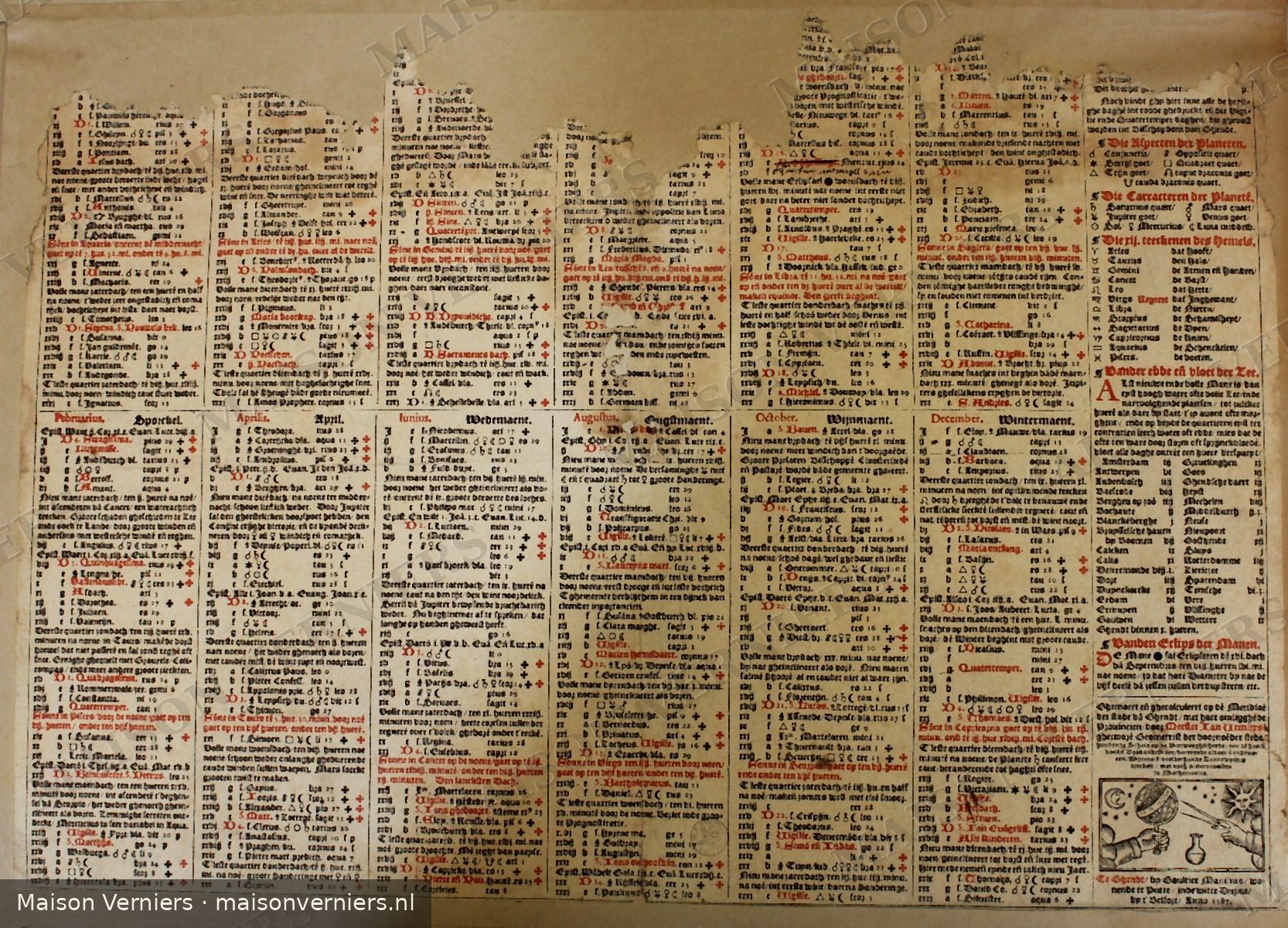
Een almanak was in de zestiende eeuw vaak geen boekje maar één groot vel, een plakalmanak die aan de muur werd gehangen. Per maand staan de dagen, de heiligen, de maanstanden en het weer erop, in zwart en rood gedrukt. Van Jan Verniers is zo'n vel bewaard voor het jaar 1587, gedrukt in Gent bij Gaultier Manilius (Bron 268). De bovenrand is weggescheurd, maar rechtsonder is nog te lezen dat de almanak "ghecalculeert" werd door Meester Jan Verniers, gezworen geometrist. Op dit vel prees Jan ook zijn eigen school aan, waar hij onder meer landmeten, wijnmeten en het trekken van zonnewijzers onderwees (Bron 100).
An almanac on the wall: Jan Verniers, 1587
In the sixteenth century an almanac was often not a booklet but a single large sheet, a wall almanac to hang up. Month by month it lists the days, the saints, the phases of the moon and the weather, printed in black and red. Such a sheet by Jan Verniers survives for the year 1587, printed in Ghent by Gaultier Manilius (Source 268). The top edge is torn away, but at the lower right one can still read that the almanac was "ghecalculeert" (calculated) by Master Jan Verniers, sworn geometrist. On this sheet Jan also advertised his own school, where he taught land surveying, wine gauging and the drawing of sundials, among other things (Source 100).
Plakalmanak voor 1587, "ghecalculeert" door Meester Jan Verniers, gedrukt te Gent bij Gaultier Manilius. Universiteitsbibliotheek Gent (Bron 268).Wall almanac for 1587, "ghecalculeert" by Master Jan Verniers, printed in Ghent by Gaultier Manilius. Ghent University Library (Source 268).
Een Antwerpse almanak voor het schrikkeljaar 1592
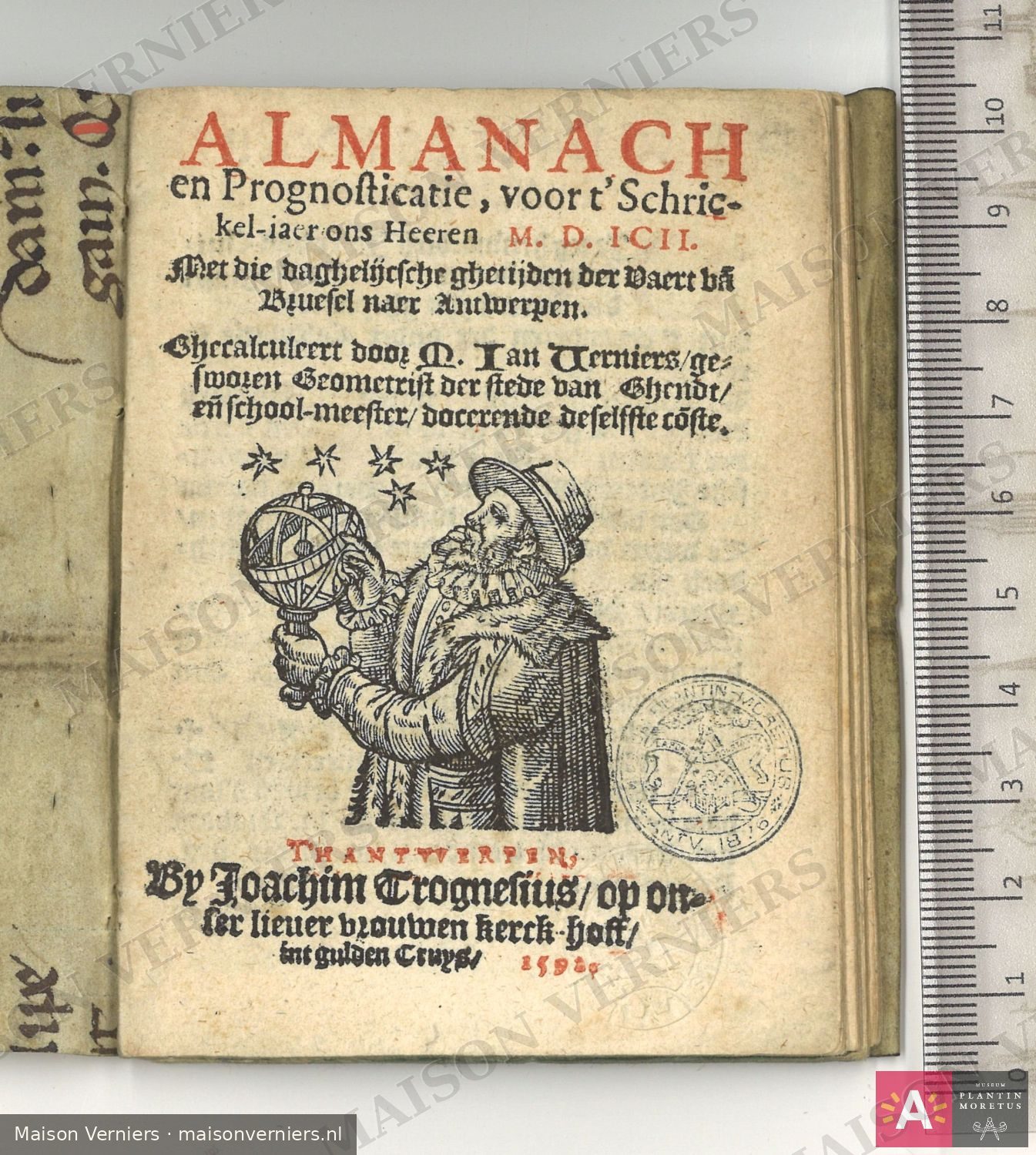
Voor 1592 verscheen een almanak van Jan Verniers in Antwerpen, bij Joachim Trognesius "op onser lieuer vrouwen kerck-hoff, int gulden Cruys". Het titelblad noemt hem "M. Ian Verniers, ghesworen Geometrist der stede van Ghendt, en school-meester, doceerende deselfste conste" en toont een geleerde met een armillairsfeer onder de sterren. Het boekje is maar zo groot als een handpalm: de liniaal ernaast laat zien dat het nog geen elf centimeter hoog is. Het exemplaar wordt bewaard in het Museum Plantin-Moretus in Antwerpen (Bron 269).
Bij dezelfde drukker verscheen dat jaar ook een tweede uitgave, waarin Jan een "doctor in de zeven kunsten" wordt genoemd, een titel die niet bestond. Vermoedelijk gaat het daarbij om een onrechtmatige nadruk (Bron 96); zie verhaal #14.
An Antwerp almanac for the leap year 1592
For 1592 an almanac by Jan Verniers appeared in Antwerp, from Joachim Trognesius "op onser lieuer vrouwen kerck-hoff, int gulden Cruys". The title page calls him "M. Ian Verniers, ghesworen Geometrist der stede van Ghendt, en school-meester, doceerende deselfste conste" (sworn geometrist of the city of Ghent and schoolmaster, teaching the same art) and shows a scholar with an armillary sphere beneath the stars. The booklet is only the size of a palm: the ruler beside it shows it is less than eleven centimetres tall. The copy is kept in the Museum Plantin-Moretus in Antwerp (Source 269).
The same printer also issued a second edition that year, in which Jan is called a "doctor of the seven arts", a title that did not exist. This was probably an unauthorised reprint (Source 96); see story #14.
Almanach en Prognosticatie voor het schrikkeljaar 1592, "ghecalculeert door M. Ian Verniers", Antwerpen, Joachim Trognesius. Museum Plantin-Moretus, Antwerpen (Bron 269).Almanach en Prognosticatie for the leap year 1592, "ghecalculeert door M. Ian Verniers", Antwerp, Joachim Trognesius. Museum Plantin-Moretus, Antwerp (Source 269).
Na zijn dood: de kerkwijdingen van Gent (1612)
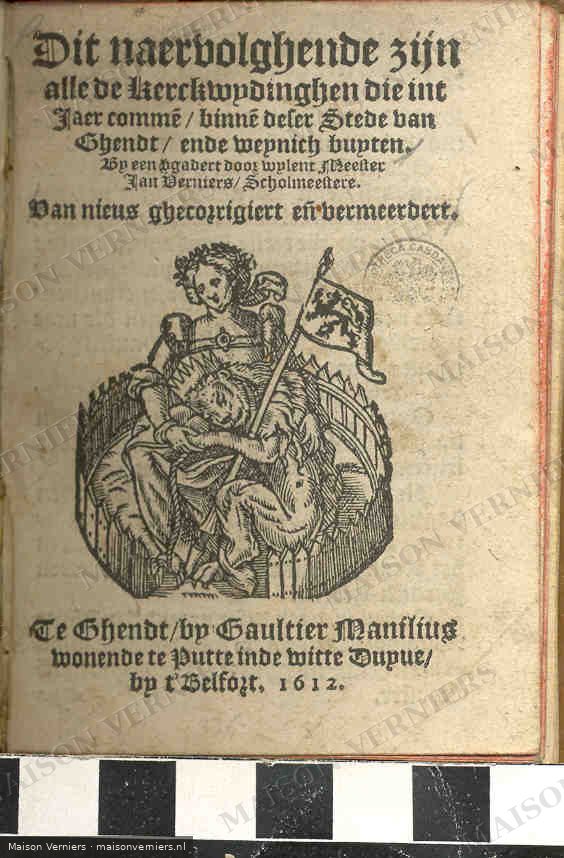
Twintig jaar later gaf drukker Gaultier Manilius opnieuw een werkje van Jan uit: een lijst van alle kerkwijdingen van het jaar in en rond Gent, "by een ghegadert door wylent Meester Jan Verniers, Scholmeestere. Van nieus ghecorrigiert ende vermeerdert". Het woord "wylent" (wijlen) laat zien dat Jan toen al was overleden. Het titelblad toont de Gentse Maagd met de Vlaamse leeuw in een omheinde tuin, het zinnebeeld van de stad.
After his death: the church dedications of Ghent (1612)
Twenty years later the printer Gaultier Manilius again published a work by Jan: a list of all the church dedications of the year in and around Ghent, "by een ghegadert door wylent Meester Jan Verniers, Scholmeestere. Van nieus ghecorrigiert ende vermeerdert" (compiled by the late Master Jan Verniers, schoolmaster; newly corrected and enlarged). The word "wylent" (the late) shows that Jan had died by then. The title page shows the Maid of Ghent with the Flemish lion in an enclosed garden, the emblem of the city.
"Dit naervolghende zijn alle de Kerckwydinghen …", Gent, Gaultier Manilius, 1612. Universiteitsbibliotheek Gent (Bron 268)."Dit naervolghende zijn alle de Kerckwydinghen …", Ghent, Gaultier Manilius, 1612. Ghent University Library (Source 268).
Rekenen met penningen: het Reken-boecxken (1622)
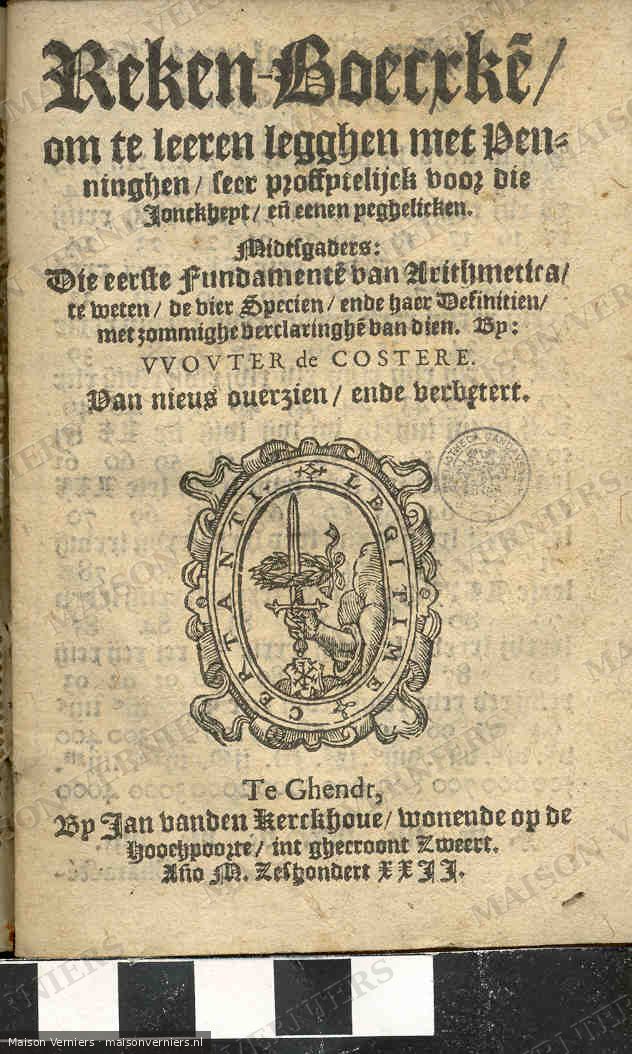
In 1622 verscheen bij Jan vanden Kerckhove in Gent het Reken-boecxken, om te leeren legghen met penninghen, seer proffytelijck voor die ionckheyt, van Wouter de Costere, waarbij ook Gillis Verniers als auteur wordt vermeld. "Legghen met penninghen" is het oude rekenen op een rekenbord, met losse rekenpenningen; daarnaast behandelt het boekje "die eerste fundamenten van arithmetica", de vier hoofdbewerkingen. Het werd lang gebruikt: in 1675 verscheen in Gent nog een nieuwe druk, bij François d'Ercle. Zie het overzicht in het Naslagwerk.
Reckoning with counters: the Reken-boecxken (1622)
In 1622 Jan vanden Kerckhove in Ghent published the Reken-boecxken, om te leeren legghen met penninghen, seer proffytelijck voor die ionckheyt (little arithmetic book, to learn to lay out counters, very profitable for the young) by Wouter de Costere, in which Gillis Verniers is also named as an author. "Legghen met penninghen" is the old way of reckoning on a counting board with loose counters; the booklet also covers "die eerste fundamenten van arithmetica", the four basic operations. It was used for a long time: a new edition still appeared in Ghent in 1675, from François d'Ercle. See the overview in the Reference section.
Reken-boecxken van Wouter de Costere, Gent, Jan vanden Kerckhove, 1622. Universiteitsbibliotheek Gent (Bron 268).Reken-boecxken by Wouter de Costere, Ghent, Jan vanden Kerckhove, 1622. Ghent University Library (Source 268).
De derde generatie: Joos Verniers, 1637
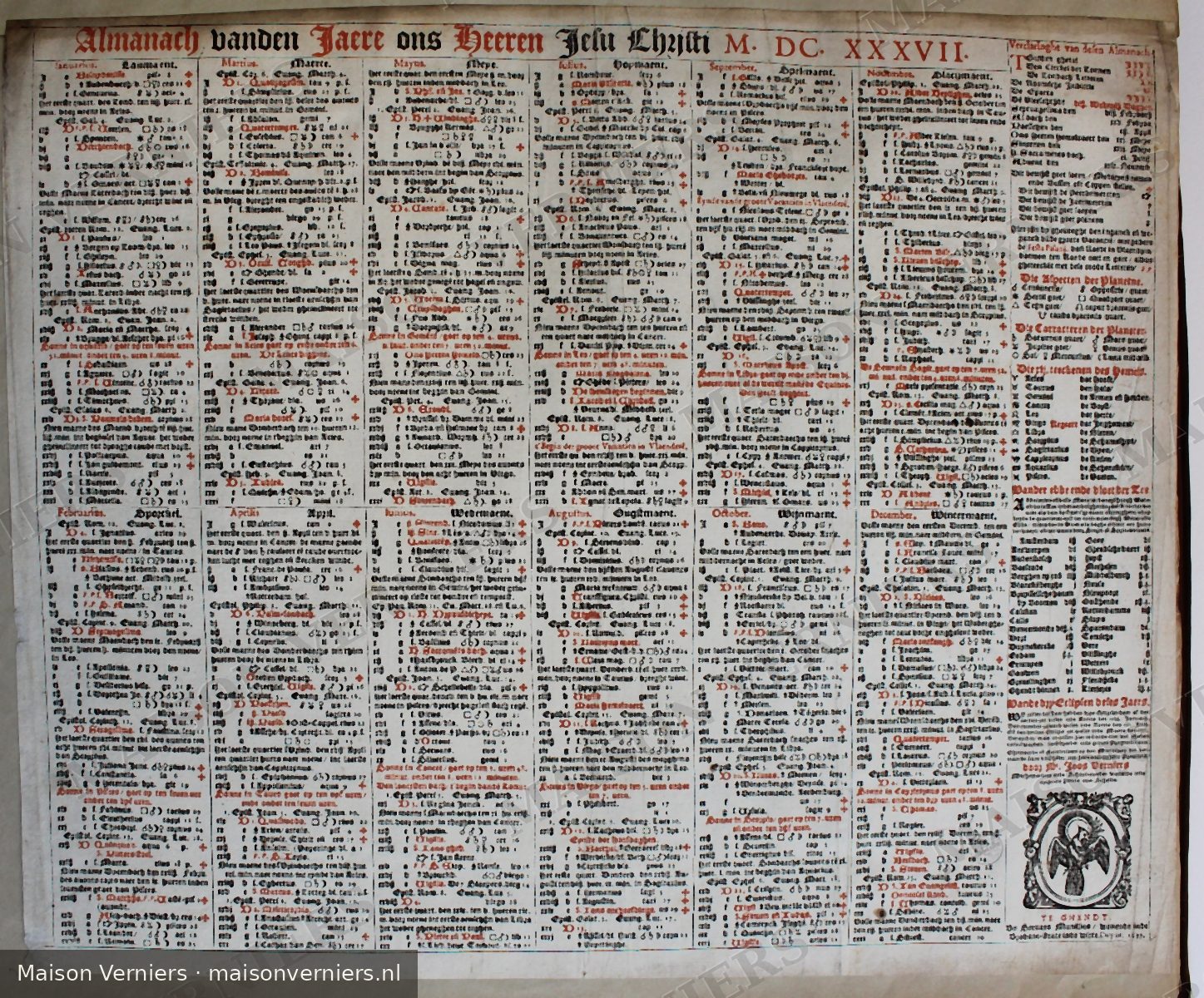
Van Joos Verniers, kleinzoon van Jan, zijn twee plakalmanakken bewaard, voor 1636 en 1637, beide gedrukt in Gent bij Servaes Manilius (Bron 89). Het vel voor 1637 is vrijwel compleet. Bovenaan staat in grote rode en zwarte letters "Almanach vanden Iaere ons Heeren Iesu Christi M.DC.XXXVII"; rechts staan de tekens van de dierenriem, de standen van de planeten en een tabel van eb en vloed, en rechtsonder de naam "Mr. Joos Verniers" boven een houtsnede van de evangelist Johannes met de adelaar.
Zo zijn van drie generaties Gentse Verniersen, grootvader, mogelijk een oom, en kleinzoon, nog boeken en almanakken in hun eigen druk of handschrift te zien.
The third generation: Joos Verniers, 1637
Two wall almanacs by Joos Verniers, Jan's grandson, survive, for 1636 and 1637, both printed in Ghent by Servaes Manilius (Source 89). The sheet for 1637 is almost complete. At the top, in large red and black letters, stands "Almanach vanden Iaere ons Heeren Iesu Christi M.DC.XXXVII"; on the right are the signs of the zodiac, the aspects of the planets and a table of the tides, and at the lower right the name "Mr. Joos Verniers" above a woodcut of John the Evangelist with the eagle.
So from three generations of Ghent Verniers, grandfather, possibly an uncle, and grandson, books and almanacs can still be seen in their own print or hand.
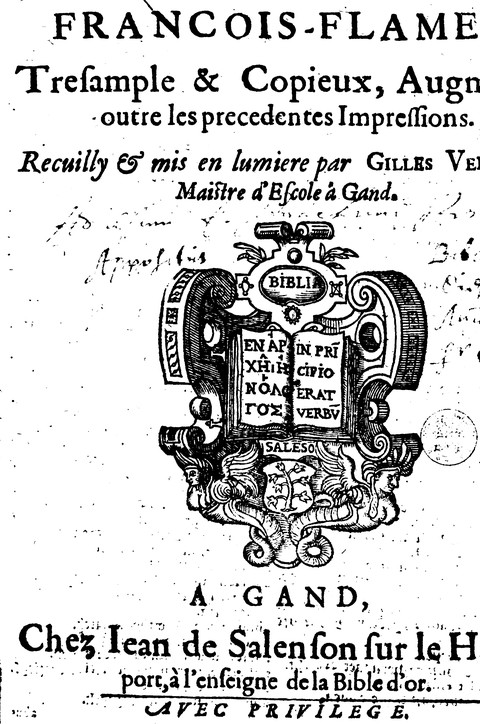
Plakalmanak voor 1637 van Mr. Joos Verniers, gedrukt te Gent bij Servaes Manilius. Universiteitsbibliotheek Gent, via de Short Title Catalogus Vlaanderen (Bron 268).Wall almanac for 1637 by Mr. Joos Verniers, printed in Ghent by Servaes Manilius. Ghent University Library, via the Short Title Catalogue Flanders (Source 268).Titelpagina van de Dictionaire François-Flamen van "Gilles Verniers, Maistre d'Escole à Gand", gedrukt te Gent bij Jan van Salenson.Title page of the Dictionaire François-Flamen by "Gilles Verniers, Maistre d'Escole à Gand", printed in Ghent by Jan van Salenson.
Van de almanak van Joos Verniers voor 1636 is hier nog geen afbeelding opgenomen. Alle titels staan in het overzicht van almanakken en woordenboeken in het Naslagwerk.
No image is included here yet of Joos Verniers's almanac for 1636. All titles are listed in the overview of almanacs and dictionaries in the Reference section.