Verhaal #19 · Verborgen VerhaalStory #19 · Hidden Story
Een gilde voor de chirurgijns van Weesp (1699)A guild for the surgeons of Weesp (1699)
Een verzoek van de chirurgijns aan het stadsbestuur, en twee heren die het reglement moesten nakijken: Cornelis Verniers en dr. Lodewijck van SandickA request from the surgeons to the town council, and two gentlemen asked to examine the rules: Cornelis Verniers and dr. Lodewijck van Sandick
Let op: dit verhaal is in opbouw. Het is gebaseerd op een getypt uittreksel uit de notulen van het stadsbestuur van Weesp, dat in het familiedossier van 1984 bewaard is. Het origineel heb ik nog niet kunnen inzien.
Chirurgijns en hun gilde
Een chirurgijn was in de zeventiende eeuw iets anders dan een chirurg nu. Hij leerde het vak niet op de universiteit, maar als leerjongen bij een meester. Hij verbond wonden, zette botten, liet aderen en trok tanden, en knipte en schoor vaak ook nog. De gestudeerde artsen, de doctoren in de medicijnen, stelden een diagnose en schreven recepten voor; de chirurgijn deed het handwerk.
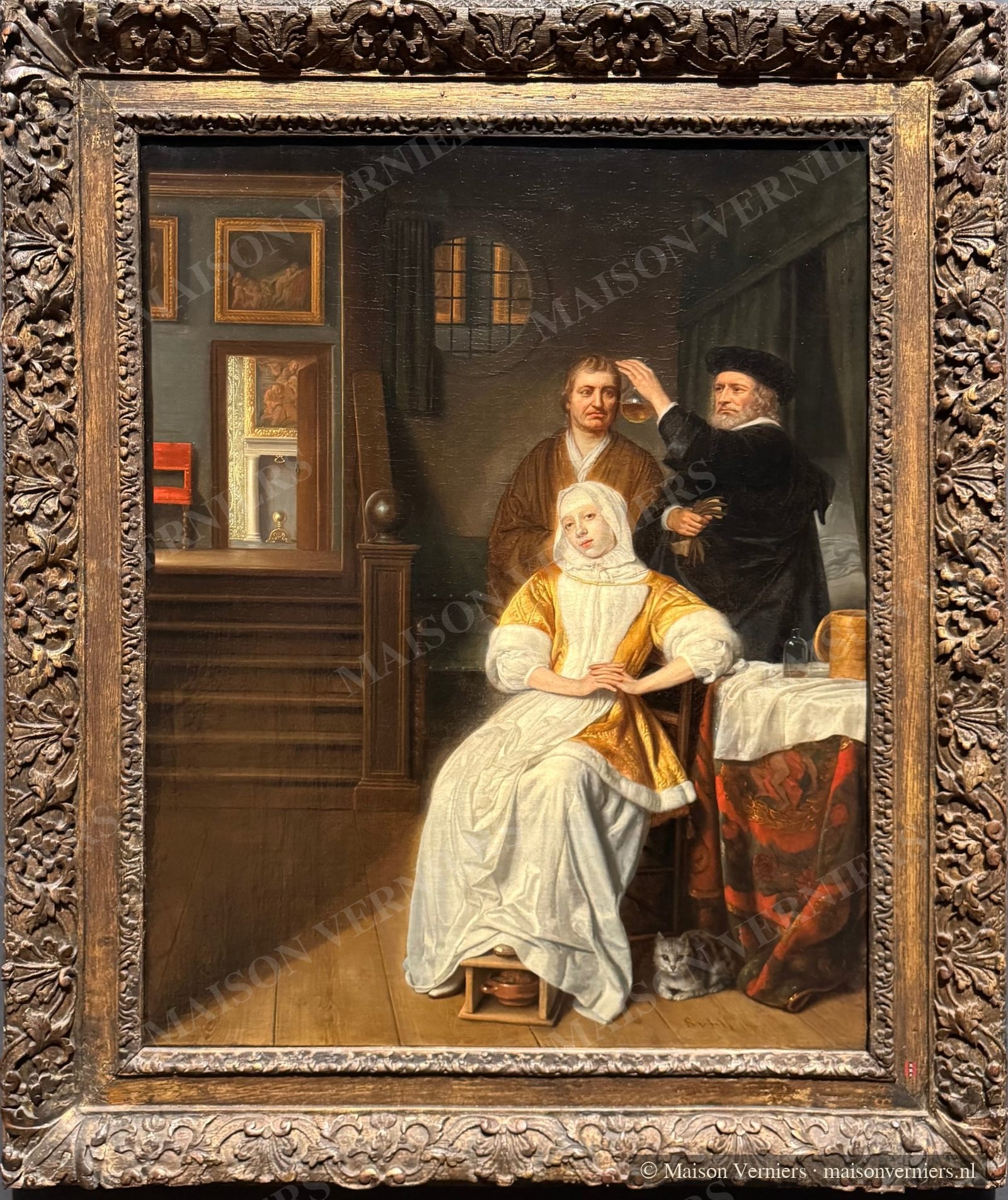
Samuel van Hoogstraten, De bleekzuchtige dame, 1660–1678. Een jonge vrouw zit ziek op een stoel, met haar voet op een stoof. Achter haar houdt een geneesheer een fles urine tegen het licht om een diagnose te stellen: het „piskijken”. Zo werkten de gestudeerde doctoren in de medicijnen; het handwerk was aan de chirurgijn. Rijksmuseum Amsterdam (SK-C-152); eigen foto. Klik op het schilderij voor groot formaat.
In veel steden waren de chirurgijns verenigd in een gilde. Zo'n gilde regelde wie het vak mocht uitoefenen. Een leerling moest een proef afleggen voordat hij zich meester mocht noemen, en wie geen lid was, mocht in de stad niet als chirurgijn werken. Het gilde zorgde ook voor zieke leden en voor weduwen. Vaak hadden chirurgijnsgilden de heiligen Cosmas en Damianus als beschermheiligen. Dat waren algemene gewoonten; hoe het in Weesp precies geregeld werd, weten we nog niet.
Voor de familie Verniers was dit een vertrouwd vak. Pieter Laurens Verniers, de vader van Cornelis, was chirurgijn in Weesp, zijn zoon Lourens was stadschirurgijn (zie het verhaal Een chirurgijn uit Weesp en de tocht naar Chatham), en ook Lourens' broer Cornelis werkte vanaf 1680 als chirurgijn (Bron 174).
Het besluit van 2 februari 1699
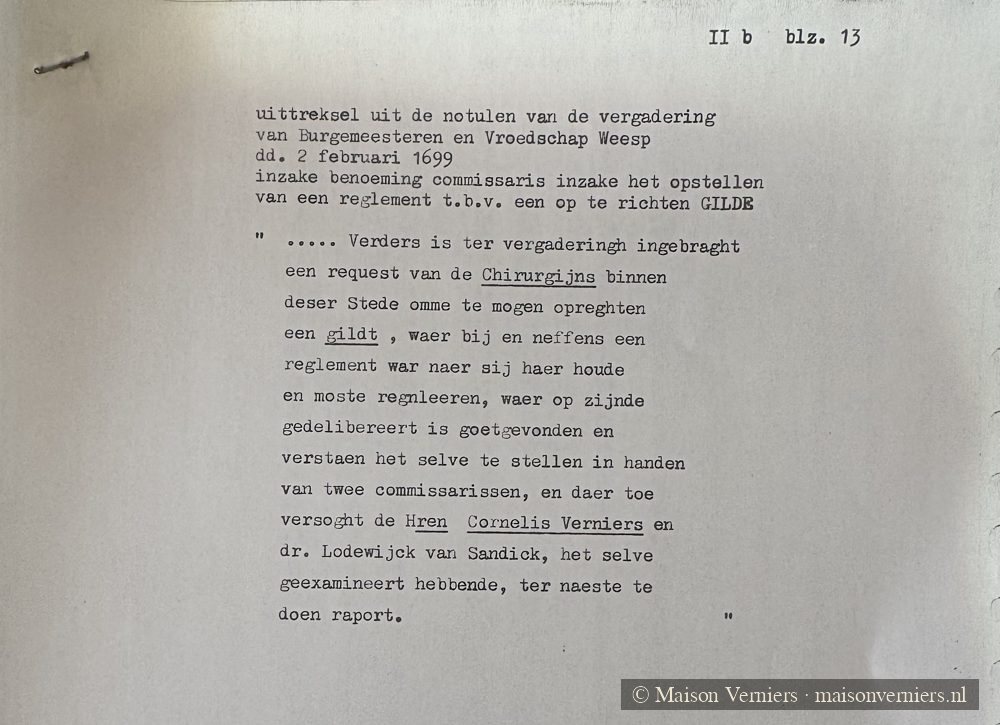
In het familiedossier van 1984 zit een getypt uittreksel uit de notulen van de vergadering van Burgemeesters en Vroedschap van Weesp, met als kop: "uittreksel uit de notulen van de vergadering van Burgemeesteren en Vroedschap Weesp dd. 2 februari 1699 inzake benoeming commissaris inzake het opstellen van een reglement t.b.v. een op te richten GILDE". De puntjes aan het begin geven aan dat het om een stukje uit een langer verslag gaat.
Weesp, notulen van Burgemeesters en Vroedschap, 2 februari 1699. Getypt uittreksel uit het familiedossier; het origineel is nog niet ingezien. Bron 182
..... Verders is ter vergaderingh ingebraght een request van de Chirurgijns binnen deser Stede omme te mogen opreghten een gildt, waer bij en neffens een reglement war naer sij haer houde en moste regnleeren, waer op zijnde gedelibereert is goetgevonden en verstaen het selve te stellen in handen van twee commissarissen, en daer toe versoght de Hren Cornelis Verniers en dr. Lodewijck van Sandick, het selve geexamineert hebbende, ter naeste te doen raport.
Het getypte uittreksel uit het familiedossier van 1984 (blz. II b 13).
Wat er precies gebeurt
In gewone taal: in de vergadering van het stadsbestuur van Weesp wordt een verzoekschrift ("request") van de chirurgijns van de stad besproken. Zij vragen toestemming om een eigen gilde op te richten. Bij hun verzoek leveren ze meteen een reglement in: de regels waaraan de leden zich moeten houden.
Het stadsbestuur beslist er nog niet zelf over. Na overleg ("gedelibereert") vindt men het goed om het verzoek in handen te geven van twee commissarissen: Cornelis Verniers en dr. Lodewijck van Sandick. Zij moeten het reglement grondig bekijken ("geexamineert hebbende") en in de volgende vergadering ("ter naeste") verslag uitbrengen. Een commissaris was hier dus een raadslid dat een zaak namens het bestuur onderzocht en er advies over gaf.
Dat juist deze twee mannen werden gevraagd, is logisch. Cornelis Verniers was zelf apotheker en sinds 1680 chirurgijn, en zat al sinds 1676 in de vroedschap. Hij kende het vak dus van binnenuit. Dr. Van Sandick was een gestudeerd geneesheer, een doctor in de medicijnen, en zat sinds 1687 ook in de vroedschap. Samen konden ze beoordelen of de regels goed waren voor de chirurgijns en voor de stad.
Cornelis Verniers
Cornelis Verniers (ca. 1652–1719) was de grote bestuurder van de familie. Volgens het familiedossier zat hij van 1676 tot 1719 in de vroedschap van Weesp, was hij schepen, apotheker en chirurgijn, en later ook burgemeester (1691 en 1702–1709). In februari 1699 was hij dus een ervaren raadslid én zelf chirurgijn. Hij moest het reglement beoordelen van een gilde waarvan hij als chirurgijn zelf lid zou worden (Bron 174).
Wie was dr. Lodewijck van Sandick?
Lodewijck van Sandick werd op 27 februari 1647 geboren in Wijk bij Duurstede, als zoon van Johan van Sandick en Abigael Schagen. Hij studeerde medicijnen en promoveerde in 1670 tot doctor in de medicijnen (volgens de familiegenealogie in Harderwijk; het familieboek noemt Leiden). Hij vestigde zich als geneesheer in Weesp en werd daar een belangrijk bestuurder. Hij was vele malen schepen (vanaf 1685), werd in 1687 lid van de vroedschap, en was onder meer gasthuismeester, weesvader, kerkmeester en in 1699 weesmeester. In 1709 werd hij burgemeester van Weesp. In 1694 trouwde hij met Agnieta de Flines, een weduwe uit Weesp. Hij overleed in Weesp op 19 juni 1711 (Bron 183).
Van Sandick en Cornelis Verniers zaten dus jarenlang samen in het stadsbestuur. In 1699 vormden ze een goed koppel om het reglement na te kijken: een doctor in de medicijnen en een chirurgijn, allebei lid van de vroedschap.
Wanneer werd het gilde opgericht?
Dat is nog niet bekend. Het uittreksel uit 1699 laat alleen zien dat de chirurgijns om een gilde vroegen en dat het stadsbestuur het reglement liet onderzoeken. Of het verzoek werd goedgekeurd, en wanneer het gilde echt van start ging, moet blijken uit de notulen van de volgende vergaderingen. Online heb ik daarover nog niets kunnen vinden. Wordt vervolgd.
Waar liggen de originele notulen?
De notulen (resoluties) van Burgemeesters en Vroedschap horen bij het oude stadsarchief van Weesp: "Stad Weesp, 1355–1795" (toegang GAW028-01). Dat archief is in december 2022 van het Regionaal Historisch Centrum Vecht en Venen overgebracht naar het Stadsarchief Amsterdam, met behoud van de oude toegangsnummers (Bron 184).
Het inventarisnummer van het deel met de notulen van 1699 heb ik online niet kunnen vinden, en de notulen zijn niet gedigitaliseerd. Bij het Stadsarchief Amsterdam kun je een gratis scan aanvragen (stadsarchief@amsterdam.nl). Vraag dan naar de resoluties van Burgemeesters en Vroedschap van Weesp van 2 februari 1699 en de vergaderingen daarna, zodat ook het besluit over het gilde gevonden kan worden.
Note: this story is still being developed. It is based on a typed extract from the minutes of the Weesp town council, kept in the 1984 family dossier. I have not yet been able to consult the original.
Surgeons and their guild
A surgeon (chirurgijn) in the seventeenth century was something different from a surgeon today. He did not learn his trade at university, but as an apprentice to a master. He dressed wounds, set bones, let blood and pulled teeth, and often also cut hair and shaved. The university-trained physicians, the doctors of medicine, made the diagnosis and wrote prescriptions; the surgeon did the manual work.
Samuel van Hoogstraten, The Anaemic Lady (De bleekzuchtige dame), 1660–1678. A young woman sits ill on a chair, her foot on a foot-stove. Behind her a physician holds a flask of urine up to the light to make a diagnosis: so-called urine-gazing. That was how the university-trained doctors of medicine worked; the hands-on work was left to the surgeon. Rijksmuseum Amsterdam (SK-C-152); own photograph. Click the painting to view it full size.
In many towns the surgeons were united in a guild. Such a guild decided who was allowed to practise. An apprentice had to pass a test before he could call himself a master, and anyone who was not a member could not work as a surgeon in the town. The guild also cared for sick members and for widows. Surgeons' guilds often had Saints Cosmas and Damian as their patrons. These were general customs; exactly how things were arranged in Weesp is not yet known.
For the Verniers family this was a familiar trade. Pieter Laurens Verniers, the father of Cornelis, was a surgeon in Weesp, his son Lourens was town surgeon (see the story A surgeon from Weesp and the Raid on Chatham), and Lourens' brother Cornelis also worked as a surgeon from 1680 (Source 174).
The decision of 2 February 1699
The 1984 family dossier contains a typed extract from the minutes of the meeting of the Burgomasters and Town Council (Vroedschap) of Weesp, headed: "uittreksel uit de notulen van de vergadering van Burgemeesteren en Vroedschap Weesp dd. 2 februari 1699 inzake benoeming commissaris inzake het opstellen van een reglement t.b.v. een op te richten GILDE" (extract from the minutes of 2 February 1699 on the appointment of commissioners for drawing up rules for a guild to be founded). The dots at the start show that this is a passage from a longer record. The text is given here in the original Dutch, as a primary source.
Weesp, minutes of the Burgomasters and Town Council, 2 February 1699. Typed extract from the family dossier; the original has not yet been consulted. Source 182
..... Verders is ter vergaderingh ingebraght een request van de Chirurgijns binnen deser Stede omme te mogen opreghten een gildt, waer bij en neffens een reglement war naer sij haer houde en moste regnleeren, waer op zijnde gedelibereert is goetgevonden en verstaen het selve te stellen in handen van twee commissarissen, en daer toe versoght de Hren Cornelis Verniers en dr. Lodewijck van Sandick, het selve geexamineert hebbende, ter naeste te doen raport.
The typed extract from the 1984 family dossier (p. II b 13).
What exactly happens
In plain terms: at a meeting of the Weesp town council, a petition ("request") from the town's surgeons is discussed. They ask permission to found a guild of their own. With their request they hand in a set of rules (a "reglement") that the members would have to follow.
The council does not decide straight away. After discussion ("gedelibereert") it agrees to hand the request to two commissioners: Cornelis Verniers and dr. Lodewijck van Sandick. They are to examine the rules carefully ("geexamineert hebbende") and report at the next meeting ("ter naeste"). A commissioner here was a council member who looked into a matter on behalf of the council and advised on it.
It makes sense that these two men were chosen. Cornelis Verniers was himself an apothecary and, from 1680, a surgeon, and had sat on the town council since 1676. He knew the trade from the inside. Dr. Van Sandick was a university-trained physician, a doctor of medicine, and had also sat on the council since 1687. Together they could judge whether the rules were good for the surgeons and for the town.
Cornelis Verniers
Cornelis Verniers (c. 1652–1719) was the great administrator of the family. According to the family dossier he sat on the Weesp town council from 1676 to 1719, was alderman, apothecary and surgeon, and later also burgomaster (1691 and 1702–1709). In February 1699 he was therefore an experienced council member and a surgeon himself. He was asked to judge the rules of a guild that he, as a surgeon, would join himself (Source 174).
Who was dr. Lodewijck van Sandick?
Lodewijck van Sandick was born on 27 February 1647 in Wijk bij Duurstede, the son of Johan van Sandick and Abigael Schagen. He studied medicine and took his doctorate in medicine in 1670 (at Harderwijk according to the family genealogy; the family book says Leiden). He settled as a physician in Weesp and became an important administrator there. He was alderman many times (from 1685), joined the town council in 1687, and served among other things as hospital master, orphan father, churchwarden and, in 1699, orphan master. In 1709 he became burgomaster of Weesp. In 1694 he married Agnieta de Flines, a widow from Weesp. He died in Weesp on 19 June 1711 (Source 183).
Van Sandick and Cornelis Verniers thus sat together on the town council for many years. In 1699 they made a good pair to examine the rules: a doctor of medicine and a surgeon, both members of the council.
When was the guild founded?
That is not yet known. The 1699 extract only shows that the surgeons asked for a guild and that the council had the rules examined. Whether the request was approved, and when the guild actually started, should appear in the minutes of the following meetings. I have not yet found anything about this online. To be continued.
Where are the original minutes?
The minutes (resolutions) of the Burgomasters and Town Council belong to the old town archive of Weesp: "Stad Weesp, 1355–1795" (access number GAW028-01). In December 2022 this archive was moved from the Regional Historical Centre Vecht en Venen to the Amsterdam City Archives, keeping the old access numbers (Source 184).
I could not find the inventory number of the volume with the 1699 minutes online, and the minutes have not been digitised. You can request a free scan from the Amsterdam City Archives (stadsarchief@amsterdam.nl). Ask for the resolutions of the Burgomasters and Town Council of Weesp of 2 February 1699 and the meetings after it, so that the decision on the guild can be found as well.