Laurens Verniers is bij zoveel betrokken geweest, en reisde zoveel, dat zijn verhaal zich niet in één rechte lijn laat vertellen. Dit verhaal probeert dat toch te doen, zo veel mogelijk chronologisch, met de brieven, twisten, plaatsen en mensen die zijn leven vormden. Het bouwt voort op wat al in Post II op het blog is verteld, en steunt op een groot aantal wetenschappelijke bronnen en archiefstukken — van zestiende-eeuwse brieven en notariële akten tot doopsgezinde geschiedschrijving uit de negentiende en twintigste eeuw, stuk voor stuk terug te vinden in de Bibliotheek.
Het bredere tijdsbeeld: Gent en de opkomst van de Reformatie
Om Laurens' latere lotgevallen te begrijpen, helpt het eerst even in te zoomen op het bredere tijdsbeeld waarin hij opgroeide. Al vroeg in de zestiende eeuw vond de Bijbel zijn weg naar de intellectuele bovenlaag via de humanisten, en ook op de Gentse (1539) en Deinse (1549–1553 en 1566) rederijkersfeesten klonken bijbelse ideeën en kritiek op rooms-katholieke gebruiken zoals aflaten en de sacramenten. Tussen 1538 en 1550 ontstond binnen deze vroege beweging een breuk, waaruit de Doopsgezinden (de latere Mennisten, naar Menno Simons), de Gereformeerden en de Calvinisten voortkwamen — Laurens zelf zou zich bij de eerste stroming aansluiten. In het roerige Wonderjaar 1566 waren het vooral de Calvinisten die in Vlaanderen de plak zwaaiden, met hagenpreken, de Beeldenstorm en de oprichting van eigen kerken en gemeenten. Filips II reageerde door de hertog van Alva te sturen, die de godsdienstopstand met harde hand onderdrukte en de bevolking via de Twintigste Penning liet meebetalen aan de Spaanse troepen — dezelfde Alva die in 1567 ook Laurens in absentia zou verbannen. Bron
Ondanks deze repressie werd Gent tussen 1578 en 1584 een calvinistische stad, en Vlaanderen grotendeels een calvinistisch land — tot de stad in 1584 onder de troepen van Alexander Farnese viel. Vlaamse calvinisten, en met hen doopsgezinden zoals de Verniers, verlieten massaal het land, richting Engeland, de Nederlanden en Duitsland, en droegen zo mee bij aan de economische bloei van de Gouden Eeuw. In Vlaanderen zelf werd het katholicisme na de val van Gent hersteld, mede door de Contrareformatie onder impuls van de jezuïeten. Bron
Verwarring in de bronnen: Vernier of Vermeren?
Eerst even wie hier eigenlijk aan het woord is. Veel van wat over Laurens bekend is, komt uit het werk van K. Vos, die in zijn boek "De Doopsgezinden te Antwerpen in de zestiende eeuw" uitgebreid onderzoek deed naar de vroege doopsgezinde gemeenschap in Antwerpen en haar leraren en oudsten — de bron is terug te vinden in het Naslagwerk. Vos schrijft daarin zelf dat de namen uit deze periode voortdurend door elkaar lopen, en dat hij aanvankelijk twee verschillende oudsten voor één persoon had aangezien.
Zijn conclusie, na lang puzzelen: de Franeker leraar die door Alva werd verbannen en in het officiële vonnis Joachim Joesz Vernier heet — gestraft omdat hij te 's-Hertogenbosch en te Antwerpen gedoopt had — is niemand anders dan onze eigen Laurens Verniers, die inderdaad een grote rol in de doopsgezinde broederschap heeft gespeeld.
Vos overwoog wel een alternatief: er is een mogelijkheid van een drukfout in het uitgegeven vonnis. Als voor "Vernier" "Vermer" gelezen mag worden, gaat het om een zekere Joachim Vermeren, die in 1563 in Keulen uit het zicht raakte en vier jaar later in Franeker weer opduikt. Vos onderzocht dit spoor serieus — hij dacht aanvankelijk zelfs dat deze Joachim Vermeren dezelfde was als een oudste die in de Antwerpse archieven "Joost Vermeren" heette, maar dat bleek achteraf een andere man, Verbeeck, te zijn. Zelfs met deze slag om de arm blijft Vos' eigen conclusie dat het vonnis over Laurens Verniers gaat. Ik neem deze identificatie dus aan als de meest waarschijnlijke, met erkenning dat er in de negentiende- en twintigste-eeuwse doopsgezinde geschiedschrijving over dit soort naamsverwarringen genuanceerd wordt gediscussieerd.
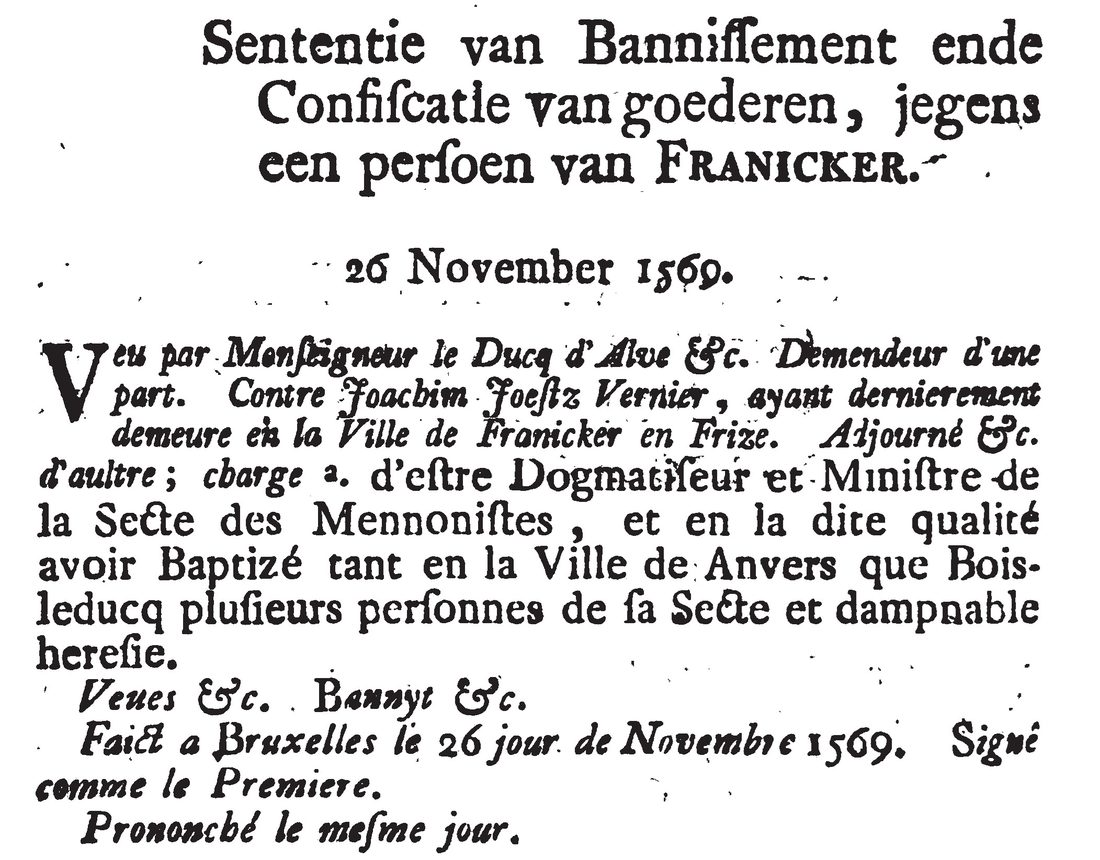
Sententie van Banissement ende Confiscatie van goederen, jegens een persoon van Franeker, 26 november 1569 — bron: J. Marcus, "Sententien en Indagingen van den Hertog van Alba", 1735, eigen bibliotheek
Franeker: diaken en leraar
Laurens vestigde zich, na zijn tijd in de Zuidelijke Nederlanden, in Franeker. Bij zijn inschrijving in het Burgerboek van Franeker op 3 december 1560 staat hij geregistreerd onder de verbasterde naam "Lourens Wermer". Hij klom op tot diaken en later leraar (oudste) van de Franeker gemeente — een positie die hem middenin de grote geloofstwisten van zijn tijd plaatste.
Wat het ambt van diaken in de praktijk inhield, wordt mooi geïllustreerd door de verklaring van een geloofsgenoot uit Antwerpen, Jan van de Walle, die in 1571 werd gearresteerd (Marnef, 2008). Verderop in dit verhaal duikt deze Jan vanden Walle nog een keer op: hij is namelijk de geadresseerde van een van de twee brieven die Hans Busschaert in 1570 vanuit Köln schreef — zie het kopje "De brief van Hans Busschaert, 24 januari 1570" hieronder. Op de vraag wat het ambt van diaken precies inhield, antwoordde Jan van de Walle in het Frans: "de recoeullir les aulmosnes et distribuer aux povres" — in hedendaags Nederlands: "het inzamelen van de aalmoezen en het uitdelen daarvan aan de armen." Dat was dus ook de kern van Laurens' eigen taak als diaken: de zorg voor de armen binnen de gemeente.
Van Jan van de Walle is ook een opmerkelijke levensloop bekend, die goed laat zien hoe mobiel de vervolgde doopsgezinde broederschap was — een mobiliteit die Laurens zelf evengoed kenmerkte. Van de Walle, een veertigjarige lintwerker, vestigde zich rond 1554 in Antwerpen, trok na ruim een jaar naar Gent (ongeveer achttien maanden), vluchtte vervolgens naar Holland (zes maanden) toen inquisiteur Titelmans hem op de hielen zat, verbleef enige tijd in het Zeeuwse Middelburg, en keerde daarna terug naar de Antwerpse regio: anderhalf jaar in Borgerhout, vijf jaar op de Markgravelei, en ten slotte binnen de stadsmuren — drie jaar in de Vliersteeg, een half jaar in de Gasthuisbeemden, drie à vier maanden achter het Tapissierspand, en uiteindelijk in de Kaasstraat, waar hij bij zijn arrestatie woonde. Er bestonden nauwe contacten tussen de doopsgezinden in de stad Antwerpen en die in de omliggende dorpen zoals Borgerhout en Wilrijk; dezelfde oudsten, predikanten en diakenen opereerden in beide, wat laat zien dat het om één en hetzelfde netwerk ging. De getuigenissen van Van de Walle en van Herman van den Greyn tonen bovendien aan dat leraars en diakenen aan de basis werden verkozen, door de gewone gemeenteleden zelf.
Onderzoek naar de beroepen van doopsgezinde ambtsdragers uit deze periode laat een duidelijk patroon zien: van 27 ambtsdragers waarvan het beroep kon worden achterhaald, waren de sectoren textiel en kleding veruit dominant, met respectievelijk negen en zeven vermeldingen, gevolgd door de commerciële sector met vijf. Bouw en leerbewerking komen elk één keer voor, kunstambachten en de restrubriek "overige" elk twee keer. Ambachtelijke beroepen — met de textielsector voorop — waren dus volledig dominant; beroepen die een uitgesproken intellectuele vorming veronderstellen, ontbraken vrijwel geheel (Marnef, 2008). Onze stamvader Laurens, lakenhandelaar van beroep, paste daar naadloos in: ook hij kwam uit diezelfde dominante textielsector.
De Vriesch-Vlaamsche twisten
De doopsgezinde beweging van de zestiende eeuw was verre van eensgezind. Rond 1560 sloten de doopsgezinde gemeenten van vier Friese steden — Harlingen, Franeker, Leeuwarden en Dokkum — een geheim, negentien artikelen tellend "Verbond" over hun onderlinge verhoudingen (Doopsgezinde Bijdragen, Scheffer, 1893). Uit dit Verbond, en de manier waarop het aan het licht kwam, ontstonden de Vriesch-Vlaamsche twisten — door K. Vos later "de donkerste plek in onze historie" genoemd (Vos, 1914). Laurens, en zijn vriend Jeroen Tinnegieter, bevonden zich middenin dit spanningsveld.
Te Franeker was het de vreemdelingen — vluchtelingen uit het zuiden — gelukt hun eigen geloofsgenoot, de Henegouwer Jeroen Tinnegieter, tot leraar te laten kiezen. De Harlingers hadden hier zware bezwaren tegen, en om het geschil te beslechten werden buitenleraren ingeroepen: Dirk Filips, Hoyte Renix Santvoort, Nette Lipkes en Hans Bouwens Busschaert. Zij herstelden de vrede, al vergat Jeroen nooit hoe zwaar hij zich beledigd voelde. Tijdens deze onderhandelingen lekte uit wat de Harlingers mede had bewogen: het bestaan van het tot dan toe onbekende Verbond, waardoor Jeroens leraarschap automatisch ook zou gelden voor Harlingen, Leeuwarden en Dokkum. Toen de broederschap dit vernam, ontstond grote verontwaardiging, vooral te Franeker.
Kort daarop kwam er, in Emden, nog een zaak bij die de gemoederen verder verhitte: de gerespecteerde oudste Leenaert Bouwens werd er — na beschuldigingen (die overigens vals bleken) over drankgebruik en het aannemen van geld voor zijn diensten — door Dirk Filips en zes medestanders geschorst als oudste. Onder die rechters bevonden zich ook Hoyte Renix en de Harlinger leraar Ebbe Pieters. Leenaert Bouwens week vervolgens uit naar een plek vlak buiten Harlingen, waar hij warm onthaald werd en waar men niet in zijn schuld geloofde.
Hierdoor ontstond een schrijnend gebrek aan een oudste in de Friese gemeenten: zonder oudste was noch doop noch avondmaal mogelijk. Het is op dit punt dat onze stamvader met naam in het verhaal verschijnt. Volgens Scheffer: "Het gaf Jeroen Tinnegieter aanleiding om met zijn vriend Laurens Verniers naar Ebbe Pieters te Harlingen te gaan en hem de vraag voor te stellen: hoe daarin te handelen, dewijle zij Leenaert Bouwens kwijt waren?" — waarbij ook meteen de principiële vraag speelde of men zich aan de bepalingen van het Verbond zou houden. Laurens wordt hier dus uitdrukkelijk Jeroens vriend genoemd, en trad samen met hem op als gezant naar Ebbe.
Ebbe achtte het, net als zijn vriend Laurens, verstandig dit principe eerst te laten beslissen door een stemming in elk van de vier gemeenten. Toen de afgevaardigden van Leeuwarden en Dokkum echter via Franeker naar Harlingen reisden, bleek dat men te Franeker de vergadering had uitgesteld, en moest er haastig, dezelfde avond nog, een bijeenkomst worden belegd. Van de ongeveer driehonderd leden kwamen er niet meer dan dertig, die het bovendien onderling oneens waren en de beslissing maar aan de kerkeraad overlieten. Die kerkeraad, met Jeroen aan het hoofd, verklaarde daarop namens Franeker het Verbond "om der liefdes wille" wel te zullen proberen na te leven, maar zich alle vrijheid voor te behouden — in de praktijk een opzegging. Harlingen, Leeuwarden en Dokkum bleven het Verbond wél trouw, zodat het voortaan een verbond van drie steden werd.
Dit veroorzaakte echter een felle terugslag in Franeker zelf: velen die niet bij de haastige vergadering aanwezig waren geweest, protesteerden luid tegen de opzegging en eisten herroeping. Het werd het begin van de scheuring. Beide partijen kwamen voortaan apart samen; de voorstanders van het Verbond schorsten op hun beurt kerkeraadsleden die het er niet mee eens waren, en werden op hun beurt zelf uit hun ambt gezet door de partij van Jeroen. Zo ontstonden de partijnamen: de vreemdelingen (grotendeels Vlamingen en Brabanders) heetten voortaan Vlamingen, de oorspronkelijke bewoners, in tegenstelling daarmee, Friezen. Jeroen voerde de Vlamingen aan te Franeker, waar de twist het hevigst woedde.
Pogingen tot verzoening liepen vast op de vraag wie bevoegd was om te oordelen. Uiteindelijk daagde Jeroen Ebbe Pieters voor de afgescheiden Franeker gemeente, met zeven beschuldigingen (13 mei 1566) — vooral dat Ebbe te Leeuwarden zou hebben verspreid dat Jeroen c.s. kerkeraadsleden hadden gebannen, terwijl er alleen schorsing was uitgesproken. Ebbe bood aan zich te verantwoorden in zijn eigen gemeente Harlingen, waar hij woonde, maar dit werd stelselmatig geweigerd.
Hoe het hierna verder liep, is dankzij Blaupot ten Cate's oudere werk hierboven al verteld: de kwestie werd uiteindelijk voorgelegd aan de Hoornse leraren Jan Willemsz en Lubbert Gerritsz, die op 19 september 1567 met het Compromis van Embden een verzoening tot stand brachten. Die verzoening bleek echter niet houdbaar — het mislukte verzoeningsritueel van 1568 en de latere tussenkomst van Dirk Philips verdiepten de breuk verder, totdat de scheiding tussen Friezen en Vlamingen definitief werd, met een verdeeldheid die zich over de hele Republiek uitstrekte.
Vos concludeerde later dat de eigenlijke grondfout niet lag in de geheimhouding van het Verbond zelf, maar in de misgreep om een zo wankelmoedige en tegelijk eerzuchtige man als Ebbe zo veel gezag te geven. De Vriesch-Vlaamsche twisten kostten de jonge broederschap veel van haar beste leden, maar uit die verbrokkeling groeide uiteindelijk toch de doopsgezinde gemeenschap die eeuwenlang zou blijven bestaan.
Nog een perspectief: Blaupot ten Cate (1847)
Dezelfde twisten worden ook beschreven in een veel ouder standaardwerk: S. Blaupot ten Cate, "Geschiedenis van de Doopsgezinden: Doopsgezinden in Friesland en Holland, Zeeland, Utrecht" (Amsterdam, P. N. van Kampen, 1847). Deze negentiende-eeuwse historicus — niet te verwarren met zijn gelijknamige boek over Groningen, Overijssel en Oost-Friesland, elders in dit verhaal al aangehaald — geeft een net iets ander, persoonlijker getint beeld van de aanloop naar de scheuring.
Volgens Blaupot ten Cate ging het niet alleen om leerstellige verschillen, maar ook om alledaagse, culturele wrijving tussen Friezen en Vlamingen. Beide groepen hielden zich aan dezelfde wet van eenvoud en spaarzaamheid, maar vulden dat verschillend in: de Friezen waren soberder in hun kleding, de Vlamingen juist weer soberder in hun huisraad (de bron zelf is op dit punt niet helemaal eenduidig geformuleerd, maar de kern is duidelijk: over en weer vond men elkaars levensstijl minder ingetogen). Vooral onder de Vlaamse vluchtelingen waren er, aldus Blaupot ten Cate, enkele "onrustige, heethoofdige mensen" die de Friese gewoonten wilden bekritiseren en verbeteren — iets wat bij een volk dat sterk aan zijn eigen gebruiken hechtte, moeilijk viel. Deze sluimerende ontevredenheid brak uiteindelijk los over het Verbond der Vier Steden.
Ook hier komt Laurens weer nadrukkelijk in beeld: "Tinnegieter en Laurens Verniers, beide van Franeker, verstonden zich te dien einde met Ebbe Pieterszoon, Dienaar te Harlingen, om de Afgevaardigden der vier steden tegen een bepaalden tijd te Harlingen samen te doen komen." Laurens en zijn vriend Jeroen namen dus zelf het initiatief om de ontmoeting tussen de vier steden te regelen — een detail dat mooi aansluit bij wat al bekend was.
Blaupot ten Cate beschrijft ook het vervolg: op 19 september 1567 kwam er, vastgelegd in het Protocol van Embden, een Compromis tot stand, opgesteld door de Hoornse leraren Jan Willemsz en Lubbert Gerritsz, waarbij Friezen én Vlamingen zich zouden verzoenen. Bij de verzoeningsbijeenkomst in 1568 liep het echter mis: toen de geknielde Vlamingen, net als de Friezen, zelf weer wilden opstaan na hun schuldbekentenis, verklaarde Jan Willemsz dat zij — als "dwalende broeders" — niet uit eigen beweging mochten opstaan, maar bij de hand overeind geholpen moesten worden. Dit kleine, vernederende gebaar deed de net herstelde vrede weer volledig instorten. Een aangrijpend randverhaal: de Vlaamse broeder Job Jansz, diep bedroefd over deze nieuwe onenigheid, trok zich terug in Zuid-Holland, werd er gevangengenomen en in december van datzelfde jaar in Den Haag om zijn geloof verbrand, samen met Jan Thielemans. Ook de Vlaamse martelaar Jacob de Roore schreef, enkele dagen voor zijn dood op de brandstapel op 10 juni 1569, nog een brief vanuit zijn gevangenis in Brugge met de dringende oproep om zachter met het bannen om te gaan.
De verdeeldheid bleek hardnekkig: Groningerland, Oost-Friesland, Vlaanderen en Zuid-Holland kozen grotendeels de kant van de Vlamingen, Noord-Holland die van de Friezen. Zierikzee probeerde neutraal te blijven en tot verzoening op te roepen, maar werd juist daarom door beide partijen gebannen — en kreeg de bijnaam "Stilstaanders". Ook Dirk Philips mengde zich later in de kwestie, en verdiepte de breuk verder door onder meer Huyte Renix en de Hoornse rechters Jan Willemsz en Lubbert Gerritsz in de ban te doen omdat zij zonder zijn instemming geoordeeld hadden.
De brief van Hans Busschaert, 24 januari 1570
Bijzondere tijdsdocumenten zijn twee brieven die Hans Busschaert, halverwege januari 1570, vanuit Köln schreef. Het zijn twee losse brieven, met twee verschillende geadresseerden. De eerste brief is rechtstreeks aan Laurens gericht; de tweede aan Jan vanden Walle (of de dienaren) te Antwerpen, waarin Hans vraagt om een boodschap aan Laurens door te geven. Beide bevestigen dus juist dat Laurens zich in en rond Franeker bevond, niet in Antwerpen (Génard, XII, 26-27).
Brief 1 — aan Laurens Verniers, te Franeker
In deze brief doet Hans verslag van zijn reis, zijn bezoeken aan Breda en 's-Hertogenbosch, en de ontvangst van zijn "verclaerynghe" — zijn uitleg over de Friesch-Vlaamsche twisten — die door sommigen goed werd ontvangen, maar niet door iedereen. De volledige tekst luidt:
"Aen de eersamen Lauwereys Verniers, tot Franeker. Van God tot eewigher saelicheyt. Amen. Voort, naer alle vrintlieke groetenesse, so laet ick horen dat ick met ghesontheyt tot Kuelen ghecomen ben de 20 oft 19 Janewary, hebbende een seer moeylicke reyse. Tot Bree hebbe ick ghewest; het staet daer tamelick wel, ende ten Bo: hebbe ick gheweest, daer mocht met someghe wel beter staen. Dan myn verclaerynghe behaechde haer allen wel dan sy seyden een paert; die ander seghen haer saeke oock seer scoon. Daarop ick haer seyde dat ick beryt was sulcx te ghestaen als ick gheseyt hadde teghen die sulcx teghen te spreken hadden, sodat ick hope dat noch ten besten commen sal. Daer moet noch toe ghedaen worden. Ick en gaf my niet gern by haer in dienst om te vermaenen, omdat ick verstont vut someghe als die Holandsche oft Vriesche qwaeraen, sy wildense oock laeten vermaenen, ende dat docht my enen onformelicken reghel te syn. Ick wees haer an dat sy van beyden niet connen bedient worden, dan ondersceyt mosten vernemen by wien recht waere, ende alsdan in vreden."
(Kanttekeningen bij deze brief: Hans ondertekent als "uw swacke broeder" — door Vos geïdentificeerd als Hans Busschaert. "Bree" is Breda of het gehucht Breedorp; "Bo:" is 's-Hertogenbosch; de "verclaerynghe" is zijn uitlegging der Friesch-Vlaamsche twisten. Zie ook D. Bijdr., 1893, blz. 16.)
Brief 2 — aan Jan vanden Walle, te Antwerpen
Deze tweede brief, ook geschreven op 24 januari 1570 in Köln, is gericht aan Jan vanden Walle (of de dienaren) te Antwerpen, waar hij op 29 januari 1570 werd ontvangen. Hans bespreekt hierin zijn bezoek aan Eindhoven, en aan Gillis, die gevraagd was om de gemeente in Kleef te dienen maar dit niet wilde aannemen vanwege de moeilijkheden rond Emmerik en zijn eigen onervarenheid daar; verder zijn reis naar Aken, Rees en Nuys, en de dienaren van Köln, die vanwege de verstrooiing op dat moment weinig konden doen, met het voorstel om naar Dordrecht te schrijven zodra de gelegenheid zich voordoet. Ook een persoonlijke noot over zijn zoon, die in Breda verblijft en daar graag les zou krijgen in lezen en schrijven. Aan het eind vraagt Hans uitdrukkelijk om een boodschap aan Laurens door te geven. De volledige tekst luidt:
"Tot iynd: hebbe ick ghewest; daer staettet oock taemelick wel. Voort hebbe ick by Gillis ghewest; het staet daer oock taemlick wel, ende hy was aanghesocht om te dienen int lant te Kleef; het welcke hy niet wel wilde annemen, overmidts dat daerduer die swaricheyt leyt tot Eymryck ende hy daer weynich in ervaren is, ende inde moeyte qwaelick dient, so verolaerde hy my van Aeken, Ree ende Nus dat daer oock noot waere dat ick daer reysde om etlicke oorsaeken vande handel te Kleef; so seyde ick hem dat my over de mate voorhanden was, dat nootsaekelick waere, so en hebbe ick niet anghenomen sulcx te doen; so heeft hyt oock niet connen aennemen. So staet dat tussen beyden ende oock weet dat het wel nut waere... so hebbe ick... te vernemen oft haer die... van Kuelen souden connen helpen an wat hantreykinghe waerop ick die D. van K. hebbe angesproken, so en connen sy op dese tyt niet ghedoen door die verstroynghe, so dat sy wel mochten an die van Do: scryven altyt 'o vere als dese connen tot gheleghender tyt wat ghedoen, dat sullen sy wel doen; dan sy en derven niet scryven, noch haer op dese tyt daerop verlaten. Voorts so hadden wy woorden van myn soon die te Breda is; ick en hebbe niet wel ghelech connen vinden tot Breda; so daer wat ghelechs waere dat hy wat lesens ende scryvens mocht leren, dat wilde ick wel. Ick hadde hem oock ghern op breyen, ghy mocht wat overlegen. Hier met den Heere bevolen. Met haest ghescreven de 24 Janewary in Kuelen. Scryft an L. Ver. dat hy haest antwoort scryft wanneer dat Hertman verdich wesen sal. Ick groete u allen hertelick met des Heeren vrede. By my u s. b. Hans b. Anden eersaemen Jan vanden Walle oft ande D..., tot Antwerpen. Ontfangen de 29e January 1570."
(Kanttekeningen bij deze brief: "Tot iynd:" is Eindhoven; "Ree ende Nus" is Rees en Nuys; "D. van K." zijn de dienaars van Köln; "Do:" is Dordrecht; "L. Ver." is Laurens Verniers zelf; en de laatste "D..." in het adres staat voor "dienaren".)
Vriendschap met Leenaert — en de vraag: was Hans zijn broer?
In zijn biografie van Menno Simons gaat Vos dieper in op deze twee mannen, in een hoofdstuk getiteld "Hoyte, Hans en Herman" (Vos, Menno Simons, 1914). Hoyte Reynx Santvoort (genoemd naar het dorpje Zandfirden of Sandvoordery bij Bolsward) was de eerste, en Hans Busschaert — ook wel "de Wever" genoemd — de tweede oudste die door Leenaert werd bevestigd. Scheffer noemt deze laatste "Hans Bouwens Busschaert". Als dat juist is, doet zich de vraag voor: was Hans een broer van Leenaert?
Die vraag komt op omdat Hans, in een brief aan "Lauwerys Verniers, diaken te Franeker", gedateerd 24 januari 1571, vraagt om zijn groeten over te brengen aan "zijn broeder en zijn huisvrouw". In die tijd woonde Leenaert — met wie Laurens zeer bevriend was — "kort buiten Harlingen". Deze brief is opvallend: dezelfde datum (24 januari) en dezelfde geadresseerde (Lauwerys Verniers te Franeker) komen ook voor bij Brief 1 hierboven, al noemt Vos daar het jaartal 1570 in plaats van 1571 — een gebruikelijke verwarring bij januari-data uit deze periode, doordat het jaar toen niet overal op 1 januari begon. Het is dus goed mogelijk dat het om dezelfde brief gaat, al is dat niet met zekerheid vast te stellen.
Vos erkent zelf dat hiervan verder nergens iets blijkt. Het zou bovendien opmerkelijk zijn geweest, als in 1567 Leenaert de zijde van de Vriezen koos en Hans die van de Vlamingen — en Vos vraagt zich zelfs af of Blaupot ten Cate zich hier vergiste, toen hij sprak van "Hans Bouwens" in plaats van Busschaert (Blaupot ten Cate, via Vos). Deze vraag blijft dus open.
Hoyte Reynx, oudste te Bolsward, speelde net als Busschaert een rol in de Vriesch-Vlaamsche twisten. Hij sloot zich aan bij de Vriezen, en nam in 1590 deel aan de onenigheden over de "buitengetrouwden" (leden die met niet-doopsgezinden waren getrouwd), waarbij hij zich afscheidde samen met Pieter Willems Bogaert en Lubbert Gerrits (Vos, Menno Simons, 1914).
Het lied: Veelderhande liedekens (1582)
Laurens' naam en rol binnen de doopsgezinde gemeenschap waren kennelijk zo bekend, dat er over hem gedicht werd: hij komt voor in de bundel "Veelderhande liedekens, gemaect uut den Ouden ende Nieuwen Testamente" uit 1582, een van de vroege doopsgezinde liedbundels. Ook in het standaardwerk van F. C. Wieder, "De Schriftuurlijke Liedekens: Inhoudsbeschrijving en Bibliographie" ('s-Gravenhage, 1900), wordt hij vermeld — op bladzijde 117, onder de offerliederen, onder de naam Louwereys Verniers. Het bestaan van het lied, in twee onafhankelijke bronnen, is op zich al een mooi bewijs van zijn aanzien binnen de gemeente. De regels waarin hij genoemd wordt, luiden als volgt:
Lauwereys Verniers oock int ghetal
Hoept dat hy mede strijden sal
Gheneghen zijnde tot dichten
Om zijnen Naesten te stichten.
Uit: "Veelderhande liedekens, gemaect uut den Ouden ende Nieuwen Testamente", 1582 — Bron 30
De Huiskopers-twist (1588–1590) en de Contra-Huiskopers
Een tweede grote scheuring waarin Laurens een actieve rol speelde, is de zogeheten Huiskopers-twist, uitvoerig beschreven door S. Blaupot ten Cate (Blaupot ten Cate, Groningen/Overijssel/Oost-Friesland) en, met veel meer namen en data, in het artikel van Willem Stuve, "Herrie om een huis: de Huiskopertwist kritisch bekeken" (Stuve, 2005). De twist draaide om een zekere Bintgens, tegen wie een tuchtzaak liep.
Dit laatste artikel geeft ook nieuw licht op Laurens zelf: hij was oorspronkelijk oudste te Antwerpen, correspondeerde met Hans Busschaert, en koos in het Vlaams-Friese conflict de zijde van de Vlamingen. Al twee jaar voordat Alva hem in 1567 in absentia uit Antwerpen verbande, was hij al vertrokken naar Franeker. Als "adherent" van Dirck Philips was hij voorstander van een streng optreden tegen "buitentrouw" (huwelijken buiten de gemeente). In het najaar van 1569 duikt hij, als oudste van Franeker, op te Kleef, waar hij samen met de oudsten Hendrik van Roosevelt en Jan van Ophoorn een geschil binnen de gemeente aldaar beslechtte — dezelfde reis naar Kleef die ook al in Post II van het blog werd genoemd.
Op 19 januari 1588 werd de zaak tegen Bintgens vervolgd. Jacob Pieters wilde precies weten waarin Bintgens gezondigd had, waarop Jacques Walraven dit nader toelichtte — met als gevolg dat niet langer alleen over schorsing, maar over volledige uitsluiting van Bintgens uit de broederschap gesproken moest worden. Gillis van Aken, Guillaume uit d'Eenhoorn en Laurens Vermers — onze stamvader — waren van diezelfde mening. De rechters zelf raakten echter verdeeld: sommigen bleven Bintgens steunen. Er ontstond een principieel geschil over de procedure: moest de zaak meteen voor alle gemeenten komen, of eerst door enkelen worden onderzocht? Busschaert, Jan Roelands, Jacob Pieters en Bintgens zelf wilden de twist eerst laten beoordelen volgens 1 Timotheüs 5.
In juli van hetzelfde jaar werden de vergaderingen hervat, met dezelfde onenigheid over onderzoek door oudsten en dienaren, of door de gemeenten zelf. Tegen het advies van de Amsterdammers in, maar volgens het gevoelen van de Haarlemmers, werd voor het eerste gekozen; de andere partij vertrok, niet zonder eerst te vragen of ook het oordeel van Brixius Gerrits en anderen uit Groningen, Emden en Köln zou worden meegewogen. Op een vergadering in 1589 te Haarlem werden Hans Busschaert, Jan Roelands en Jacob Pieters door de Amsterdammers beschuldigd het onrecht van Bintgens het jaar ervoor te Franeker te hebben toegedekt. Bintgens en Michiel Reijers bestreden op hun beurt de legitimiteit van de ongevraagde komst van de Groningers en Oost-Friezen. Die laatsten vertrokken, maar schreven vanuit Amsterdam op 3 november 1589 een brief aan de Haarlemse gemeente om de beschuldiging te weerleggen en tot zachtmoedigheid en vrede te manen. De Haarlemse vergadering eindigde er niettemin mee dat Haarlem de partij vóór Bintgens bleef steunen, en Amsterdam de partij tegen hem.
De zaak escaleerde verder toen bleek dat Hans Busschaert had meegeholpen aan de ban van Jacob Reininghen (of Keest), een vroege tegenstander van Bintgens, maar tegelijk in het midden liet of deze man ook gemeden moest worden. Dit bracht Brixius, Ganglofs en vele bezorgde gemeenten er uiteindelijk toe volledig de kant van Jacob Keest te kiezen: Bintgens, Busschaert en Jacob van der Molen werden over en weer in de ban gedaan.
Op 5 februari 1590 deed de gemeente van Franeker een publieke verklaring uitgaan, waarin zij iedereen die meende dat hun iets te verwijten viel, uitnodigde om dit in persoon te komen aantonen. Een aantal Haarlemse broeders wilde op deze uitnodiging ingaan — wat de Haarlemse oudsten zo weinig beviel, dat zij tussen 5 februari en 13 mei 1590 juist hén in de ban deden: Willem Jansz. Buis, Laurens Verniers, Jacques Outerman, Cornelis de Cuper en Jaques Gerrits, plus de Amsterdammer Cornelis van Tongerloo (Stuve, 2005). Onze stamvader werd dus zelf door Haarlem gebannen, nog vóórdat hij samen met de Amsterdammers naar Franeker afreisde.
Diezelfde afgevaardigden reisden op 13 mei 1590 naar Franeker, met een tussenstop te Harlingen. Vanuit Harlingen stuurden zij op 15 mei twee nog niet-gebannen broeders vooruit om Bintgens te vragen in Franeker te blijven. Eenmaal in Franeker aangekomen, weigerde Bintgens brief na brief in ontvangst te nemen, precies omdat de ondertekenaars — onder wie Laurens — inmiddels gebannen waren. Deze brieven zijn ondertekend door Willem Jans Buys, Cornelis de Keyser, Laurens Vermers, Jaques Outermans, Cornelis van Tongerloo, Jaques Walraven, Gillis van Aken en Guillaume uit d'Eenhoorn — Laurens dus wederom nadrukkelijk aanwezig. Ook een poging om de Dokkumer oudste Jan Alberts erbij te betrekken liep vast: op 18 en 20 mei weigerde hij zich van zijn gezelschap te laten scheiden, waarna ook hij door Bintgens werd gebannen. Na zeer onbeleefd behandeld te zijn, keerden de afgevaardigden terug naar Amsterdam, waarmee de Vlaamse gemeente daar zich definitief aansloot bij de partij der Contra-Huiskopers. Op 3 september 1590 stelden zij in Amsterdam een verslag van de hele gebeurtenis op.
Rond diezelfde tijd verloor Bintgens ook zijn steun in Groningen, Oost-Friesland en Overijssel, nadat Jan Alberts — door Bintgens zelf naar Franeker ontboden, maar niet bereid te komen zonder zijn Groningse en Oost-Friese gezelschap — zonder opgaaf van redenen in de ban werd gedaan door een delegatie van Bintgens. Jan Alberts keerde kalm terug naar Dokkum, maar het gerucht hiervan zorgde ervoor dat men in de drie gewesten, en in Amsterdam, de zijde van Bintgens geheel verliet. De Huiskopers gingen uiteindelijk ten onder; nadat Van der Molen ook Bintgens' eigen beschermer Busschaert in de ban deed, werden Van der Molen en Bintgens de leiders van wat bekend werd als de partij der Bankeroetiers.
De belangrijkste bevinding uit "Herrie om een huis" is dat deze twist — ondanks de kleine, persoonlijke aanleiding (een huizenkoop) — uitgroeide tot een blijvende breuklijn tussen Amsterdam en Haarlem, die pas in 1632 met de hereniging van Oude en Jonge Vlamingen echt geheeld werd. Vrijwel alle betrokkenen, aan beide kanten, waren oorspronkelijk afkomstig uit Vlaanderen — ook Laurens dus — wat laat zien dat de scheidslijn niet zozeer liep tussen noord en zuid, maar dwars door de Vlaamse vluchtelingengemeenschap zelf.
Amsterdam: Van Dillen, De Oranjeboom en de lakenhandel
In Amsterdam wordt Laurens in 1585 opgenomen in het werk van Van Dillen (Van Dillen). Hij bezat er een huis aan de Kalverstraat (1585), en later het huis "De Oranjeboom" aan de Warmoesstraat (1591). Een masterscriptie Stadsgeschiedenis aan de UvA, "Welvaartsspreiding in Amsterdam ten tijde van de Capitale Impositie, 1585", geeft een nog preciezer beeld van zijn woonplek in dat jaar: in het belastingregister van de Capitale Impositie staat hij genoteerd aan de Oostzijde van de Warmoesstraat, vanaf de noorderhoek van de Sint-Annastraat richting de kerk — met als aanslagcode "Q Q 37 Q Q Q Q" (Capitale Impositie 1585). De precieze betekenis van deze code moet nog verder worden uitgezocht, maar de locatie plaatst hem middenin het toenmalige koopmanskwartier, vlak bij de Oude Kerk — waar hij vijftien jaar later ook begraven zou worden.
Van beroep was hij lakenhandelaar — een vak dat opvallend vaak voorkwam onder doopsgezinden. Veel Vlaamse vluchtelingen namen hun kennis van de textielnijverheid uit het zuiden mee naar het noorden, en de handel in laken en andere stoffen stond, anders dan sommige gilden, minder streng onder controle van kerkelijke eden en gilde-verplichtingen die voor godsdienstige dissenters een probleem konden vormen.
Overlijden en begrafenis
Laurens Verniers werd begraven op 27 december 1600 in de Oude Kerk te Amsterdam, aan de Oudezijds Voorburgwal bij de Varkensluis (DTB 1042, folio 260). Zijn weduwe, Grietge Joosten, verkocht in 1601 het huis "De Witte Voet".
Dit verhaal is opgebouwd uit fragmenten en citaten uit K. Vos' onderzoek, en wordt aangevuld zodra er meer bronnen beschikbaar komen — onder andere over zijn eerste huwelijk, en de volledige inhoud van het lied uit 1582.
Laurens Verniers was involved in so much, and travelled so widely, that his story cannot be told along a single straight line. This account nevertheless tries to do so, as chronologically as possible, following the letters, disputes, places and people that shaped his life. It builds on what was already told in Post II on the blog, and draws on a large number of scholarly sources and archival records — from sixteenth-century letters and notarial deeds to Mennonite historiography from the nineteenth and twentieth centuries, all of them traceable in the Library.
The wider backdrop: Ghent and the rise of the Reformation
To understand Laurens' later fortunes, it helps first to zoom out to the wider world he grew up in. Early in the sixteenth century the Bible found its way to the intellectual elite through the humanists, and biblical ideas and criticism of Roman Catholic practices such as indulgences and the sacraments were already voiced at the Ghent (1539) and Deinze (1549–1553 and 1566) rhetoricians' festivals. Between 1538 and 1550 this early movement split, giving rise to the Mennonites (named after Menno Simons), the Reformed, and the Calvinists — Laurens himself would join the first of these. In the turbulent Wonderjaar of 1566 it was mainly the Calvinists who called the tune in Flanders, with hedge-preaching, the Iconoclastic Fury, and the founding of their own churches and congregations. Philip II responded by sending the Duke of Alva, who suppressed the religious uprising with a heavy hand and made the population help pay for the Spanish troops through the Tenth Penny tax — the same Alva who in 1567 would also banish Laurens in absentia. Source
Despite this repression, Ghent became a Calvinist city between 1578 and 1584, and Flanders largely a Calvinist land — until the city fell to Alexander Farnese's troops in 1584. Flemish Calvinists, and with them Mennonites such as the Verniers, left the country en masse, heading for England, the Netherlands and Germany, and so contributed to the economic flourishing of the Dutch Golden Age. In Flanders itself, Catholicism was restored after the fall of Ghent, helped along by the Counter-Reformation driven by the Jesuits. Source
Confusion in the sources: Vernier or Vermeren?
Before going further, a word on who is actually speaking here. Much of what is known about Laurens comes from the work of K. Vos, who in his book "De Doopsgezinden te Antwerpen in de zestiende eeuw" carried out extensive research into the early Mennonite community in Antwerp and its teachers and elders — the source can be found in the Reference. Vos himself writes that the names from this period are constantly muddled, and that he had at first mistaken two different elders for one and the same person.
His conclusion, after much puzzling: the Franeker teacher who was banished by Alva and who, in the official sentence, is named Joachim Joesz Vernier — punished for having been baptized at 's-Hertogenbosch and at Antwerp — is none other than our own Laurens Verniers, who did indeed play a major role within the Mennonite brotherhood.
Vos did consider an alternative: there is a possibility of a misprint in the published sentence. If "Vermer" may be read for "Vernier", this would be a certain Joachim Vermeren, who disappeared from view in Cologne in 1563 and resurfaces in Franeker four years later. Vos investigated this lead seriously — he initially even thought this Joachim Vermeren was the same person as an elder named "Joost Vermeren" in the Antwerp archives, but that turned out to be a different man, Verbeeck. Even with this caveat, Vos's own conclusion remains that the sentence concerns Laurens Verniers. I therefore adopt this identification as the most likely one, while acknowledging that nineteenth- and twentieth-century Mennonite historiography discusses this kind of name confusion with some nuance.
Sentence of Banishment and Confiscation of Goods, against a person of Franeker, 26 November 1569 — source: J. Marcus, "Sententien en Indagingen van den Hertog van Alba", 1735, own library
Franeker: deacon and teacher
After his time in the Southern Netherlands, Laurens settled in Franeker. On his registration in the Franeker Burgher Book on 3 December 1560 he is recorded under the corrupted name "Lourens Wermer". He rose to become deacon and later teacher (elder) of the Franeker congregation — a position that placed him squarely in the great doctrinal disputes of his time.
What the office of deacon meant in practice is nicely illustrated by the statement of a fellow believer from Antwerp, Jan van de Walle, who was arrested in 1571 (Marnef, 2008). Later in this story this same Jan vanden Walle turns up again: he is in fact the addressee of one of the two letters Hans Busschaert wrote from Cologne in 1570 — see "The letter of Hans Busschaert, 24 January 1570" below. Asked exactly what a deacon's office entailed, Jan van de Walle answered, in French: "de recoeullir les aulmosnes et distribuer aux povres" — in modern English: "to collect the alms and distribute them to the poor." That, then, was also the core of Laurens' own task as deacon: caring for the poor within the congregation.
Jan van de Walle's own remarkable life story is also known, and it illustrates well how mobile the persecuted Mennonite brotherhood was — a mobility that marked Laurens himself just as much. Van de Walle, a forty-year-old ribbon-maker, settled in Antwerp around 1554, moved after just over a year to Ghent (about eighteen months), fled to Holland (six months) when the inquisitor Titelmans was on his heels, spent some time in Middelburg in Zeeland, and then returned to the Antwerp region: a year and a half in Borgerhout, five years on the Markgravelei, and finally within the city walls — three years in the Vliersteeg, half a year in the Gasthuisbeemden, three to four months behind the Tapissierspand, and finally in the Kaasstraat, where he lived at the time of his arrest. There were close ties between the Mennonites of the city of Antwerp and those in surrounding villages such as Borgerhout and Wilrijk; the same elders, preachers and deacons operated in both, showing that this was one and the same network. The testimonies of Van de Walle and of Herman van den Greyn also show that teachers and deacons were chosen from the ground up, by the ordinary members of the congregation themselves.
Research into the occupations of Mennonite office-holders from this period shows a clear pattern: of 27 office-holders whose occupation could be traced, the textile and clothing sectors were by far the most dominant, with nine and seven mentions respectively, followed by trade with five. Construction and leatherworking each appear once, and crafts and the residual category "other" twice each. Craft occupations — with the textile sector foremost — were thus completely dominant; occupations presupposing a pronounced intellectual education were almost entirely absent (Marnef, 2008). Our stamvader Laurens, a cloth merchant by trade, fitted this pattern exactly: he too came from that same dominant textile sector.
The Frisian-Flemish disputes
The sixteenth-century Mennonite movement was far from unified. Around 1560 the Mennonite congregations of four Frisian towns — Harlingen, Franeker, Leeuwarden and Dokkum — concluded a secret "Covenant" of nineteen articles governing their mutual relations (Doopsgezinde Bijdragen, Scheffer, 1893). Out of this Covenant, and the way it came to light, arose the Frisian-Flemish disputes — later called "the darkest spot in our history" by K. Vos (Vos, 1914). Laurens, and his friend Jeroen Tinnegieter, found themselves right in the middle of this tension.
At Franeker the newcomers — refugees from the south — had succeeded in having their own fellow believer, the Hainaut man Jeroen Tinnegieter, elected as teacher. The Harlingen congregation had serious objections to this, and outside teachers were called in to settle the dispute: Dirk Filips, Hoyte Renix Santvoort, Nette Lipkes and Hans Bouwens Busschaert. They restored the peace, though Jeroen never forgot how deeply insulted he felt. During these negotiations it emerged what had partly moved the Harlingen congregation: the existence of the hitherto unknown Covenant, which meant that Jeroen's teachership would automatically also apply to Harlingen, Leeuwarden and Dokkum. When the brotherhood learned of this, great indignation followed, especially in Franeker.
Shortly afterwards, in Emden, another case arose that further inflamed tempers: the respected elder Leenaert Bouwens was suspended as elder there — after accusations (which incidentally proved false) of drinking and of accepting money for his services — by Dirk Filips and six associates. Among those judges were also Hoyte Renix and the Harlingen teacher Ebbe Pieters. Leenaert Bouwens then withdrew to a place just outside Harlingen, where he was warmly received and where people did not believe him guilty.
The letter of Hans Busschaert, 24 January 1570
Remarkable documents from the period are two letters that Hans Busschaert wrote from Cologne in mid-January 1570. They are two separate letters, with two different addressees. The first letter is addressed directly to Laurens; the second to Jan vanden Walle (or the servants) at Antwerp, in which Hans asks that a message be passed on to Laurens. Both thereby confirm precisely that Laurens was in and around Franeker at the time, not in Antwerp (Génard, XII, 26-27).
Letter 1 — to Laurens Verniers, at Franeker
In this letter Hans reports on his journey, his visits to Breda and 's-Hertogenbosch, and the reception of his "verclaerynghe" — his explanation of the Frisian-Flemish disputes — which was well received by some, though not by all. The full text reads (original sixteenth-century Dutch, left untranslated as a primary source):
"Aen de eersamen Lauwereys Verniers, tot Franeker. Van God tot eewigher saelicheyt. Amen. Voort, naer alle vrintlieke groetenesse, so laet ick horen dat ick met ghesontheyt tot Kuelen ghecomen ben de 20 oft 19 Janewary, hebbende een seer moeylicke reyse. Tot Bree hebbe ick ghewest; het staet daer tamelick wel, ende ten Bo: hebbe ick gheweest, daer mocht met someghe wel beter staen. Dan myn verclaerynghe behaechde haer allen wel dan sy seyden een paert; die ander seghen haer saeke oock seer scoon. Daarop ick haer seyde dat ick beryt was sulcx te ghestaen als ick gheseyt hadde teghen die sulcx teghen te spreken hadden, sodat ick hope dat noch ten besten commen sal. Daer moet noch toe ghedaen worden. Ick en gaf my niet gern by haer in dienst om te vermaenen, omdat ick verstont vut someghe als die Holandsche oft Vriesche qwaeraen, sy wildense oock laeten vermaenen, ende dat docht my enen onformelicken reghel te syn. Ick wees haer an dat sy van beyden niet connen bedient worden, dan ondersceyt mosten vernemen by wien recht waere, ende alsdan in vreden."
(Notes on this letter: Hans signs as "your weak brother" — identified by Vos as Hans Busschaert. "Bree" is Breda or the hamlet Breedorp; "Bo:" is 's-Hertogenbosch; the "verclaerynghe" is his explanation of the Frisian-Flemish disputes. See also D. Bijdr., 1893, p. 16.)
Letter 2 — to Jan vanden Walle, at Antwerp
This second letter, also written on 24 January 1570 in Cologne, is addressed to Jan vanden Walle (or the servants) at Antwerp, where it was received on 29 January 1570. In it Hans discusses his visit to Eindhoven, and to Gillis, who had been asked to serve the congregation at Kleve but did not wish to accept this because of the difficulties surrounding Emmerich and his own inexperience there; further his journey to Aachen, Rees and Neuss, and the servants of Cologne, who because of the scattering could do little at that moment, with the proposal to write to Dordrecht once the opportunity arose. Also a personal note about his son, who was staying in Breda and would have liked to be taught reading and writing there. At the end Hans explicitly asks that a message be passed on to Laurens. The full text reads (original, left untranslated):
"Tot iynd: hebbe ick ghewest; daer staettet oock taemelick wel. Voort hebbe ick by Gillis ghewest; het staet daer oock taemlick wel, ende hy was aanghesocht om te dienen int lant te Kleef; het welcke hy niet wel wilde annemen, overmidts dat daerduer die swaricheyt leyt tot Eymryck ende hy daer weynich in ervaren is, ende inde moeyte qwaelick dient, so verclaerde hy my van Aeken, Ree ende Nus dat daer oock noot waere dat ick daer reysde om etlicke oorsaeken vande handel te Kleef; so seyde ick hem dat my over de mate voorhanden was, dat nootsaekelick waere, so en hebbe ick niet anghenomen sulcx te doen; so heeft hyt oock niet connen aennemen. So staet dat tussen beyden ende oock weet dat het wel nut waere... so hebbe ick... te vernemen oft haer die... van Kuelen souden connen helpen an wat hantreykinghe waerop ick die D. van K. hebbe angesproken, so en connen sy op dese tyt niet ghedoen door die verstroynghe, so dat sy wel mochten an die van Do: scryven altyt 'o vere als dese connen tot gheleghender tyt wat ghedoen, dat sullen sy wel doen; dan sy en derven niet scryven, noch haer op dese tyt daerop verlaten. Voorts so hadden wy woorden van myn soon die te Breda is; ick en hebbe niet wel ghelech connen vinden tot Breda; so daer wat ghelechs waere dat hy wat lesens ende scryvens mocht leren, dat wilde ick wel. Ick hadde hem oock ghern op breyen, ghy mocht wat overlegen. Hier met den Heere bevolen. Met haest ghescreven de 24 Janewary in Kuelen. Scryft an L. Ver. dat hy haest antwoort scryft wanneer dat Hertman verdich wesen sal. Ick groete u allen hertelick met des Heeren vrede. By my u s. b. Hans b. Anden eersaemen Jan vanden Walle oft ande D..., tot Antwerpen. Ontfangen de 29e January 1570."
(Notes on this letter: "Tot iynd:" is Eindhoven; "Ree ende Nus" is Rees and Neuss; "D. van K." are the servants of Cologne; "Do:" is Dordrecht; "L. Ver." is Laurens Verniers himself; and the final "D..." in the address stands for "servants".)
Friendship with Leenaert — and the question: was Hans his brother?
In his biography of Menno Simons, Vos goes further into these two men, in a chapter titled "Hoyte, Hans en Herman" (Vos, Menno Simons, 1914). Hoyte Reynx Santvoort (named after the hamlet of Zandfirden or Sandvoordery near Bolsward) was the first, and Hans Busschaert — also called "the Weaver" — the second elder confirmed by Leenaert. Scheffer calls the latter "Hans Bouwens Busschaert". If that is correct, the question arises: was Hans a brother of Leenaert?
That question arises because Hans, in a letter to "Lauwerys Verniers, deacon at Franeker", dated 24 January 1571, asks that his greetings be passed on to "his brother and his wife". At that time Leenaert — with whom Laurens was very close — lived "just outside Harlingen". This letter is striking: the same date (24 January) and the same addressee (Lauwerys Verniers at Franeker) also occur in Letter 1 above, although Vos there gives the year as 1570 rather than 1571 — a common confusion with January dates from this period, since the year did not then begin everywhere on 1 January. It is thus quite possible that this is the same letter, though this cannot be established with certainty.
Vos himself acknowledges that nothing further is known of this. It would moreover have been remarkable if, in 1567, Leenaert had sided with the Frisians and Hans with the Flemings — and Vos even wonders whether Blaupot ten Cate was mistaken here, when he spoke of "Hans Bouwens" instead of Busschaert (Blaupot ten Cate, via Vos). This question therefore remains open.
Hoyte Reynx, elder at Bolsward, played a role in the Frisian-Flemish disputes just as Busschaert did. He sided with the Frisians, and in 1590 took part in the disagreements over "outside marriages" (members who had married non-Mennonites), separating himself together with Pieter Willems Bogaert and Lubbert Gerrits (Vos, Menno Simons, 1914).
The song: Veelderhande liedekens (1582)
Laurens' name and standing within the Mennonite community were apparently so well known that a song was written about him: he appears in the songbook "Veelderhande liedekens, gemaect uut den Ouden ende Nieuwen Testamente" of 1582, one of the early Mennonite hymnals. He is also mentioned in F. C. Wieder's standard work "De Schriftuurlijke Liedekens: Inhoudsbeschrijving en Bibliographie" ('s-Gravenhage, 1900) — on page 117, among the offertory songs, under the name Louwereys Verniers. The existence of the song, in two independent sources, is in itself fine evidence of his standing within the congregation. The lines in which he is named read as follows (original sixteenth-century Dutch):
Lauwereys Verniers oock int ghetal
Hoept dat hy mede strijden sal
Gheneghen zijnde tot dichten
Om zijnen Naesten te stichten.
From: "Veelderhande liedekens, gemaect uut den Ouden ende Nieuwen Testamente", 1582 — Source 30
The Huiskopers dispute (1588–1590) and the Contra-Huiskopers
A second major schism in which Laurens played an active part is the so-called Huiskopers dispute, described extensively by S. Blaupot ten Cate (Blaupot ten Cate, Groningen/Overijssel/Oost-Friesland) and, with many more names and dates, in the article by Willem Stuve, "Herrie om een huis: de Huiskopertwist kritisch bekeken" (Stuve, 2005). The dispute centred on a certain Bintgens, against whom a disciplinary case was underway.
This latter article also sheds new light on Laurens himself: he was originally elder at Antwerp, corresponded with Hans Busschaert, and in the Flemish-Frisian conflict took the side of the Flemings. Two years before Alva banished him in absentia from Antwerp in 1567, he had already left for Franeker. As an "adherent" of Dirck Philips he favoured a strict stance against "outside marriage" (marriages outside the congregation). In the autumn of 1569 he appears, as elder of Franeker, at Kleve, where together with the elders Hendrik van Roosevelt and Jan van Ophoorn he settled a dispute within the congregation there — the same trip to Kleve already mentioned in Post II of the blog.
On 19 January 1588 the case against Bintgens was pursued further. Jacob Pieters wanted to know precisely how Bintgens had sinned, whereupon Jacques Walraven explained this further — with the result that the discussion was no longer only about suspension, but about Bintgens' complete exclusion from the brotherhood. Gillis van Aken, Guillaume uit d'Eenhoorn and Laurens Vermers — our stamvader — held the same view. The judges themselves, however, became divided: some continued to support Bintgens. A dispute of principle arose over procedure: should the case go immediately before all the congregations, or first be investigated by a few? Busschaert, Jan Roelands, Jacob Pieters and Bintgens himself wanted the dispute to be judged first according to 1 Timothy 5.
In July of the same year the meetings resumed, with the same disagreement over whether the investigation should be by elders and servants, or by the congregations themselves. Against the advice of the Amsterdammers, but in line with the view of the Haarlem congregation, the first option was chosen; the other party left, though not before asking whether the judgment of Brixius Gerrits and others from Groningen, Emden and Cologne would also be taken into account. At a meeting in Haarlem in 1589, Hans Busschaert, Jan Roelands and Jacob Pieters were accused by the Amsterdammers of having covered up Bintgens' wrongdoing at Franeker the year before. Bintgens and Michiel Reijers in turn disputed the legitimacy of the unrequested arrival of the Groningen and East Frisian delegates. The latter departed, but wrote a letter from Amsterdam on 3 November 1589 to the Haarlem congregation to refute the accusation and to urge gentleness and peace. The Haarlem meeting nevertheless ended with Haarlem continuing to support the party in favour of Bintgens, and Amsterdam the party against him.
The matter escalated further when it emerged that Hans Busschaert had helped ban Jacob Reininghen (or Keest), an early opponent of Bintgens, while at the same time leaving open whether this man should also be shunned. This eventually led Brixius, Ganglofs and many concerned congregations to side fully with Jacob Keest: Bintgens, Busschaert and Jacob van der Molen were banned from one another in turn.
On 5 February 1590 the Franeker congregation issued a public declaration inviting anyone who believed they had a grievance to come and demonstrate this in person. A number of Haarlem brethren wished to take up this invitation — which displeased the Haarlem elders so much that, between 5 February and 13 May 1590, it was precisely these men whom they banned: Willem Jansz. Buis, Laurens Verniers, Jacques Outerman, Cornelis de Cuper and Jaques Gerrits, plus the Amsterdammer Cornelis van Tongerloo (Stuve, 2005). Our stamvader was thus himself banned by Haarlem, even before he travelled to Franeker together with the Amsterdammers.
These same delegates travelled to Franeker on 13 May 1590, with a stop at Harlingen. From Harlingen they sent two not-yet-banned brethren ahead on 15 May to ask Bintgens to remain in Franeker. Once arrived in Franeker, Bintgens refused to accept letter after letter, precisely because the signatories — Laurens among them — had by then been banned. These letters were signed by Willem Jans Buys, Cornelis de Keyser, Laurens Vermers, Jaques Outermans, Cornelis van Tongerloo, Jaques Walraven, Gillis van Aken and Guillaume uit d'Eenhoorn — Laurens once again explicitly present. An attempt to involve the Dokkum elder Jan Alberts also failed: on 18 and 20 May he refused to be separated from his company, whereupon he too was banned by Bintgens. Having been treated very rudely, the delegates returned to Amsterdam, with the result that the Flemish congregation there finally aligned itself with the Contra-Huiskopers party. On 3 September 1590 they drew up a report of the whole affair in Amsterdam.
Around the same time Bintgens also lost his support in Groningen, East Frisia and Overijssel, after Jan Alberts — summoned to Franeker by Bintgens himself, but unwilling to come without his Groningen and East Frisian company — was banned without stated reason by a delegation of Bintgens. Jan Alberts calmly returned to Dokkum, but rumour of this caused people in the three provinces, and in Amsterdam, to abandon Bintgens' side entirely. The Huiskopers eventually collapsed; after Van der Molen also banned Bintgens' own protector Busschaert, Van der Molen and Bintgens became the leaders of what became known as the Bankeroetiers party.
The main finding from "Herrie om een huis" is that this dispute — despite its small, personal cause (a house purchase) — grew into a lasting rift between Amsterdam and Haarlem, only truly healed in 1632 with the reunification of the Old and Young Flemings. Almost everyone involved, on both sides, originally came from Flanders — Laurens included — which shows that the dividing line ran not so much between north and south, but right through the Flemish refugee community itself.
Amsterdam: Van Dillen, De Oranjeboom and the cloth trade
In Amsterdam, Laurens is recorded in 1585 in the work of Van Dillen (Van Dillen). He owned a house there on the Kalverstraat (1585), and later the house "De Oranjeboom" on the Warmoesstraat (1591). A Master's thesis in Urban History at the University of Amsterdam, "Welvaartsspreiding in Amsterdam ten tijde van de Capitale Impositie, 1585", gives an even more precise picture of his residence that year: in the tax register of the Capitale Impositie he is recorded on the eastern side of the Warmoesstraat, from the northern corner of the Sint-Annastraat towards the church — with the assessment code "Q Q 37 Q Q Q Q" (Capitale Impositie 1585). The precise meaning of this code still needs further investigation, but the location places him right in the heart of the merchant quarter of the day, close to the Oude Kerk — where, fifteen years later, he would also be buried.
By trade he was a cloth merchant — an occupation that occurred remarkably often among Mennonites. Many Flemish refugees carried their knowledge of the textile industry from the south to the north, and the trade in cloth and other fabrics was, unlike some guilds, less strictly controlled by ecclesiastical oaths and guild obligations that could pose a problem for religious dissenters.
Death and burial
Laurens Verniers was buried on 27 December 1600 in the Oude Kerk in Amsterdam, on the Oudezijds Voorburgwal near the Varkensluis (DTB 1042, folio 260). His widow, Grietge Joosten, sold the house "De Witte Voet" in 1601.
This story is built up from fragments and quotations from K. Vos's research, and will be supplemented as more sources become available — among other things about his first marriage, and the full text of the 1582 song.