Verhaal #18 · Verborgen VerhaalStory #18 · Hidden Story
Een chirurgijn uit Weesp en de tocht naar ChathamA surgeon from Weesp and the Raid on Chatham
Een medische verklaring uit 1668, een brief van de Marine uit 1967, en het grootste succes van de Nederlandse vlootA medical declaration from 1668, a letter from the Navy in 1967, and the greatest success of the Dutch fleet
Let op: dit verhaal is in opbouw. Het is gebaseerd op een brief van de Marine uit 1967 uit het familiearchief en op een notariële akte uit 1668. Van die akte zat in het familiearchief alleen een getypt afschrift; inmiddels is ook het origineel teruggevonden.
Een brief uit 1967
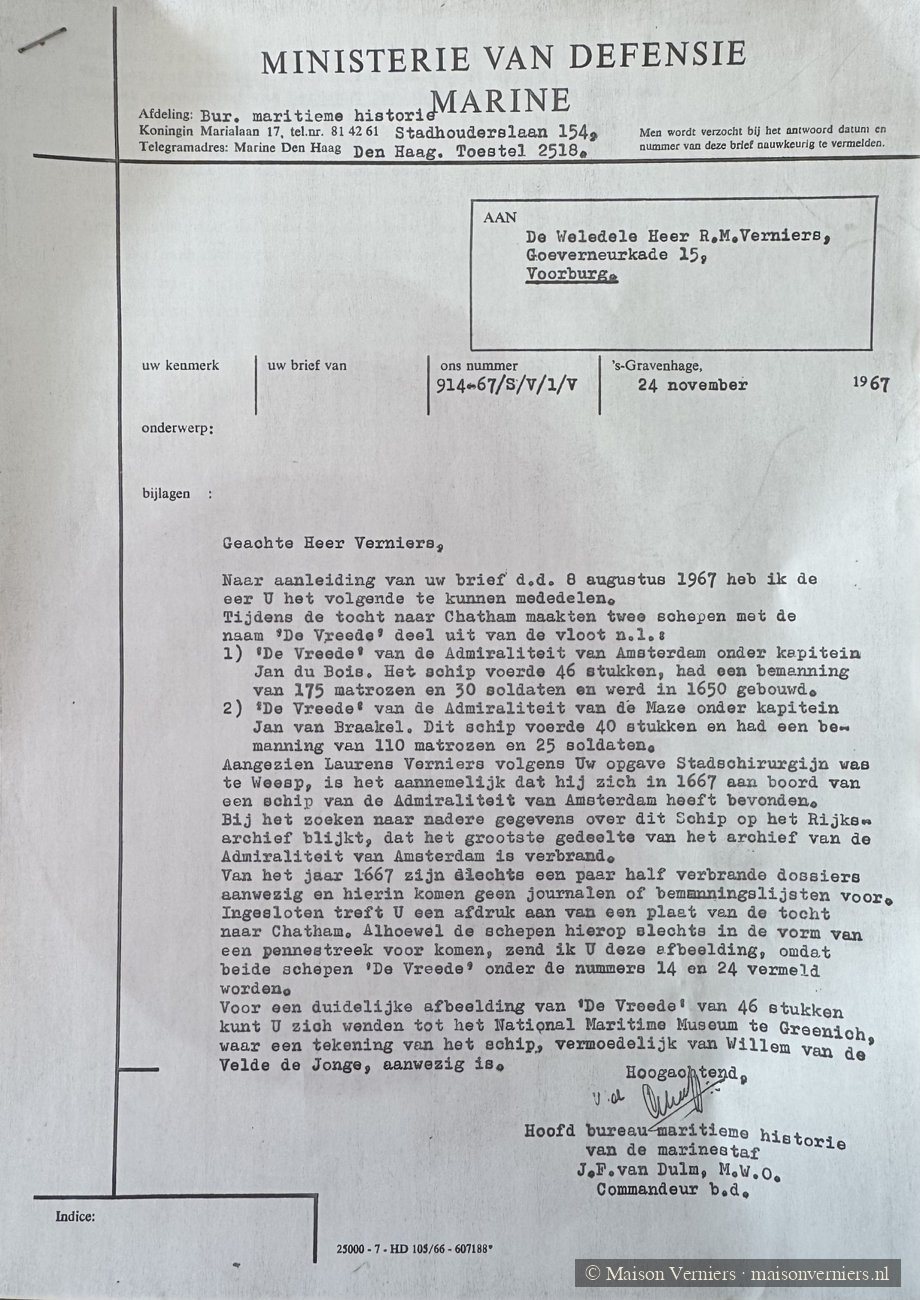
Op 24 november 1967 kreeg R.M. (Rudi) Verniers, toen wonend in Voorburg, antwoord van het Bureau Maritieme Historie van de Marinestaf in Den Haag. Hij had op 8 augustus van dat jaar een vraag gesteld over een voorvader: Laurens Verniers, stadschirurgijn van Weesp, en diens verband met de beroemde tocht naar Chatham in 1667. De datum van de brief is veelzeggend. Rudi was dus al in 1967 volop aan het verzamelen, vijftien jaar vóór zijn dood en zeventien jaar voordat zijn materiaal in mei 1984 tot het familiedossier werd geordend (zie het Dankwoord) (Bron 175).
Commandeur b.d. J.F. van Dulm, hoofd van het bureau, schreef dat er tijdens de tocht naar Chatham twee schepen met de naam De Vreede in de vloot meevoeren:
De Vreede van de Admiraliteit van Amsterdam, onder kapitein Jan du Bois: 46 stukken geschut, 175 matrozen en 30 soldaten, gebouwd in 1650;
De Vreede van de Admiraliteit van de Maze (Rotterdam), onder kapitein Jan van Braakel: 40 stukken, 110 matrozen en 25 soldaten.
Omdat Laurens stadschirurgijn van Weesp was, vond Van Dulm het aannemelijk dat het om het Amsterdamse schip ging. Verder zoeken bleek lastig: het grootste deel van het archief van de Admiraliteit van Amsterdam is verbrand. Van 1667 zijn slechts een paar half verbrande dossiers over, zonder scheepsjournalen of bemanningslijsten. Van Dulm stuurde wel een afdruk mee van een plaat van de tocht naar Chatham, waarop beide schepen De Vreede als kleine pennenstreekjes onder de nummers 14 en 24 staan. Voor een duidelijke afbeelding van het Amsterdamse schip verwees hij naar het National Maritime Museum in Greenwich, waar een tekening van het schip ligt, vermoedelijk van Willem van de Velde de Jonge.
De brief van de Marine aan R.M. Verniers, 24 november 1967 (familiearchief).
De akte van 29 mei 1668
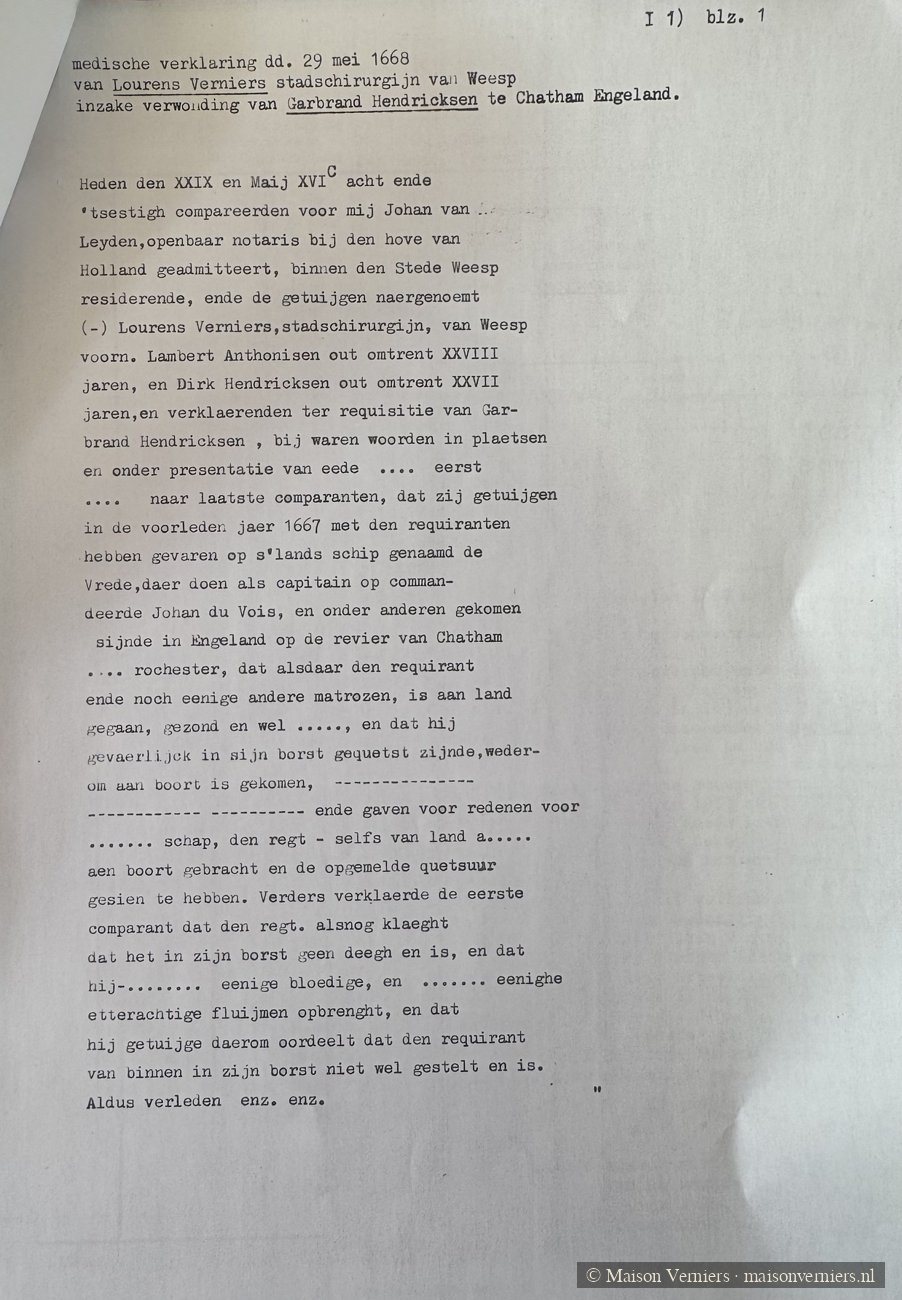
Het stuk waar het allemaal om draait, is een verklaring die op 29 mei 1668 in Weesp werd opgemaakt voor notaris Johan van Leyden. In het familiearchief zit een getypt afschrift ervan, met als kop: "medische verklaring dd. 29 mei 1668 van Lourens Verniers stadschirurgijn van Weesp inzake verwonding van Garbrand Hendricksen te Chatham Engeland". Hieronder staat het afschrift als afbeelding; de stippellijntjes geven plekken aan die de overschrijver niet kon lezen.
Weesp, notaris Johan van Leyden, 29 mei 1668. Getypt afschrift uit het familiearchief. Bron 176
Het getypte afschrift van de verklaring uit het familiearchief.
Het origineel teruggevonden
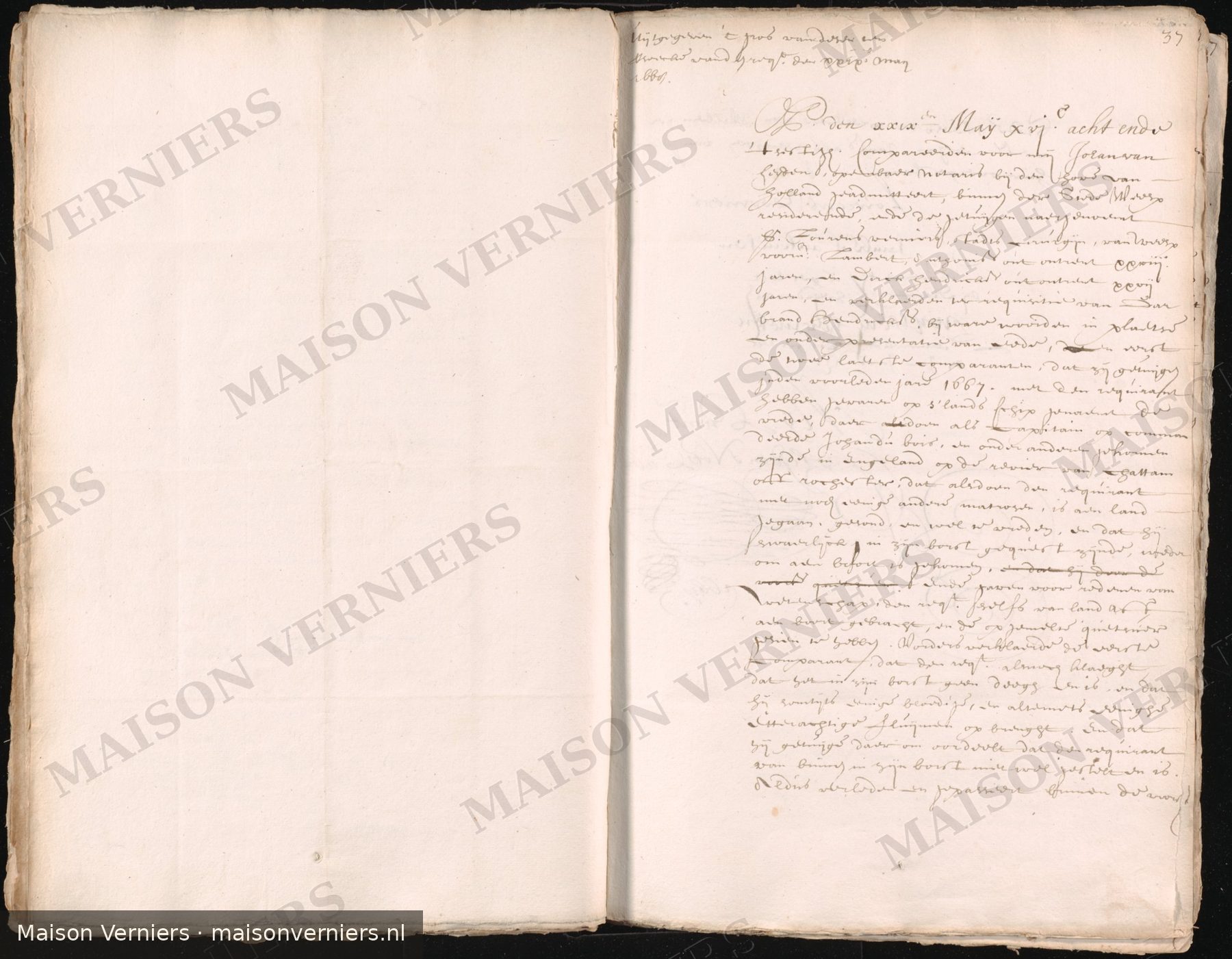
De originele akte is inmiddels teruggevonden in het archief Notarissen te Weesp (GAW138) bij het Stadsarchief Amsterdam, in het protocol van notaris Johan van Leyden, op folio 37 en 38 (Bron 265). Daarmee kunnen de open plekken in het getypte afschrift worden ingevuld.
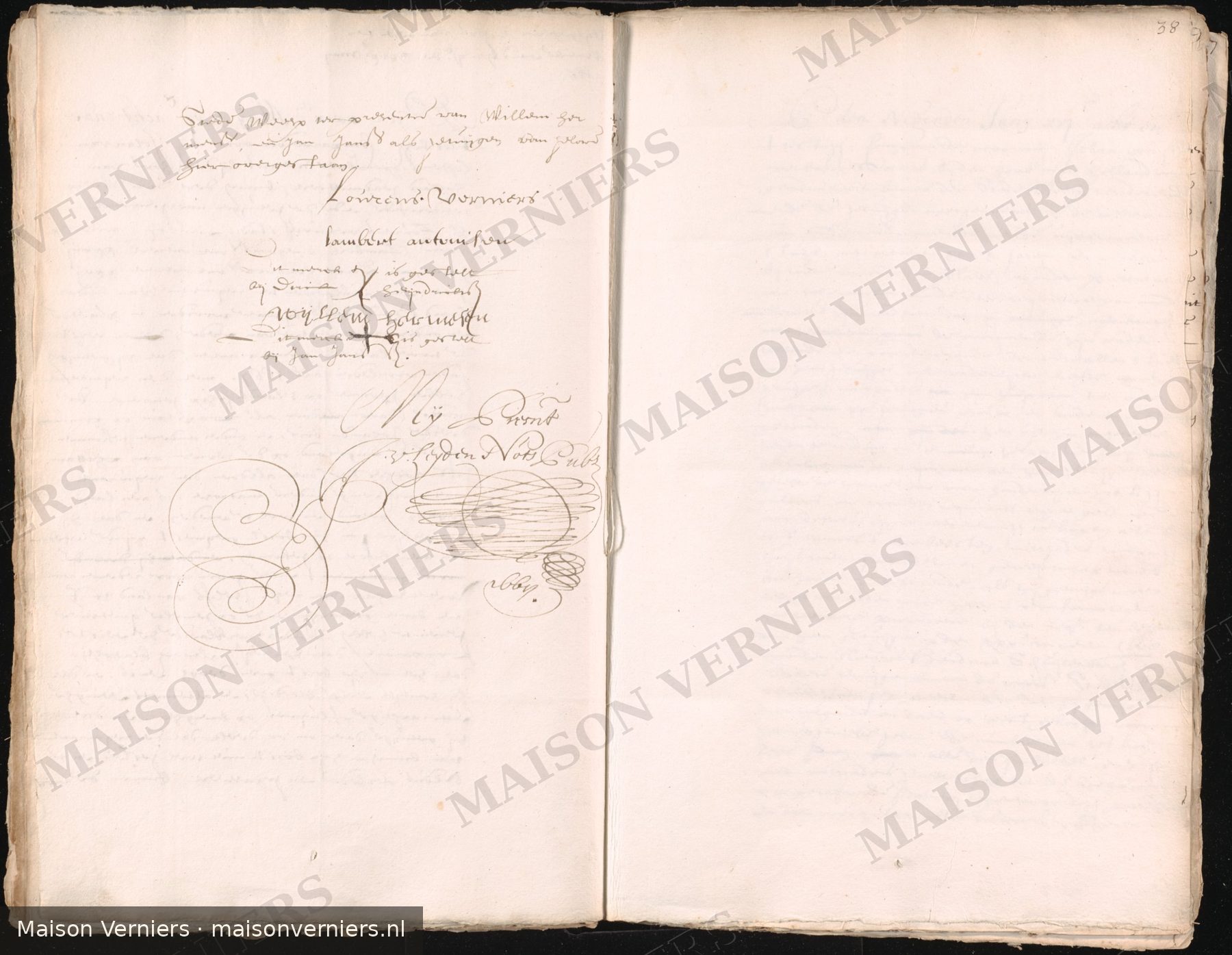
De originele akte van 29 mei 1668, fol. 37: de verklaring. Stadsarchief Amsterdam, Notarissen te Weesp (GAW138), protocol van notaris Johan van Leyden, scan 33 (Bron 265).Fol. 37v–38: het slot met de ondertekening. Bovenaan de eigen handtekening "Lourens Verniers", daaronder Lambert Antonisen, het merk van Dirck Heijndricksz, Willem Hermensen, het merk van Jan Jansz en de krullende handtekening van notaris J. van Leyden. Stadsarchief Amsterdam, GAW138, scan 34 (Bron 265).
Transcriptie van het origineel, in de spelling van de tijd. Doorgehaalde woorden staan doorgestreept; onzekere lezingen tussen vierkante haken. Bron 265
[In de marge: "Uytgegeven … den xxixe Maij 1668" — lezing onzeker]
Heden den xxixen Maij xvjc acht ende tsestigh compareerden voor mij Johan van Leyden, openbaer notaris bij den Hove van Holland geadmitteert, binnen der Stede Weesp residerende, ende de getuygen naergenoemt, [Mr?] Lourens Verniers, stadts chirurgijn van Weesp voorn., Lambert Anthonisz out ontrent xxviij jaren, en Dirck Hendricksz out ontrent xxvij jaren, en verklaerden ter requisitie van Garbrand Hendricksz, bij ware woorden in plaetse en onder presentatie van eede, eerst de twee laetste comparanten, dat zij getuygen inden voorleden jare 1667 met den requirant hebben gevaren op 's lands schip genaemt de Vrede, daer doen als capitain op commandeerde Johan du Bois, en onder anderen gekomen zijnde in Engeland op de revier van Chattam ofte Rochester, dat aldoen den requirant met noch eenige andere matrosen is aen land gegaen, gesond en wel te vreden, en dat hij swaerlijck in zijn borst gequetst zijnde, wederom aen boort is gekomen, ende dat hij door de voorss. quetsuere ende gaven voor redenen van wetenschap, den reqt. selfs van land af aen boort gebraght, en de opgemelde quetsuere gesien te hebben.
Voorders verklaerde de eerste comparant, dat den reqt. almede klaeght dat het in zijn borst geen deugh en is, en dat hij somtijds eenige bloedige, en altemets eenige etteraghtige fluijmen op brengt. En dat hij getuyge daerom oordeelt dat den requirant van binnen in zijn borst niet wel gestelt en is.
Aldus verleden en gepasseert binnen de voorss. Stede Weesp, ter presentie van Willem Hermensz ende Jan Jansz als getuygen hier over gestaen.
Lourens VerniersLambert Antonisen
Dit merck [X] is gestelt bij Dirck Heijndricksz
Willem Hermensen
Dit merck [+] is gestelt bij Jan Jansz
Mij present, J. v. Leyden, Nots Pubs, 1668
Wat het origineel toevoegt
De eigen handtekening van Lourens. Onder de akte staat in een vaste, verzorgde hand "Lourens Verniers". Het is de eerste handtekening van hem die op deze site te zien is.
Wie kon schrijven en wie niet. Lambert Anthonisz en de getuige Willem Hermensz ondertekenden zelf. Dirck Hendricksz en de getuige Jan Jansz zetten een merk, met de notitie "Dit merck is gestelt bij …". De afschrijver van het familiedossier had de twee aktegetuigen, Willem Hermensz en Jan Jansz, weggelaten.
De plek. Het origineel noemt "de revier van Chattam ofte Rochester": de Medway bij Chatham of Rochester.
De wond. Garbrand ging volgens de getuigen "gesond en wel te vreden" aan land en kwam "swaerlijck" (zwaar) gewond in de borst terug aan boord. Het afschrift las hier "gevaerlijck".
De klachten. Lourens verklaart dat Garbrand "somtijds" bloedige en "altemets" (nu en dan) etterachtige fluimen ophoest. Een jaar na de tocht was de wond dus nog niet genezen.
Een doorgehaalde zin. Na de beschrijving van de wond begon de notaris aan een zin over de gevolgen ("ende dat hij door de voorss. quetsuere …"), maar hij streepte die door. De verklaring blijft zo beperkt tot wat de getuigen zelf hadden gezien.
Een uitgifte. In de marge staat een aantekening met de datum 29 mei 1668, vermoedelijk dat Garbrand dezelfde dag een afschrift ("uytgegeven") meekreeg, dat hij kon gebruiken bij een aanvraag om vergoeding. De lezing van die aantekening is onzeker.
Het origineel bevestigt wat het afschrift al deed vermoeden: Lourens was niet zelf aan boord. Hij trad op als stadschirurgijn die de matroos een jaar later onderzocht.
Wat er precies gebeurt
In gewone taal: op 29 mei 1668 verschijnen drie mannen bij notaris Johan van Leyden in Weesp: de stadschirurgijn Lourens Verniers, Lambert Anthonisen (ongeveer 28 jaar) en Dirk Hendricksen (ongeveer 27 jaar). Ze leggen een verklaring onder ede af op verzoek van een matroos, Garbrand Hendricksen.
Eerst spreken de twee laatstgenoemden. Zij vertellen dat ze in 1667 samen met Garbrand op het oorlogsschip de Vrede hebben gevaren, onder kapitein Johan du Vois (Jan du Bois). In Engeland, op de rivier bij Chatham en Rochester, ging Garbrand met nog enkele andere matrozen gezond aan land. Hij kwam terug aan boord met een zware verwonding in zijn borst. De twee getuigen weten dat zo zeker omdat zij hem zelf van het land aan boord hebben gebracht en de wond met eigen ogen hebben gezien.
Daarna spreekt Lourens Verniers als chirurgijn. Hij verklaart dat Garbrand nog steeds klaagt dat het in zijn borst niet goed is, en dat hij bloedige en etterachtige fluimen ophoest. Lourens concludeert dat Garbrand "van binnen in zijn borst niet wel gestelt" is: er is inwendig iets blijvend mis.
Waarom liet Garbrand zo'n verklaring opmaken? Dat staat niet in het afschrift. Vermoedelijk wilde hij bij de Admiraliteit een vergoeding aanvragen voor zijn verwonding; matrozen die in dienst van het land gewond raakten, konden aanspraak maken op smartengeld, en daarvoor was bewijs nodig van getuigen en van een chirurgijn. Dit is een veronderstelling, geen vaststaand feit.
Een belangrijk detail: de akte zegt, ook in het origineel, niet dat Lourens zelf aan boord van de Vrede was. Volgens de tekst voeren de twee getuigen met Garbrand mee; Lourens onderzocht hem een jaar later als stadschirurgijn in Weesp. De brief van 1967 gaat ervan uit dat Lourens in 1667 aan boord van een Amsterdams schip was, maar dat volgt niet uit deze akte. Of Lourens zelf naar Chatham voer, is dus nog een open vraag.
Lourens is hoogstwaarschijnlijk Mr. Lourens Verniers, zoon van Pieter Laurens Verniers, die volgens het familiedossier lid van de vroedschap en stadschirurgijn van Weesp was en op 25 maart 1673 overleed (Bron 174). Een andere kandidaat ligt niet voor de hand: zijn vader Pieter, ook chirurgijn, was toen al overleden (tussen 1662 en 1665). Lourens moet nog jong zijn geweest, want zijn ouders trouwden pas tussen 1646 en 1650. Waarschijnlijk had hij de praktijk van zijn vader overgenomen.
De tocht naar Chatham, 1667
De tocht naar Chatham geldt als een van de grootste successen uit de Nederlandse zeegeschiedenis. Hij vond plaats aan het eind van de Tweede Engelse Oorlog (1665–1667), een handelsoorlog tussen de Republiek en Engeland om de macht op zee. In 1667 werd in Breda al over vrede onderhandeld, maar de Engelse koning Karel II rekte de besprekingen. Uit geldgebrek had hij zijn grote oorlogsschepen opgelegd op de Medway, de rivier die bij Chatham uitmondt in de Theems.
Raadpensionaris Johan de Witt zag zijn kans. Hij liet een vloot onder luitenant-admiraal Michiel de Ruyter uitvaren, met zijn broer Cornelis de Witt aan boord als vertegenwoordiger van de Staten-Generaal. Op 20 juni 1667 veroverden de Nederlanders het fort van Sheerness bij de monding van de Medway. Twee dagen later, op 22 juni, voer een eskader onder Willem Joseph van Ghent de rivier op. Bij Gillingham lag een zware ijzeren ketting over de rivier, als versperring. Kapitein Jan van Brakel, met De Vreede van de Admiraliteit van de Maze, ging voorop: hij veroverde het Engelse schip Unity, waarna het branderschip Pro Patria de ketting brak. Dat is dus het andere schip De Vreede uit de brief van 1967.
Daarna was de Engelse vloot weerloos. De Nederlanders staken onder meer de grote oorlogsschepen Royal James, Loyal London en Royal Oak in brand, en veroverden het Engelse vlaggenschip, de Royal Charles, dat als trofee naar Hellevoetsluis werd gesleept. Het sierlijke spiegelstuk van dat schip hangt nu in het Rijksmuseum. Op 24 juni trok de vloot zich terug. De schok in Engeland was groot, en op 31 juli 1667 werd de Vrede van Breda gesloten, op voorwaarden die gunstig waren voor de Republiek (Bron 177)(Bron 178).
De data zijn volgens de Nederlandse (gregoriaanse) kalender. Engelse bronnen gebruiken de oude juliaanse kalender en noemen daarom 9–14 juni 1667.
Jan van Leyden, De Hollanders steken Engelse schepen in brand tijdens de tocht naar Chatham, ca. 1667–1669. Rijksmuseum Amsterdam, SK-A-1386 (publiek domein, via Wikimedia Commons) (Bron 179). De schilder heet toevallig net als de notaris uit 1668; voor zover bekend is er geen verband.
De plaat die Van Dulm in 1967 meestuurde, was een donkere kopie van een oude prent met genummerde schepen. Zo'n overzichtsprent met nummers werd in 1667 door onder anderen Romeyn de Hooghe gemaakt; het Rijksmuseum bewaart verschillende prenten van de tocht, die online in hoge kwaliteit te bekijken zijn, zoals Cornelis de Witt leidt de aanval op de Engelse vloot en de prent van Romeyn de Hooghe(Bron 180). Of dit precies de prent met de nummers 14 en 24 is, kon ik nog niet vaststellen. De tekening van het Amsterdamse schip De Vreede in het National Maritime Museum in Greenwich heb ik online niet kunnen vinden.
Verder zoeken: wordt vervolgd
Ik heb geprobeerd deze geschiedenis verder uit te zoeken: wie Garbrand Hendricksen was, of hij een vergoeding kreeg, en of Lourens Verniers zelf aan boord was. Tot nu toe helaas zonder resultaat. Zoals de brief van 1967 al meldde, is het grootste deel van het archief van de Admiraliteit van Amsterdam verloren gegaan. Wordt vervolgd.
Waar ligt de originele akte?
Gevonden. De akte staat in het protocol van notaris Johan van Leyden in het archief Notarissen te Weesp (GAW138), folio 37–38, scans 33–34 (Bron 265). De zoektocht hieronder laat zien hoe lastig dat was.
De oude notariële archieven van Weesp vallen onder het archief "Notarissen te Weesp, 1609–1842" (toegang GAW138). Dat archief lag vroeger bij het Regionaal Historisch Centrum Vecht en Venen en is sinds eind 2022, na de samenvoeging van Weesp met Amsterdam, bij het Stadsarchief Amsterdam. Het is daar in de studiezaal in te zien, en je kunt er een (gratis) scan van aanvragen.
In de online index van de Weesper notariële akten (via Open Archieven) staat de akte van 29 mei 1668 niet. Voor 1668 zijn maar een twintigtal akten geïndexeerd, allemaal van notaris Johan van Es. Zijn protocol is wel bewaard, maar niet op naam geïndexeerd; de akte kwam pas boven water door de scans zelf door te nemen. Johan van Leyden komt in de index wel voor, onder meer als notaris in een akte van 27 januari 1673 (Bron 181).
Wel vond ik andere akten met Lourens Verniers erin, waaronder een akte van 12 september 1669 waarin hij "Mr. Lourens Verniers" heet, en zijn testament van 20 maart 1673 (notaris Johan van Es), vijf dagen vóór de sterfdatum die het familiedossier noemt. Daarin worden Cornelis, Claes en Pieter Verniers genoemd.
Note: this story is still being developed. It is based on a 1967 letter from the Dutch Navy in the family archive and on a notarial deed of 1668. The family archive only held a typed copy of that deed; the original has since been found as well.
A letter from 1967
On 24 November 1967 R.M. (Rudi) Verniers, then living in Voorburg, received a reply from the Maritime History Office of the Naval Staff in The Hague. On 8 August that year he had asked about an ancestor: Laurens Verniers, town surgeon of Weesp, and his connection with the famous Raid on Chatham in 1667. The date of the letter says a lot. Rudi was already collecting actively in 1967, fifteen years before his death and seventeen years before his material was put in order as the family dossier in May 1984 (see the Acknowledgements) (Source 175).
Retired Commander J.F. van Dulm, head of the office, wrote that two ships named De Vreede sailed with the fleet on the Raid on Chatham:
De Vreede of the Admiralty of Amsterdam, under Captain Jan du Bois: 46 guns, 175 sailors and 30 soldiers, built in 1650;
De Vreede of the Admiralty of the Maze (Rotterdam), under Captain Jan van Braakel: 40 guns, 110 sailors and 25 soldiers.
Because Laurens was town surgeon of Weesp, Van Dulm thought it likely that the Amsterdam ship was meant. Further research proved difficult: most of the archive of the Admiralty of Amsterdam has been destroyed by fire. Only a few half-burnt files survive from 1667, with no logbooks or crew lists. Van Dulm did enclose a copy of a print of the Raid on Chatham, on which both ships named De Vreede appear as small pen strokes under the numbers 14 and 24. For a clear image of the Amsterdam ship he referred to the National Maritime Museum in Greenwich, which holds a drawing of the ship, probably by Willem van de Velde the Younger.
The Navy's letter to R.M. Verniers, 24 November 1967 (family archive).
The deed of 29 May 1668
The key document is a declaration drawn up in Weesp on 29 May 1668 before the notary Johan van Leyden. The family archive holds a typed copy of it, headed: "medische verklaring dd. 29 mei 1668 van Lourens Verniers stadschirurgijn van Weesp inzake verwonding van Garbrand Hendricksen te Chatham Engeland" (medical declaration of 29 May 1668 by Lourens Verniers, town surgeon of Weesp, concerning the wounding of Garbrand Hendricksen at Chatham, England). The copy is shown below as an image; the dotted lines mark places the copyist could not read.
Weesp, notary Johan van Leyden, 29 May 1668. Typed copy from the family archive. Source 176
The typed copy of the declaration from the family archive.
The original found
The original deed has since been found in the archive Notarissen te Weesp (GAW138) at the Amsterdam City Archives, in the records of the notary Johan van Leyden, on folios 37 and 38 (Source 265). This allows the gaps in the typed copy to be filled in.
The original deed of 29 May 1668, fol. 37: the declaration. Amsterdam City Archives, Notarissen te Weesp (GAW138), records of the notary Johan van Leyden, scan 33 (Source 265).Fol. 37v–38: the end of the deed with the signatures. At the top Lourens's own signature "Lourens Verniers", below it Lambert Antonisen, the mark of Dirck Heijndricksz, Willem Hermensen, the mark of Jan Jansz and the flourished signature of the notary J. van Leyden. Amsterdam City Archives, GAW138, scan 34 (Source 265).
Transcription of the original, in the original Dutch spelling. Words struck through in the original are shown struck through; uncertain readings are in square brackets. Source 265
[In the margin: "Uytgegeven … den xxixe Maij 1668" — reading uncertain]
Heden den xxixen Maij xvjc acht ende tsestigh compareerden voor mij Johan van Leyden, openbaer notaris bij den Hove van Holland geadmitteert, binnen der Stede Weesp residerende, ende de getuygen naergenoemt, [Mr?] Lourens Verniers, stadts chirurgijn van Weesp voorn., Lambert Anthonisz out ontrent xxviij jaren, en Dirck Hendricksz out ontrent xxvij jaren, en verklaerden ter requisitie van Garbrand Hendricksz, bij ware woorden in plaetse en onder presentatie van eede, eerst de twee laetste comparanten, dat zij getuygen inden voorleden jare 1667 met den requirant hebben gevaren op 's lands schip genaemt de Vrede, daer doen als capitain op commandeerde Johan du Bois, en onder anderen gekomen zijnde in Engeland op de revier van Chattam ofte Rochester, dat aldoen den requirant met noch eenige andere matrosen is aen land gegaen, gesond en wel te vreden, en dat hij swaerlijck in zijn borst gequetst zijnde, wederom aen boort is gekomen, ende dat hij door de voorss. quetsuere ende gaven voor redenen van wetenschap, den reqt. selfs van land af aen boort gebraght, en de opgemelde quetsuere gesien te hebben.
Voorders verklaerde de eerste comparant, dat den reqt. almede klaeght dat het in zijn borst geen deugh en is, en dat hij somtijds eenige bloedige, en altemets eenige etteraghtige fluijmen op brengt. En dat hij getuyge daerom oordeelt dat den requirant van binnen in zijn borst niet wel gestelt en is.
Aldus verleden en gepasseert binnen de voorss. Stede Weesp, ter presentie van Willem Hermensz ende Jan Jansz als getuygen hier over gestaen.
Lourens VerniersLambert Antonisen
Dit merck [X] is gestelt bij Dirck Heijndricksz
Willem Hermensen
Dit merck [+] is gestelt bij Jan Jansz
Mij present, J. v. Leyden, Nots Pubs, 1668
What the original adds
Lourens's own signature. Below the deed, in a steady, careful hand, stands "Lourens Verniers". It is the first signature of his shown on this site.
Who could write and who could not. Lambert Anthonisz and the witness Willem Hermensz signed themselves. Dirck Hendricksz and the witness Jan Jansz made a mark, noted as "Dit merck is gestelt bij …" (this mark was made by …). The copyist of the family dossier had left out the two witnesses to the deed, Willem Hermensz and Jan Jansz.
The place. The original names "de revier van Chattam ofte Rochester": the Medway at Chatham or Rochester.
The wound. According to the witnesses, Garbrand went ashore "gesond en wel te vreden" (healthy and in good spirits) and came back on board "swaerlijck" (severely) wounded in the chest. The typed copy read "gevaerlijck" (dangerously) here.
The complaints. Lourens declares that Garbrand "somtijds" (sometimes) coughs up bloody and "altemets" (now and then) purulent phlegm. A year after the raid, the wound had still not healed.
A struck-out sentence. After describing the wound, the notary began a sentence about its consequences ("ende dat hij door de voorss. quetsuere …"), but struck it out. The declaration thus stays limited to what the witnesses had seen themselves.
A copy issued. A note in the margin carries the date 29 May 1668, probably recording that Garbrand received a copy ("uytgegeven") the same day, which he could use in a claim for compensation. The reading of that note is uncertain.
The original confirms what the typed copy already suggested: Lourens was not on board himself. He acted as town surgeon examining the sailor a year later.
What exactly happens
In plain terms: on 29 May 1668 three men appear before the notary Johan van Leyden in Weesp: the town surgeon Lourens Verniers, Lambert Anthonisen (about 28) and Dirk Hendricksen (about 27). They make a sworn statement at the request of a sailor, Garbrand Hendricksen.
The last two speak first. They say that in 1667 they sailed with Garbrand on the warship de Vrede, under Captain Johan du Vois (Jan du Bois). In England, on the river near Chatham and Rochester, Garbrand went ashore in good health with some other sailors. He came back on board with a severe wound in his chest. The two witnesses know this for certain because they brought him back on board from the shore themselves and saw the wound with their own eyes.
Then Lourens Verniers speaks as a surgeon. He declares that Garbrand still complains that something is wrong in his chest, and that he coughs up bloody and pus-like phlegm. Lourens concludes that Garbrand is "van binnen in zijn borst niet wel gestelt": something is permanently wrong inside his chest.
Why did Garbrand have this declaration drawn up? The copy does not say. He probably wanted to claim compensation from the Admiralty for his injury; sailors wounded in the service of the state could claim "smartgeld" (injury money), and for that they needed evidence from witnesses and a surgeon. This is an assumption, not an established fact.
An important detail: the deed, in the original too, does not say that Lourens himself was on board de Vrede. According to the text, the two witnesses sailed with Garbrand; Lourens examined him a year later as town surgeon in Weesp. The 1967 letter assumes that Lourens was on board an Amsterdam ship in 1667, but that does not follow from this deed. Whether Lourens himself sailed to Chatham therefore remains an open question.
Lourens is very probably Mr. Lourens Verniers, son of Pieter Laurens Verniers, who according to the family dossier was a member of the town council and town surgeon of Weesp and died on 25 March 1673 (Source 174). No other candidate is obvious: his father Pieter, also a surgeon, had already died (between 1662 and 1665). Lourens must still have been young, as his parents only married between 1646 and 1650. He had probably taken over his father's practice.
The Raid on Chatham, 1667
The Raid on Chatham (in English usually the Raid on the Medway) is regarded as one of the greatest successes in Dutch naval history. It took place at the end of the Second Anglo-Dutch War (1665–1667), a trade war between the Dutch Republic and England over power at sea. In 1667 peace talks were already under way in Breda, but the English king Charles II was dragging them out. For lack of money he had laid up his great warships on the Medway, the river that joins the Thames near Chatham.
Grand Pensionary Johan de Witt saw his chance. He sent out a fleet under Lieutenant-Admiral Michiel de Ruyter, with his brother Cornelis de Witt on board as representative of the States General. On 20 June 1667 the Dutch captured the fort at Sheerness at the mouth of the Medway. Two days later, on 22 June, a squadron under Willem Joseph van Ghent sailed up the river. At Gillingham a heavy iron chain had been stretched across the river as a barrier. Captain Jan van Brakel, with De Vreede of the Admiralty of the Maze, led the way: he captured the English ship Unity, after which the fireship Pro Patria broke the chain. That is the other De Vreede mentioned in the 1967 letter.
After that the English fleet was defenceless. The Dutch set fire to the great warships Royal James, Loyal London and Royal Oak, among others, and captured the English flagship, the Royal Charles, which was towed to Hellevoetsluis as a trophy. Its ornate stern now hangs in the Rijksmuseum. On 24 June the fleet withdrew. The shock in England was enormous, and on 31 July 1667 the Peace of Breda was signed, on terms favourable to the Republic (Source 177)(Source 178).
Dates follow the Dutch (Gregorian) calendar. English sources use the old Julian calendar and therefore give 9–14 June 1667.
Jan van Leyden, The Dutch Burning English Ships during the Raid on the Medway, c. 1667–1669. Rijksmuseum Amsterdam, SK-A-1386 (public domain, via Wikimedia Commons) (Source 179). The painter happens to share his name with the notary of 1668; as far as is known, they are not connected.
The plate Van Dulm enclosed in 1967 was a dark copy of an old print with numbered ships. Overview prints of this kind were made in 1667 by, among others, Romeyn de Hooghe; the Rijksmuseum holds several prints of the raid that can be viewed online in high quality, such as Cornelis de Witt leading the attack on the English fleet and the print by Romeyn de Hooghe(Source 180). Whether this is exactly the print with the numbers 14 and 24 I have not yet been able to establish. I could not find the drawing of the Amsterdam ship De Vreede in the National Maritime Museum, Greenwich, online.
Further research: to be continued
I have tried to research this story further: who Garbrand Hendricksen was, whether he received compensation, and whether Lourens Verniers himself was on board. So far, unfortunately, without result. As the 1967 letter already noted, most of the archive of the Admiralty of Amsterdam has been lost. To be continued.
Where is the original deed?
Found. The deed is in the records of the notary Johan van Leyden in the archive Notarissen te Weesp (GAW138), folios 37–38, scans 33–34 (Source 265). The search below shows how difficult that was.
The old notarial records of Weesp form the archive "Notarissen te Weesp, 1609–1842" (access number GAW138). It used to be kept by the Regional Historical Centre Vecht en Venen and, since late 2022, after Weesp merged with Amsterdam, it has been held by the Amsterdam City Archives. It can be consulted in the reading room there, and you can request a (free) scan.
The deed of 29 May 1668 is not in the online index of Weesp notarial deeds (via Open Archieven). Only about twenty deeds from 1668 are indexed, all by the notary Johan van Es. His records have survived but are not indexed by name; the deed only surfaced by going through the scans themselves. Johan van Leyden does appear in the index, for instance as notary in a deed of 27 January 1673 (Source 181).
I did find other deeds mentioning Lourens Verniers, including a deed of 12 September 1669 in which he is called "Mr. Lourens Verniers", and his will of 20 March 1673 (notary Johan van Es), five days before the date of death given in the family dossier. It names Cornelis, Claes and Pieter Verniers.