Verhaal #27 · Verborgen VerhaalStory #27 · Hidden Story
Bier, mout en brandewijn: de brouwers van Weesp (1661–1680)Beer, malt and brandy: the brewers of Weesp (1661–1680)
De Cuyps, de Dells, de Schoutens en Snouck in de akten van notaris Johan van LeydenThe Cuyps, the Dells, the Schoutens and Snouck in the deeds of the notary Johan van Leyden
In de akten van notaris Johan van Leyden, van 1661 tot 1680, komen de brouwers van Weesp telkens terug: als burgemeesters en schepenen, als erfgenamen en voogden, als handelaars. De Verniersen stonden dicht bij hen. Marritje Dircks, de weduwe van Mr. Pieter Lourens Verniers, koos in 1672 als voogden over haar zonen Coenraet Mersenier, die een mouterij had, en Bruyningh van Marken, die twee jaar later een brouwerij kocht (zie verhaal #26). Mr. Cornelis Verniers trouwde met Grietje Pieters de Gooijer, uit een brouwersfamilie (zie verhaal #17).
Dit verhaal brengt bijeen wat de akten over de brouwers zeggen. Het is een begin: familie die later wordt gevonden, kan worden toegevoegd.
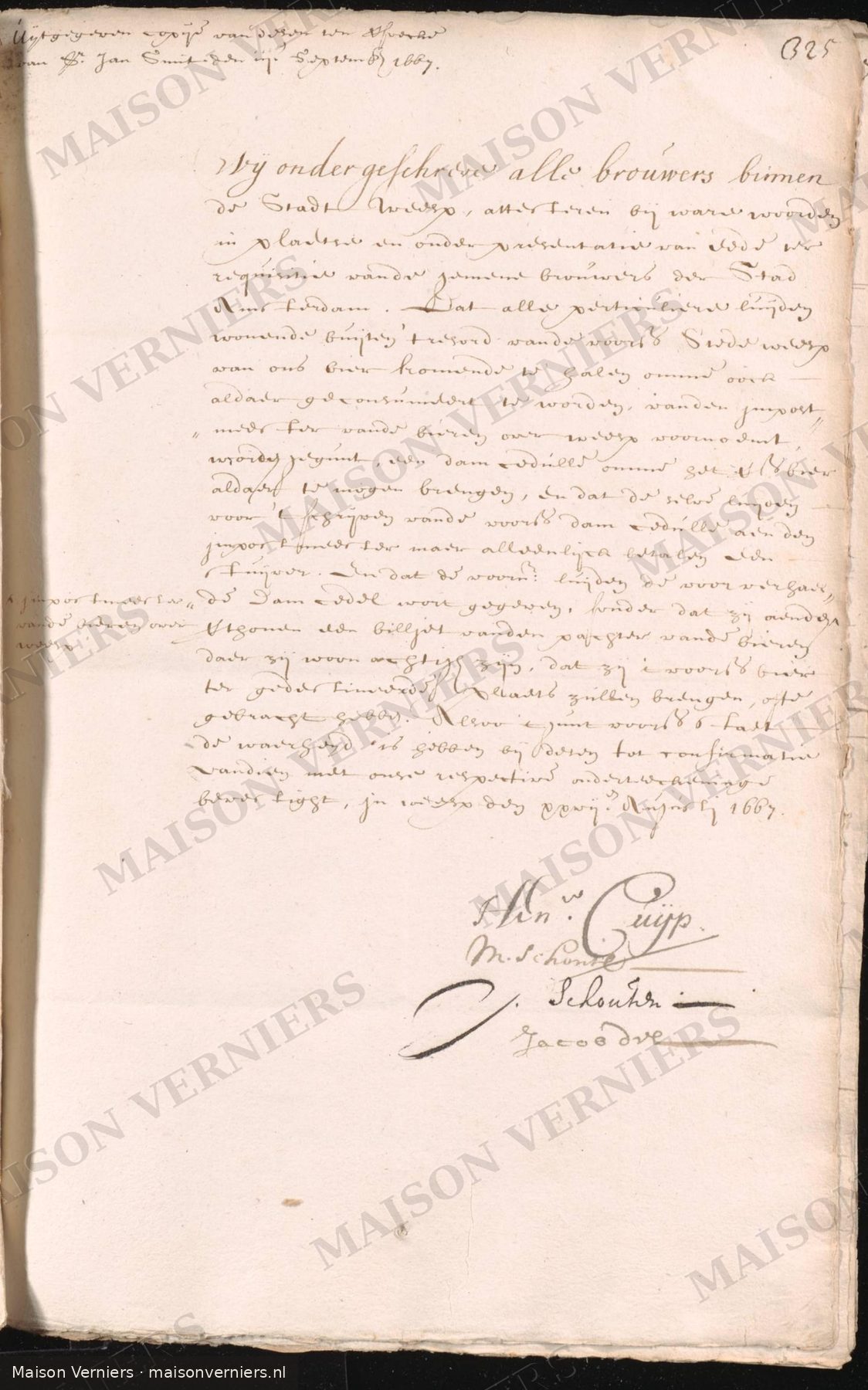
"Alle brouwers binnen der stadt Weesp", 1667
Op 27 augustus 1667 legden "wij ondergeschreven alle brouwers binnen der stadt Weesp" samen een verklaring af, op verzoek van de brouwers van Amsterdam, over bier dat buiten de stad werd gehaald en de belasting daarop. Vier namen staan eronder: Henricus Cuyp, Mathijs Schouten, Jacob Schouten en Jacob Dell (Bron 292). Daarmee hebben we voor 1667 een lijst van de brouwers, uit hun eigen hand.
In the deeds of the notary Johan van Leyden, from 1661 to 1680, the brewers of Weesp keep appearing: as burgomasters and aldermen, as heirs and guardians, as traders. The Verniers were close to them. Marritje Dircks, widow of Mr. Pieter Lourens Verniers, chose as guardians of her sons in 1672 Coenraet Mersenier, who had a malt-house, and Bruyningh van Marken, who bought a brewery two years later (see story #26). Mr. Cornelis Verniers married Grietje Pieters de Gooijer, from a brewing family (see story #17).
This story brings together what the deeds say about the brewers. It is a beginning: family members found later can be added.
"All the brewers within the town of Weesp", 1667
On 27 August 1667 "wij ondergeschreven alle brouwers binnen der stadt Weesp" (we, the undersigned, all the brewers within the town of Weesp) made a joint declaration, at the request of the brewers of Amsterdam, about beer fetched from outside the town and the excise on it. Four names stand beneath it: Henricus Cuyp, Mathijs Schouten, Jacob Schouten and Jacob Dell (Source 292). So for 1667 we have a list of the brewers in their own hand.
De verklaring van "alle brouwers binnen der stadt Weesp", 27 augustus 1667, met de handtekeningen van Henr. Cuyp, M. Schouten, J. Schouten en Jacob Dell. Inv. 5201, fol. 325 (Bron 292).The declaration of "all the brewers within the town of Weesp", 27 August 1667, signed by Henr. Cuyp, M. Schouten, J. Schouten and Jacob Dell. Inv. 5201, fol. 325 (Source 292).
De Boog: van de Cuyps naar Bruyningh van Marken
In november 1663 machtigden Gerbrandus, Wilhelmus, Hendrick en Christina Cuyp, de erfgenamen van Dirck Jansz Cuyp, hun zwager Gerard den Otter voor de nalatenschap in Amsterdam (Bron 288). In juli 1665 heet Henricus Cuyp "brouwer in de brouwerij van de Boog"; op zijn verzoek verklaarden getuigen over bier voor hooiers en de belasting daarop (Bron 312). In november van dat jaar werd de nalatenschap verdeeld, met de brouwerij De Boog (Bron 291).
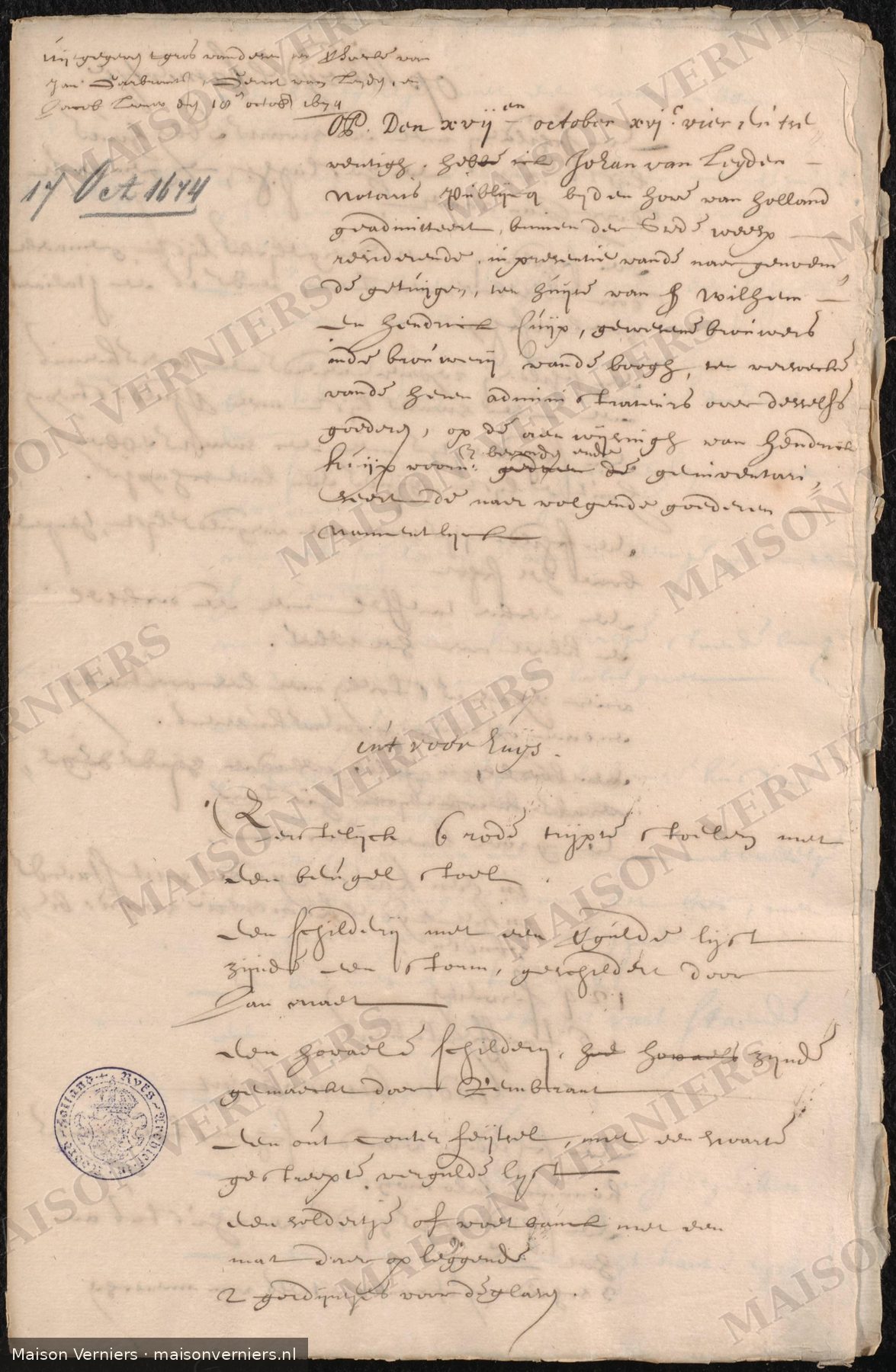
Op 17 oktober 1674 maakte de notaris een inventaris ten huize van "Wilhelm en Hendrick Kuyp, gewezen brouwers in de brouwerij van de Boogh", kamer voor kamer: het voorhuis, het zijkamertje, de keuken, de spijskamer, het pakhuis en de vliering. Aan de muren hingen een zeeslag en "een Italiaens zeelantschap", beide "gemaeckt door" dezelfde meester (de naam is niet zeker te lezen), een boerenkermis, een landschapje, "koninck Salomon" boven de schoorsteen, een Christus aan het kruis, "een alchimist", een stilleven met visjes, "een ontbyt" en drie portretten; verder tin, koper en 124 servetten (Bron 306).
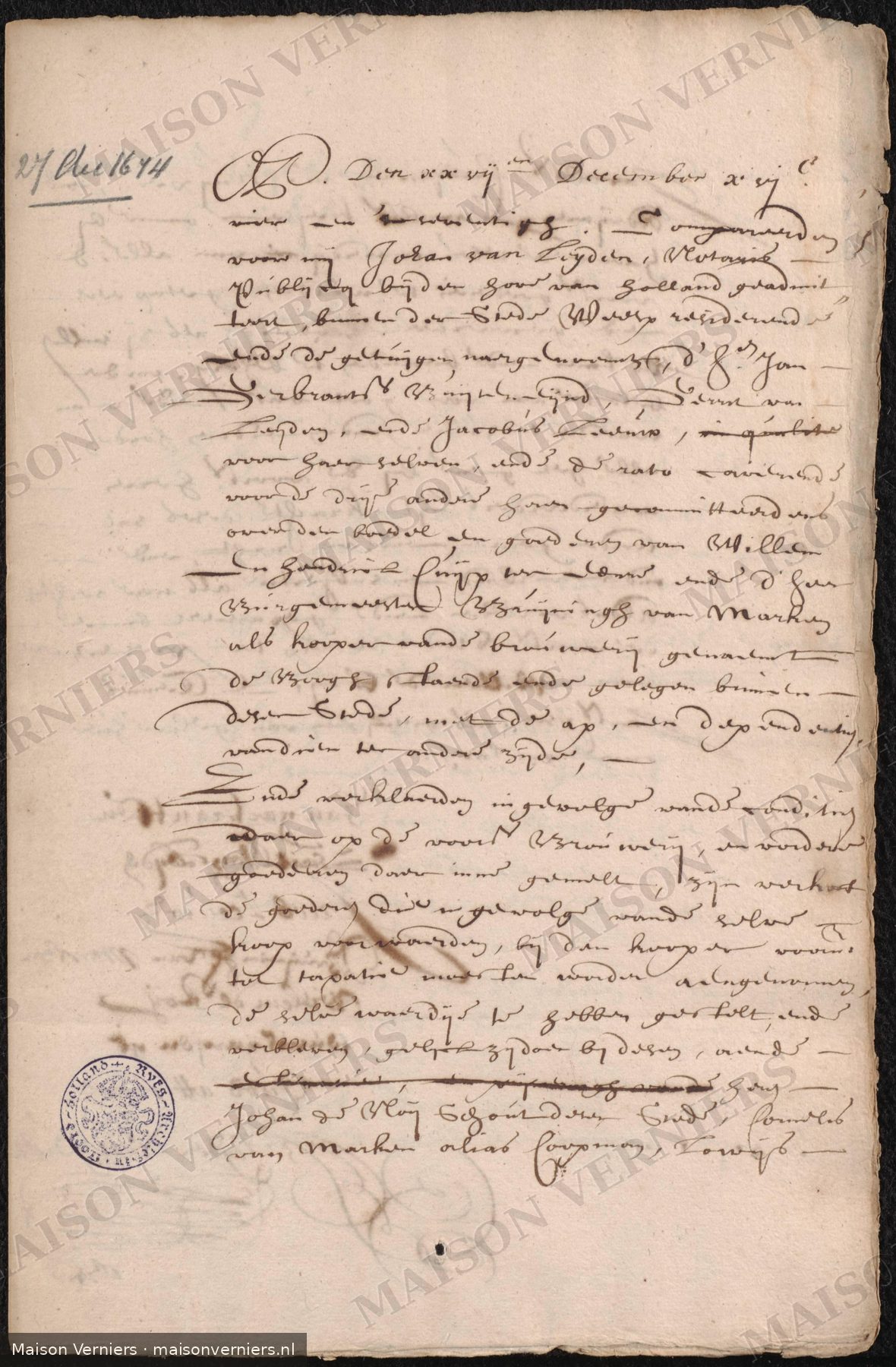
Op 27 december 1674 werd het brouwgerei getaxeerd tussen de gecommitteerden over de boedel van Willem en Hendrick Kuyp en "d'Heer burgemeester Bruyningh van Marken, als koper van de brouwerij genaamt de Boogh". Een waterschuit werd op 200 gulden gezet, een bierschuit op 40 gulden; de tonnen werden per last geteld (Bron 307). Zo kwam De Boog in handen van de man die twee jaar eerder voogd over de zonen van Marritje Dircks was geworden. Hij handelde ook in ossen: op 1 januari 1674 sloot hij met zijn broer Cornelis van Marken en Thomas Pietersz Bas… een compagnie in magere ossen, en Thomas zou daarvoor naar Denemarken reizen (Bron 308).
De Boog: from the Cuyps to Bruyningh van Marken
In November 1663 Gerbrandus, Wilhelmus, Hendrick and Christina Cuyp, heirs of Dirck Jansz Cuyp, authorised their brother-in-law Gerard den Otter for the estate in Amsterdam (Source 288). In July 1665 Henricus Cuyp is called "brewer in the brewery De Boog"; at his request witnesses testified about beer for haymakers and the excise on it (Source 312). In November of that year the estate was divided, including the brewery De Boog (Source 291).
On 17 October 1674 the notary drew up an inventory at the house of "Wilhelm and Hendrick Kuyp, former brewers in the brewery De Boogh", room by room: the front room, the side room, the kitchen, the pantry, the warehouse and the attic. On the walls hung a sea battle and "an Italian seascape", both "made by" the same master (the name cannot be read with certainty), a peasant fair, a small landscape, "King Solomon" above the chimney piece, a Christ on the cross, "an alchemist", a still life with small fish, "a breakfast piece" and three portraits; also pewter, copper and 124 napkins (Source 306).
On 27 December 1674 the brewing equipment was valued between the commissioners for the estate of Willem and Hendrick Kuyp and "the burgomaster Bruyningh van Marken, as buyer of the brewery called De Boogh". A water barge was put at 200 guilders, a beer barge at 40; the casks were counted by the last (Source 307). So De Boog came into the hands of the man who two years earlier had become guardian of Marritje Dircks's sons. He also traded in oxen: on 1 January 1674 he formed a company in lean oxen with his brother Cornelis van Marken and Thomas Pietersz Bas…, and Thomas was to travel to Denmark for them (Source 308).
Het begin van de inventaris van 17 oktober 1674 ten huize van Wilhelm en Hendrick Kuyp, met de eerste kamer, "int voorhuys". Inv. 5204 (Bron 306).The opening of the inventory of 17 October 1674 at the house of Wilhelm and Hendrick Kuyp, with the first room, "int voorhuys" (the front room). Inv. 5204 (Source 306).De akte van 27 december 1674 met "Bruyningh van Marken als koper van de brouwerij genaamt de Boogh". Inv. 5204 (Bron 307).The deed of 27 December 1674 naming "Bruyningh van Marken as buyer of the brewery called De Boogh". Inv. 5204 (Source 307).
De W. en Kroon en de Dells
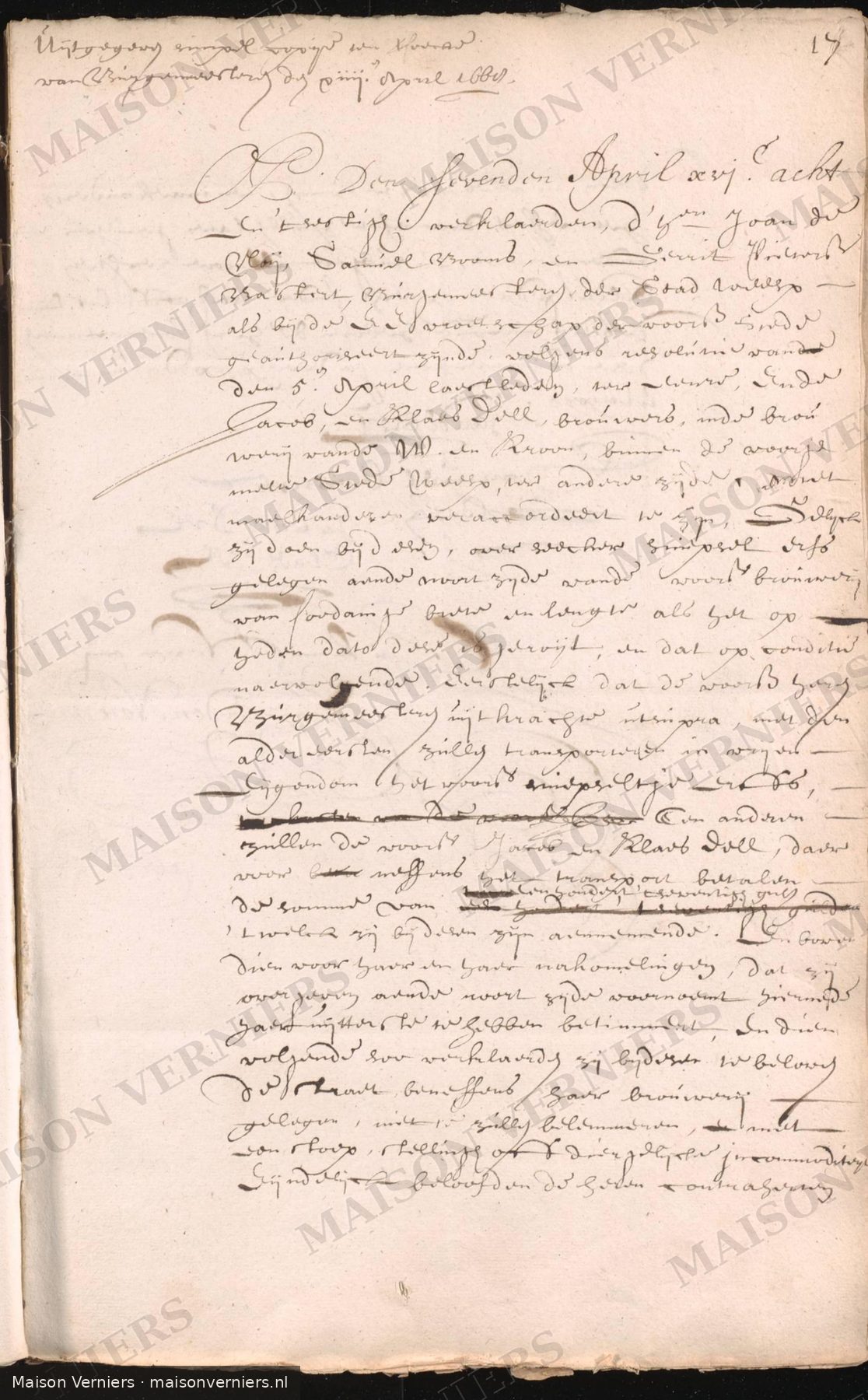
Op 18 mei 1664 kregen Jacob Dell en Elisabeth Schouten bij hun huwelijksvoorwaarden een brouwerij bij de Muiderpoort; Jacob werd daarbij bijgestaan door zijn zwager Joannes Snouck (Bron 266). Op 7 april 1668 sloten de burgemeesters een akkoord met "Jacob en Klaas Dell, brouwers in de brouwerij van de W. en Kroon", over een stuk grond aan de noordzijde van de brouwerij; de Dells beloofden de straat te bestraten (Bron 296). Of de W. en Kroon de brouwerij bij de Muiderpoort is, zeggen de akten niet met zoveel woorden.
In 1672 trad Juffr. Margareta Dell tweemaal op als "brouwster binnen deze stede": een vrouw aan het hoofd van een brouwerij. In januari 1673 heet Nicolaas Dell "brouwer binnen deze stede" (Bron 302). Joannes Snouck was in december 1667 zelf "brouwer binnen Weesp" (Bron 294).
De W. en Kroon and the Dells
On 18 May 1664 Jacob Dell and Elisabeth Schouten received a brewery at the Muiderpoort in their marriage settlement; Jacob was assisted by his brother-in-law Joannes Snouck (Source 266). On 7 April 1668 the burgomasters made an agreement with "Jacob and Klaas Dell, brewers in the brewery De W. en Kroon", about a piece of ground on the north side of the brewery; the Dells promised to pave the street (Source 296). Whether De W. en Kroon is the brewery at the Muiderpoort, the deeds do not say in so many words.
In 1672 Juffr. Margareta Dell twice acted as "brouwster binnen deze stede" (brewster within this town): a woman at the head of a brewery. In January 1673 Nicolaas Dell is called "brewer within this town" (Source 302). Joannes Snouck was himself "brewer within Weesp" in December 1667 (Source 294).
Het akkoord van 7 april 1668 tussen de burgemeesters en "Jacob en Klaas Dell, brouwers in de brouwerij van de W. en Kroon". Inv. 5202, fol. 17 (Bron 296).The agreement of 7 April 1668 between the burgomasters and "Jacob and Klaas Dell, brewers in the brewery De W. en Kroon". Inv. 5202, fol. 17 (Source 296).
De W. en Star en de Schoutens
De Schoutens brouwden in "de W. en Star". Bij de huwelijksvoorwaarden van Lambert Schouten en Catharina Dell in 1669 kreeg het paar een derde part van de brouwerij (Bron 279); bij die van Gerard Schouten en Christina Oliviers in 1672 werd vastgelegd dat Christina de brouwerij met de mouterij samen met Mathijs Schouten mocht houden als Gerard kinderloos stierf (Bron 285). Achter de Middelstraat lag de mouterij van Coenraet Mersenier, tegen de muur waarvan Christina een duivenhok en een washuisje had (Bron 286).
In maart 1668 lieten oud-burgemeester Jacob Schouten en zijn broer Lambert vastleggen dat een lading kolen onbruikbaar was voor de brouwerij; met "vette kolen" kostte elk brouwsel bier vijftig manden turf extra (Bron 297). Moeder Barbara Leeuw, de weduwe van burgemeester Cornelis Schouten, overleed in het najaar van 1671 (Bron 310).
De W. en Star and the Schoutens
The Schoutens brewed in "De W. en Star". In the marriage settlement of Lambert Schouten and Catharina Dell in 1669 the couple received a third share of the brewery (Source 279); in that of Gerard Schouten and Christina Oliviers in 1672 it was laid down that Christina might keep the brewery and the malt-house together with Mathijs Schouten if Gerard died childless (Source 285). Behind the Middelstraat lay the malt-house of Coenraet Mersenier, against whose wall Christina had a dovecote and a wash-house (Source 286).
In March 1668 former burgomaster Jacob Schouten and his brother Lambert had it recorded that a load of coal was useless for the brewery; with "fat coal" each brew cost fifty baskets of peat extra (Source 297). Their mother Barbara Leeuw, widow of burgomaster Cornelis Schouten, died in the autumn of 1671 (Source 310).
Kuipers tegen brouwers, 1664
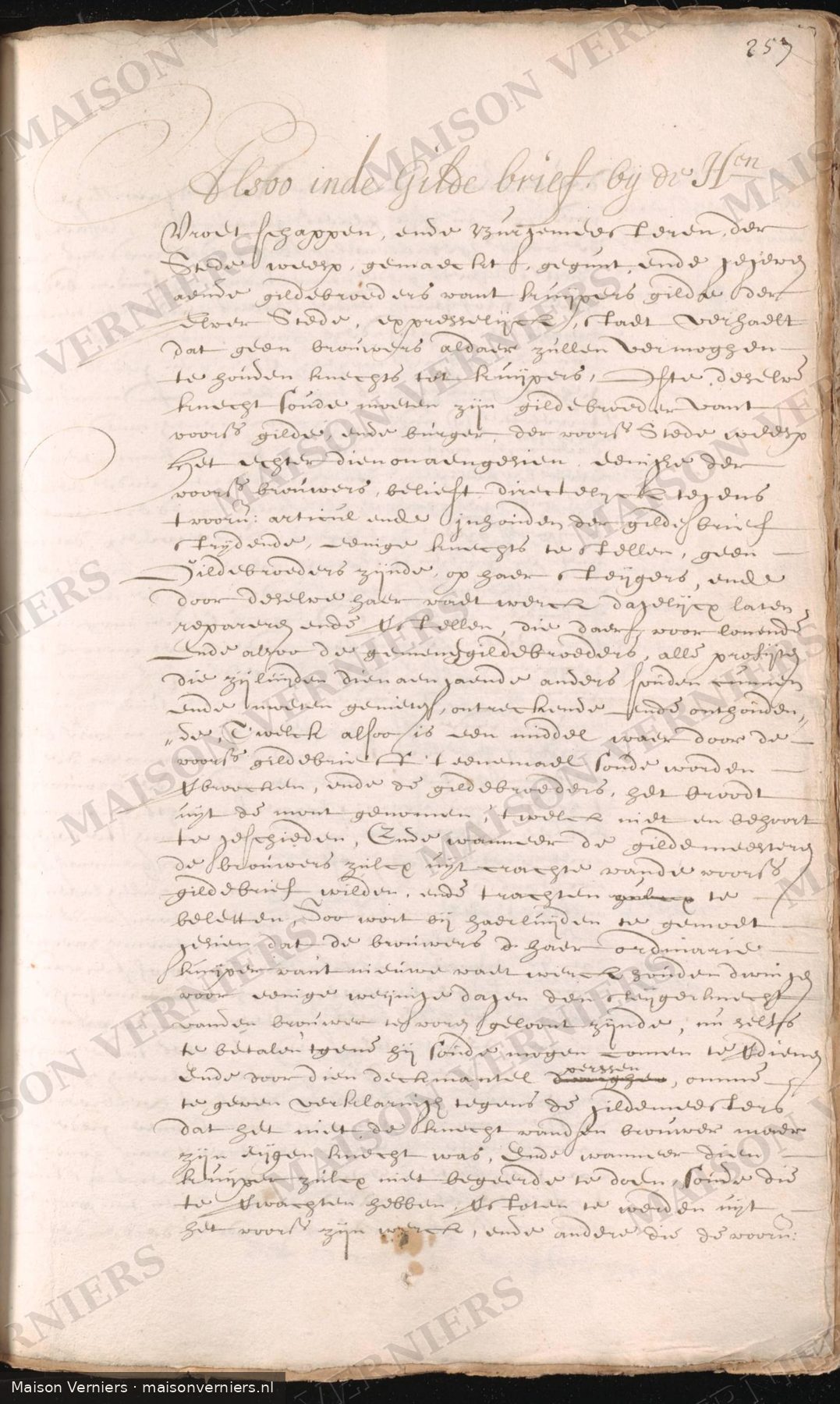
In januari 1664 verklaarden de gildebroeders van het kuipersgilde van Weesp samen dat hun gildebrief verbood dat brouwers eigen knechten als kuiper lieten werken als die geen lid van het gilde waren. Ze beloofden geen verklaringen meer af te leggen ten gunste van de brouwers, op straffe van honderd gulden boete. Ruim twintig kuipers ondertekenden, een deel met een merk (Bron 287).
Coopers against brewers, 1664
In January 1664 the members of the coopers' guild of Weesp declared jointly that their guild charter forbade brewers to have their own servants work as coopers if these were not members of the guild. They promised not to make any more declarations in the brewers' favour, on pain of a fine of a hundred guilders. Over twenty coopers signed, some with a mark (Source 287).
Het begin van de verklaring van de gildebroeders van het kuipersgilde, januari 1664. Inv. 5200, fol. 257 (Bron 287).The opening of the declaration by the members of the coopers' guild, January 1664. Inv. 5200, fol. 257 (Source 287).
Brouwers als handelaars: Deense ossen
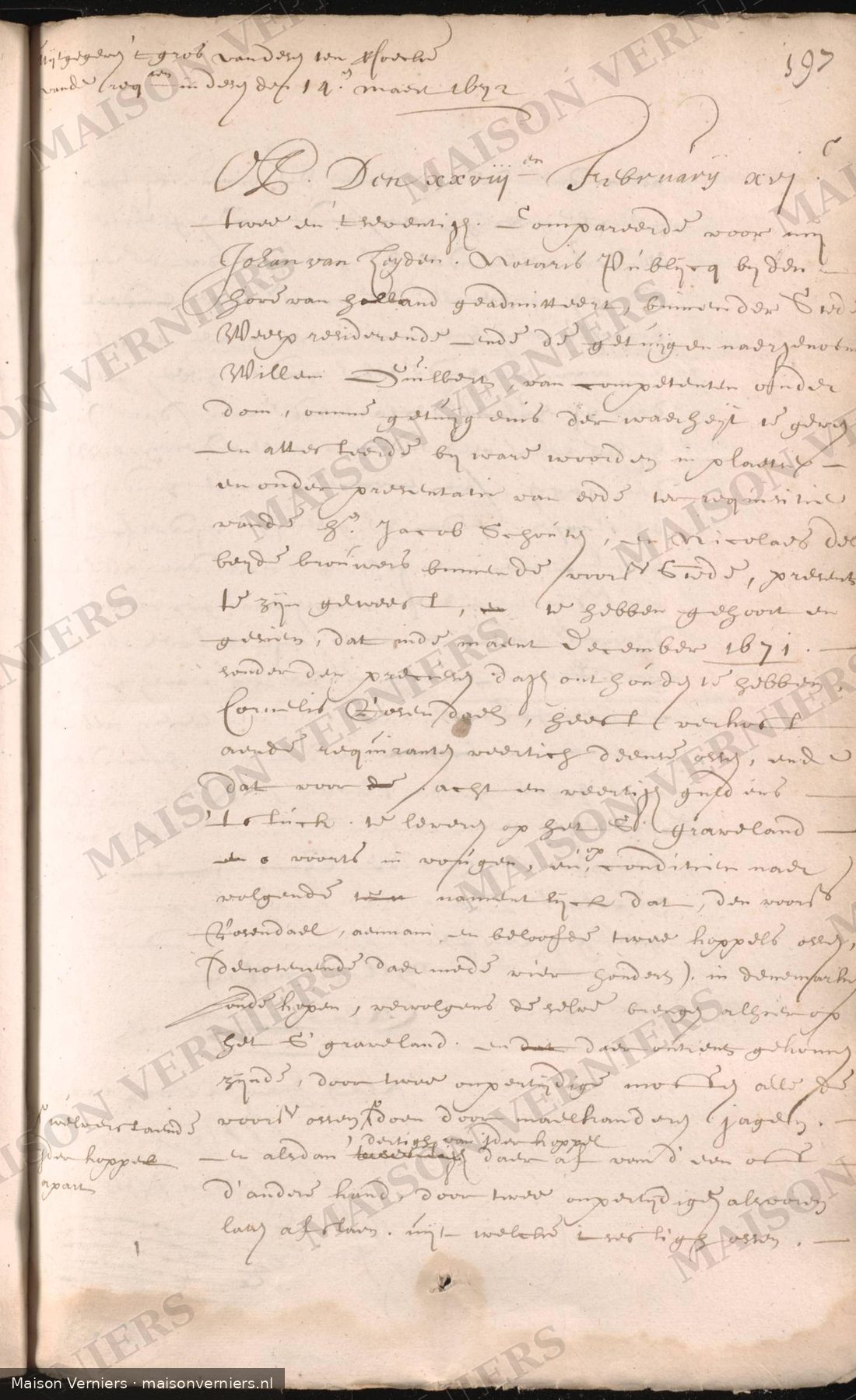
Brouwers verdienden niet alleen aan bier. In december 1671 kochten "Jacob Schouten en Nicolaas Dell, beide brouwers binnen deze stede", veertig Deense ossen van 48 gulden per stuk, te leveren op 's-Graveland (Bron 301). Ook Bruyningh van Marken handelde, zoals hierboven, in ossen uit Denemarken (Bron 308).
Brewers as traders: Danish oxen
Brewers did not earn from beer alone. In December 1671 "Jacob Schouten and Nicolaas Dell, both brewers within this town", bought forty Danish oxen at 48 guilders each, to be delivered at 's-Graveland (Source 301). Bruyningh van Marken, as above, also traded in oxen from Denmark (Source 308).
De verklaring van 27 februari 1672 ter requisitie van "Jacob Schouten en Nicolaas Dell, beide brouwers binnen deze stede", over veertig Deense ossen. Inv. 5203, fol. 197 (Bron 301).The declaration of 27 February 1672 at the request of "Jacob Schouten and Nicolaas Dell, both brewers within this town", about forty Danish oxen. Inv. 5203, fol. 197 (Source 301).
Brandewijn
Naast de brouwers waren er stokers. In juni 1664 komt Andries Teunisz voor als brandewijnbrander te Weesp (Bron 313). In november en december 1671 volgde een reeks protesten over de koop van brandewijn, tientallen aam van rond de 25 gulden per aam, gericht aan onder anderen burgemeester Hendrick van der Poort; in mei 1672 heet Dirck Pietersz Houtman "brandewijnbrander binnen deze stede" (Bron 303). Over de opkomst van de branderijen, de varkens en de VOC: zie verhaal #28.
Een halve eeuw later zat de branderij er nog stevig in. Op 24 augustus 1720 maakte Willem van Bruggen, raad en oud-burgemeester van Weesp en weduwnaar van Anna van Ooyen, zijn testament bij notaris Cornelis Hoet (Bron 331). Zijn zoon Jan werd universeel erfgenaam en kreeg het woonhuis in de Nieuwstraat "met de branderye daar agter staande", met het gereedschap en de granen en wijnen, de tuin buiten de Utrechtse poort en de aandelen in de molen De Haan. Zoon Pieter had al f 3.057 gekregen "tot beginnen en opregtinge van zyn negotie in wynen". De hele boedel werd op zo'n f 20.920 geschat. In een peiling van het meel en graan op de Weesper molens uit dezelfde zomer staat Van Bruggen met rogge en mout op de molens Kostverloren en De Haan (Bron 335). Over die peiling en de molens van Weesp: verhaal #31.
Waar stonden de brouwerijen?
De akten zeggen weinig over plaatsen. Er was een brouwerij bij de Muiderpoort (1664), de W. en Kroon had aan de noordzijde een stuk grond aan de straat (1668), en de mouterij van Coenraet Mersenier lag achter bij de Middelstraat (1672). Precieze adressen zijn hier niet gegeven; daarvoor zijn andere bronnen nodig, zoals de kohieren van de verponding of een oude plattegrond van Weesp.
Wordt vervolgd
Familie van de brouwers, en akten van andere notarissen in Weesp, worden hier toegevoegd zodra ze gevonden zijn.
Brandy
Besides the brewers there were distillers. In June 1664 Andries Teunisz appears as a brandy distiller in Weesp (Source 313). In November and December 1671 a series of protests followed about the purchase of brandy, tens of aam at around 25 guilders each, addressed among others to burgomaster Hendrick van der Poort; in May 1672 Dirck Pietersz Houtman is called "brandy distiller within this town" (Source 303). On the rise of the distilleries, the pigs and the VOC: see story #28.
Half a century later distilling was still going strong. On 24 August 1720 Willem van Bruggen, councillor and former burgomaster of Weesp and widower of Anna van Ooyen, made his will before the notary Cornelis Hoet (Source 331). His son Jan became universal heir and received the house in the Nieuwstraat "met de branderye daar agter staande" (with the distillery behind it), with the equipment, grain and wine, the garden outside the Utrecht gate and the shares in the mill De Haan. His son Pieter had already received f 3,057 "tot beginnen en opregtinge van zyn negotie in wynen" (to start his wine trade). The whole estate was valued at some f 20,920. In an inspection of the meal and grain in the mills of Weesp from the same summer, Van Bruggen appears with rye and malt at the mills Kostverloren and De Haan (Source 335). On that inspection and the mills of Weesp: story #31.
Where were the breweries?
The deeds say little about places. There was a brewery at the Muiderpoort (1664), De W. en Kroon had a piece of ground on its north side along the street (1668), and the malt-house of Coenraet Mersenier lay at the back by the Middelstraat (1672). Exact addresses are not given here; that needs other sources, such as the verponding tax registers or an old town plan of Weesp.
To be continued
Family of the brewers, and deeds of other notaries in Weesp, will be added here as they are found.