Based on my own research I had worked out the hypothesis that, somewhere in the sixteenth and seventeenth centuries, a quite different branch of the name had been active in Ghent: not merchants or surgeons, but schoolmasters, land surveyors and writers of almanacs and arithmetic books. I had pieced together those loose clues — names from old library catalogues, the occasional accidentally found title page — myself. In 2024 this same hypothesis received a solid, scholarly foundation: in her master's thesis at Ghent University, Naar een gebruiksgeschiedenis van de vroegmoderne Gentse almanak: auteurs, gebruikers (Towards a use-history of the early modern Ghent almanac: authors, users), researcher Lisa Michiels (2024) mapped out the Ghent almanac market of the sixteenth and seventeenth centuries on the basis of the existing sources and archival records, and in doing so demonstrated the family ties between these Ghent Verniers. In her work, generation after generation, the name Verniers keeps turning up.
Important to say up front: no proven family tie exists between these Ghent schoolmasters and our own confirmed family line (Laurens Verniers, banished in 1569, and his descendants in Amsterdam and Weesp). This story, like that of Pieter Vernier of Mechelen, stands for now on its own. But the resemblance in name, time and place, and the fact that these Ghent Verniers have now for the first time been mapped as a family in their own right, make this a trail more than worth investigating.
A line of schoolmasters
Michiels reconstructs three generations: Jan Verniers, schoolmaster and sworn land surveyor, active from the 1570s into the 1590s; his son Gillis Verniers, likewise a schoolmaster; and his son Joos Verniers, who besides being a schoolmaster also wrote almanacs himself. Jan may have had a second son, Josse Verniers, professor of arithmetic — the thesis calls him "possibly the brother of Gillis", and therefore likewise a son of Jan, though this remains a supposition.
Our stamvader Laurens Verniers is banished from Antwerp by Alva — fifteen years before the closure of Gillis's school in Ghent, for the same reason. Read his story →
Keeps school at the Vierweeghscheede, on the corner with the Brabantstraat: land surveying, wine measuring, drawing sundials and other "consten in Mathematica". Source
Professor of the "cijferkunst" (arithmetic); writes the manuscript Arithmetica, still preserved at Ghent University. Source
Three consecutive annual almanacs, printed by Ghileyn Manilius in Ghent. Source
Two almanacs from Joachim Trognaesius — probably an illegal or fraudulent edition, see below. Source
Publishes his French-Flemish dictionary, dedicated to the reform-minded high bailiff and aldermen of Ghent, then governed by Jan van Hembyze. Source
His school is closed by order of the bishop, during the Catholic restoration under governor Alexander Farnese. Source
Marries Catelyne Pyssoens in the parish of Sint-Michiels-Noord, witnessed by Jacob de Groote and Jacob de Scheppere fs. Mathys, from another Ghent schoolmaster family. Source
Antonius Sanderus publishes De Gandavensibus eruditionis fama claris libri tres, with praise for learned citizens of Ghent — including Jan Verniers. Source
Appears as "Judocus Verniers" on the membership list of the free schoolmasters. Source
Two broadside almanacs, printed by Servaes Manilius; states himself as living "inde Schelde over de Penne". Source
Becomes sub-dean of the guild of free schoolmasters. Source
The authority of the schoolmaster
What did it actually mean to be a schoolmaster, in the time of Jan, Gillis and Joos Verniers? A good picture of this is given by De Regel der Duytsche Schoolmeester (1591), a largely rhymed handbook by the West-Frisian schoolmaster Dirck Adriaensz Valcooch. Almost nothing is known of Valcooch himself — not even his birth or death year — but his irritation with incompetent colleagues is well documented: anyone who could write his name and sing a little soon considered himself fit for the trade, and thrifty school boards were content with that (De Rooij, 2018/2024).
Valcooch sketches a schoolmaster who led a full and useful village life: moderate and exemplary in conduct, careful in teaching, but also burdened with ecclesiastical and civic tasks such as maintaining the church, greasing and winding the church clock and keeping up the churchyard — and never out on the street without writing materials, so he could serve fellow villagers at any moment. Side jobs such as cutting hair, treating small wounds, cobbling shoes, making coffins or binding books were permitted; serving drink explicitly was not. At school, piety came first, supplemented by basic civility (table manners, washing hands, cutting nails), and teaching was not done as a class but one pupil at a time: a master could thus "hear" a hundred children in two hours, or even four hundred with the help of the best pupils.
On punishment Valcooch was strict: as soon as a child entered school, it fell under the master's authority, and neither government nor parents were to interfere. His chief tools were accordingly "a fine hand-paddle" and "a sturdy rod of willow twig" — but used with judgement: no beating in the first month, only from the third month could it become more serious, and even then no blood was to be drawn. A schoolmaster who could not control himself, Valcooch held, had better find another trade — if only because he would otherwise fall into disgrace with the villagers. At the same time he was, like a doctor who cannot cure his patients without causing them pain, entirely dependent on those same parents: if they did not send their children to his school, he was powerless and without income.
This school regime worked: around 1600 some sixty percent of men in the Netherlands could sign their name instead of making a cross, a high proportion for the time, presupposing at least three years of education. Arithmetic teaching changed drastically in this same period: the traditional "laying out of coins" on a counting board gave way to the new place-value system with Arabic numerals that had blown over from Italy, spread through printing. The best-known example of this is Willem Bartjens's De Cyfferinghe (1604), with numerous practical examples from trade — such as the galley division that returns later in this story (De Rooij, 2018/2024).
It was precisely in these two worlds — the authoritative, all-seeing schoolmastership, and the rise of the new arithmetic — that Jan, Gillis, Joos and Josse Verniers moved. And like Bartjens, they had their own interest in it: a schoolmaster who also wrote almanacs, dictionaries or arithmetic books benefited from as wide a readership as possible. The more people who could read and calculate, the larger the market for exactly the booklets they themselves put to the press. Teaching and selling books thus went hand in hand for these Ghent Verniers.
Jan Verniers combined teaching with the sworn office of land surveyor. According to the almanac published in Antwerp in 1592, he had himself studied under Peeter Hassard van Armentières. That same almanac, however, is viewed with suspicion: it appeared alongside another edition, likewise printed by Joachim Trognaesius, which does not mention this study — and in which Verniers is moreover addressed as "doctor in the seven arts", a title that did not exist. This is probably an illegal or forged copy, a phenomenon that was widespread on the almanac market at the time (see below).
Where exactly was that school? A local history of Ghent suggests it may have been held in a striking corner house: on the south-west corner once stood "het steen van Papeghem", named after the fourteenth/fifteenth-century owner Dirk van Papeghem, a priest. His successor sold part of it in 1419, after which the building appears to have lost its name; remains of this steen still existed until 1822, when they were demolished for the widening of the Brabantstraat. "Perhaps", the source carefully suggests, it was in this corner house that Jan Verniers kept school in the last quarter of the sixteenth century — with the same description of his teaching (land surveying, wine measuring, drawing sundials, "with still other consten in Mathematica") also cited by Michiels and the Biekorf author, taken here from his own broadside almanac for 1587, printed by Wouter Manilius — the Flemish form of the same name that elsewhere appears as Gaultier or Gualterus Manilius. This source too suggested, independently of Blommaert, Michiels and Biekorf, that Jan "probably belonged to the family of Gillis Verniers", who kept school around the same time and published the French-Flemish dictionary. (De Potter, 1888)
This seems to have done little to diminish his authority as a surveyor and mathematician. In 1624 he is mentioned in Antonius Sanderus's book of praise, De Gandavensibus eruditionis fama claris libri tres ("Three books on the citizens of Ghent famed for their learning"), with the following description: "Ioannes Vernirius Gandensis, patriae suae geometra seu mensor iuratus, in mathematicis disciplinis non vulgariter versatus fuit, & Ephemerides aliquot Meteorologicas pariter conscripsit" — in translation: "Johannes Vernirius of Ghent, sworn land surveyor of his fatherland, was exceptionally skilled in the mathematical disciplines, and also wrote several meteorological ephemerides." Source
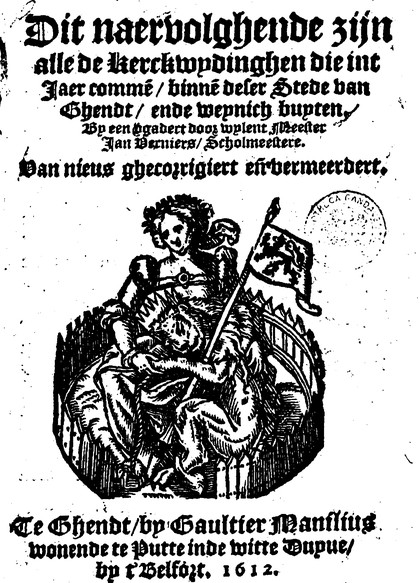
Title page of "Dit naervolghende zijn alle de Kerckwydinghen die int Jaer commen, binnen deser Stede van Ghendt, ende weynich buyten", republished posthumously in 1612 by Gaultier Manilius — "gathered together by the late Master Jan Verniers, Schoolmaster". Source
The title page of his posthumously republished (1612) overview of Ghent church dedications explicitly calls him "wylent Meester Jan Verniers" — "wylent" means "the late", deceased. Jan must therefore have died between his last known almanac (1592) and 1612, when Gaultier Manilius republished his work "newly corrected and enlarged".
A title with allure: the "sworn Geometrist"
Sanderus was not the first to give Jan Verniers this dignified label — he had already used it himself, decades earlier. Alongside the ordinary title "sworn land surveyor", a somewhat more pretentious counterpart came into vogue in Ghent after 1550: "ghezworen geometrist", a designation that appears in no archival document, but does adorn the title pages of almanacs. Master Pieter de Buck — the same man who already appeared above via Sanderus — used that title first, in a Ghent almanac of 1563: "mathematicus ende ghezworen geometrist der stede van Ghendt". Jan Verniers adorned himself with exactly the same title in his own Prognosticatie of 1589 (Biekorf, 1966).
In Antwerp the "doctors of medicine" and "sworn surgeons" had long held a monopoly on almanacs, until in 1592 a "geometrist" appears there too, for the first time, on an almanac title — the year and the city strikingly match Verniers's own, probably forged, Antwerp almanac of that same year, though the source does not name him explicitly. Ghent itself kept using the title: in 1623 and 1624 broadside almanacs appeared by Master Isaac Kips, "Mathematicus ende ghezworen Geometrist ofte Lantmeter der Casselrye vander Auderburch van Ghendt" — a contemporary of, and possibly even a competitor to, Joos Verniers's own almanacs of 1636 and 1637.
The title fits a larger movement: in the Renaissance, land surveyors increasingly grew into cartographers. Geeraerd de Jode (1521–1591) became surveyor, engraver and publisher of important cartographic work; Christiaen Sgrooten (1532–1608) rose to become official "geographus" to King Philip II and the Archdukes; and the painter Pieter Pourbus (1524–1584) put the title of surveyor beside his own name on the map of the island of Kadzand. Sanderus's famous Flandria Illustrata (1641) could never have come about without surveyors such as Louis de Bersacques (city plans of Kortrijk and Menen) and Vedastus du Plouich — who himself ran a "Mathematische Schole" in Westouter. In that company, the Biekorf author explicitly calls Jan Verniers a "didactic forerunner" of such surveying schools, with the same description of his 1578 Ghent school that Michiels also cites (Biekorf, 1966). A last, small echo of that same tradition: surveyor Jan van Spiere maintained and renewed the town clock of Oudenaarde from 1520 onward — the town that, via the cloth trade and the many Werniers in the probate records, already appears elsewhere on this site as a possible cradle of the family name.
Stars, politics and the Revolt
Jan Verniers's 1592 Antwerp almanac also turns up in quite different research: into how astrology was used to interpret the Dutch Revolt against Spain. In her master's thesis in history at KU Leuven, Over Mars en Venus: Constructie van identiteiten in Brabantse almanakken (1578–1648) (On Mars and Venus: construction of identities in Brabant almanacs), historian Cara Janssen repeatedly uses Verniers's Prognosticatie ofte voorsegginghe, van dat wonderlycke schrickel jaer onses Heeren 1592 as one of her key sources (Janssen, 2013).
Astrology and the almanac genre were inseparably linked in the early modern Low Countries, and remained popular well into the seventeenth century. Verniers opens his prognostication with a pious verse: "For God the Lord above all rules everything, the planets with the whole of heaven." Like many colleagues, he explicitly invoked the classical authority of Ptolemy, describing himself as that master's "disciple, prince of all astronomy".
Such prognostications were anything but innocent entertainment for readers. Whoever produced them, according to Janssen, was well aware that the genre — in the words of researcher Van Kampen — was "a mass manipulation medium", constantly used between 1578 and 1598 in Brabant to subtly proclaim a religious message. Like other Brabant almanac-makers, Verniers assigned the four main planets a political role in the course of the Revolt: Jupiter stood for Christianity and protected believers, Venus was "by nature feminine" and brought peace, but as soon as Mars and Saturn gained the upper hand, the clouds gathered over the Netherlands. If Jupiter or Venus appeared in the sky, the Netherlands, according to Verniers, leaned more towards "treves" (truce) than "orloghe" (war). Strikingly, the fifth planet then known, Mercury — which represented trade — remained largely absent from this kind of political interpretation (Janssen, 2015).
After the fall of Antwerp and the final reconciliation treaty of 1585 — by which the recaptured Brabant towns were obliged once more to accept the Catholic faith exclusively — this astrological language acquired a pronounced religious element. Historian Guido Marnef describes this period as one in which a "Catholic revival" took hold in the Scheldt city, and under that influence prognosticators such as Verniers, from 1585 onward, added an extra religious layer to their predictions. Verniers writes in 1592 that God would "not stir a fin" until believers turned to penance: only then could peace, under the favourable influence of Jupiter and Venus, return. Janssen places this statement by Verniers in the same breath as that very same idea in no less than Nostradamus, who two years later wrote that only after such a conversion could prosperity come, "that which God the Father, God the Son and God the Holy Spirit wish to grant us". The schoolmaster from Ghent is thus literally named in one breath with the most famous prophet in history — not because he was his equal, but because both men's almanacs served as evidence for exactly the same religious-political argument. The ongoing war was thus presented, in part, as a punishment from God for a sinful life — a message that fitted the Habsburg aim of leading the population back into "the sheepfold of the holy Roman Church". After the Peace of Münster in 1648 this politico-astrological language quickly faded: the outcome of the Revolt was settled, church control over this kind of ephemeral printed matter increased, and the role of the stars in public debate on war and peace dwindled. Verniers's 1592 almanac thus falls right in the middle of the period when such predictions carried their greatest political charge.
Gillis and Joos: the next generations
Around 1580 Gillis Verniers published his French-Flemish dictionary — dedicated to the high bailiff and the aldermen of Ghent, who at that moment were, to a man, adherents of the "new doctrine": Ghent was governed in 1580 by Jan van Hembyze, at the head of the short-lived Calvinist Ghent Republic. That political context proved not without consequence. At the Catholic restoration of 1584, set in motion by the entry into Ghent of governor Alexander Farnese, Duke of Parma, Verniers's school was closed by order of the bishop (Nederlandsch Museum, 1881). Twenty-seven years later, on 19 October 1611, a Gillis Verniers married Catelyne Pyssoens in the Ghent parish of Sint-Michiels-Noord, witnessed by Jacob de Scheppere fs. Mathys — the same combination of names (bride, witness) already known via Michiels, now recovered in the original marriage register. The proof is not watertight, but the chance that this concerns a different, identically named Gillis Verniers is small (Ghent City Archives). It is not known whether Gillis himself wrote almanacs — no copy by him survives, though Michiels considers it plausible. His son Joos, in any case, did put pen to paper: two broadside almanacs by him survive, for the years 1636 and 1637, printed by Servaes Manilius. Joos combined authorship with the schoolmaster's trade: in 1626 he appears as "Judocus Verniers" on the membership list of the free schoolmasters, and by 1639 rises to sub-dean of that guild.
The same dictionary, two names: Gillis Verniers and Jan Taye
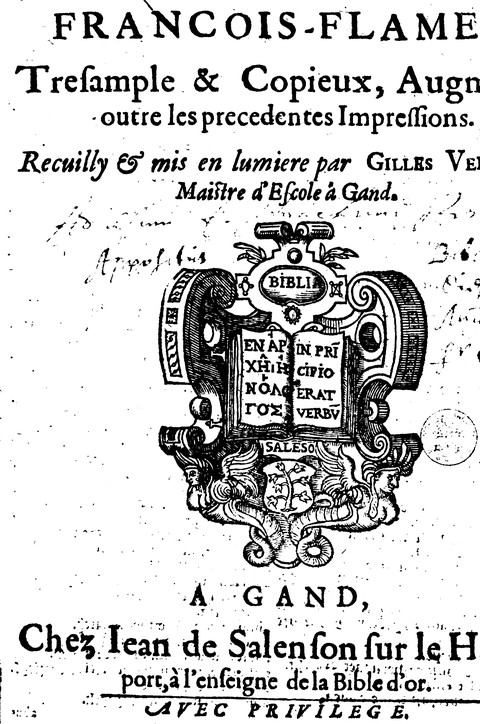
Title page of Gillis Verniers's dictionary: "Francois-Flamen, tresample & copieux", printed by Jean de Salenson in Ghent, "à l'enseigne de la Bible d'or" — with printer's mark and the inscription "Avec Privilege". Source: Blommaert, 1862
The full title page of Gillis's dictionary read: "Dictionaire françois-flamen, tresample & copieux, augmenté outre les precedentes impressions. Recueilly et mis en lumière par Gilles Verniers, maistre d'escole à Gand" — in translation: "French-Flemish dictionary, very ample and copious, enlarged beyond the previous printings. Collected and brought to light by Gilles Verniers, schoolmaster at Ghent". It was printed "A Gand, chez Jean de Salenson, sur le hault-port, à l'enseigne de la Bible d'or", that is, "At Ghent, by Jean de Salenson, on the Hoogpoort, at the sign of the Golden Bible" — the shop of bookseller Jan van Salenson, whose handsome printer's mark (an open Bible with "In principio erat verbum") adorns the title page. At the bottom, "Avec Privilege" is prominently stated — unlike so many of the almanacs discussed later in this story, this was therefore a legal, licensed edition (Blommaert, 1862). In the same source Blommaert also confirms the family tie that Michiels would later suggest again: "At the same time lived Josse Verniers, possibly the brother of Gilles; he was professor of the cijferkonst (arithmetic)", citing the manuscript Arithmetica of cyfferkonst of 1584 as evidence — exactly the same hypothesis that resurfaces, 162 years later and entirely independently, in a university thesis.
Two years later, in 1582, virtually the same dictionary appeared once more — now under the name of Jan Taye, likewise a teacher in Ghent. Blommaert establishes that it is "entirely the same" work as that of Gillis Verniers, apart from a few added words on the first two pages. This edition too was dedicated to the high bailiff, aldermen and deans of Ghent, and contained a laudatory poem by the well-known Ghent painter-poet Lucas d'Heere. Both editions carried the name of bookseller Jan van Salenson on the title page, but were in reality printed by Cornelis De Rekenare, ten Putte in Ghent (Blommaert, 1862).
Jan Taye (in full Jan Tayaert) also turned out to be an adherent of the new religion — and this already held for his whole family. His father had twice recanted the Roman faith and had likewise kept school, a school that was therefore also twice closed by the aldermen; his mother had been imprisoned for heresy. Jan himself kept a French school on the Kalanderberg in Ghent in the 1560s-70s — as successor to a certain Jan van Gheldere, who was already teaching there in 1566 — until his school too, like that of Gillis Verniers some years later, was closed by order of the bishop: as early as 10 November 1569, the same year in which our stamvader Laurens Verniers was banished from Antwerp (De Potter, 1889).
After that closure Jan Tayaert moved to Lokeren to work there as a teacher. The story preserved about this is a colourful one: at the market he offered the local parish priest a petition to be appointed teacher. That priest, who had already agreed with the aldermen that a chaplain still to be appointed would provide the teaching, expressed himself contemptuously about Tayaert in the surviving document: a "sotckebroet" (scoundrel), a "Pigmeus" (Pygmy), a "thoroughly monstrous creature". Nonetheless the Lokeren aldermen — themselves sympathetic to the Geuzen (rebels) — appointed him on the spot, to the fury of the priest, who felt deceived (De Potter, 1889). What happened to Jan Tayaert afterwards is not known. What is known is that in 1582 he had his dictionary printed by Cornelis de Rekenare in Ghent, with a French laudatory poem by Lucas D'Heere on the reverse of the title page — and a none too modest dedication to the Ghent city government, in which he declares himself well aware of the talent God had given him, and his intention to use it for the benefit of the youth.
Who actually wrote the dictionary first, incidentally, remains a point of discussion among later researchers: F. Van der Haeghen, in his Bibliographie Gantoise, attributed it to Tayaert, while Blommaert attributed it to Gillis Verniers, around 1580. Because the Verniers edition bears no date, the matter is hard to settle — though the words on Gillis's own title page, "augmenté outre les precedentes impressions" (enlarged beyond the previous printings), suggest rather that his version was the older, original one, and Tayaert's the later reworking (De Potter, 1889). Finally, the chronicler Philip De Kempenare relates that Taye's wife was once imprisoned by inquisitor Petrus Titelman for heresy; she recanted her errors and was released, but relapsed into them again. The couple attended Geuzen sermons, had one of their children baptized in the Geuzen temple, and were themselves later buried there too (Blommaert, 1862). Three generations of the same family — parents, Jan himself, and his wife — thus each, in their turn, came into contact with the persecution of the new faith.
A small, personal trace of Gillis himself turned up in a quite different corner of the Ghent archive. In the sixteenth century, registrars and their clerks had the habit of writing a motto or moral lesson on the parchment cover or title page of the registers they handled daily — a small window onto their state of mind. On the Weezenboek (Orphans' Book) of 1396-1397 and on that of 1588-1589, someone wrote the same lines: "Dieu est mon guide et mon appuy, Et tout mon espoir est en luy" ("God is my guide and support; in Him is all my hope"), signed with the name Gillis Verniers. The year 1588-1589 falls in the years right after the closure of his school in 1584 — so it is quite possible that this same Gillis, after losing his post as schoolmaster, went to work as registrar of the Ghent Orphans' Chamber, and left his personal devotion on the cover of his new register (De Potter, 1886).
Ghent under Spanish rule: what was allowed, what was not
The Nederlandsch Museum article that records the closure of Gillis's school first sketches the broader educational ideal of the time: according to this system, education was to focus on three things. The education of the soul consisted of exercise in piety, guiding the will towards good and reining in the passions; the education of the mind encompassed everything that promoted judgement, memory and thinking ability; and the education of the body concerned the care of health and physical exercise — a triptych of soul, mind and body that the sixteenth-century school, including that of a Jan or Gillis Verniers, held up as its ideal (Nederlandsch Museum, 1881).
The closure of Gillis's school in 1584 does not stand alone. Sixteenth-century Ghent, like Antwerp, saw a remarkably lively movement around civic (non-ecclesiastical) education — fed in part by the fact that part of the population had embraced the Reformation. The Spanish authorities tried to contain this movement with edicts against civic education, but could not eradicate it. Teachers sometimes used books in their schools without the required imprimatur (official approval), thereby exposing themselves to serious trouble; forbidden books smuggled in secretly from Antwerp — where "heretically inclined" printers were active — were, if the court officers caught them, burned without mercy on the Vrijdagmarkt (Nederlandsch Museum, 1881).
The fate of Gillis Verniers thus fits a larger, well-known movement: first the brief breathing space of the Calvinist Ghent Republic, in which a dictionary could be dedicated to reform-minded city governors, and then the harsh reversal as soon as Farnese brought the city back under Spanish-Catholic rule. In precisely those same years, and for precisely the same reason, our own stamvader Laurens Verniers left the Southern Netherlands: in 1569, fifteen years earlier and some fifty kilometres away in Antwerp, he was banished by Alva. Whether Laurens and Gillis were related to each other has not been demonstrated — but both were teachers or literate men from the same region, struck by the same persecution, with a gap of no more than a decade and a half.
Education itself, in the Ghent of that time, had incidentally long been a matter for the city, quite apart from the later religious struggle. Charles V established the Armenkamers (Poor Chambers) in 1534, intended to curb begging: begging in the street and in churches was forbidden, and schools were set up where poor children learned to read and write, boys a trade and girls sewing. Children under eight had to attend all day — an early form of compulsory education, with even a kind of part-time system for older children, half the day work, the other half school. After the suppression of the 1539 Ghent revolt, the board of the poor schools asked Charles V whether the confiscated weaving building "de Bogaard" could serve as a permanent schoolroom; the emperor refused that request in 1542. It is in that tradition of municipal, partly charitable education that a generation later Jan, Gillis and Joos Verniers likewise kept their schools (Nederlandsch Museum, 1881).
A dictionary that still counts
Gillis's dictionary proved no flash in the pan. More than two and a half centuries later, in his study on the compilation of a general Low German (Dutch) dictionary, linguist Constant Philippe Serrure counts the Dictionnaire françois-flameng by "G. Verniers, maistre d'escole à Gand" among the important old dictionaries a modern compiler should consult — named in the same breath as the great reference works of Kiliaen, Plantyn and Vanderschueren (Serrure).
Serrure also cites Gillis's dictionary for a concrete linguistic fact: he translates the French mites ou mitons (spots eaten away by woodworm) as meluwen oft maeyen — the Ghent dialect word for wood decayed by woodworm or mould. The same decay was called memel in Antwerp (as in High German, according to Weiland), molm in Holland, and miluwe or meluwe by the sixteenth-century lexicographer Kiliaen. Three entirely different words for the same phenomenon, each tied to its own region — and Gillis's dictionary is one of the earliest places where the Ghent word meluwen appears in print.
The title of Gillis's dictionary itself, seen in hindsight, also turns out to be a period piece. "Tresample & copieux" (very rich and abundant) sounds like personal self-praise, but was in reality a fixed marketing formula: language historian Alisa van de Haar shows that exactly the same words — "tres ample et copieux" — also appear on the title pages of the dictionaries of Mathias Sasbout (1576 and 1579) and Elcie Édouard Léon Mellema (1591 and 1599) (Van de Haar, 2018). Sixteenth-century schoolmasters rarely presented their dictionaries explicitly as resistance to French loanwords, but did constantly invoke this rhetorical claim of richness and abundance (copia): a promise that their language could be just as elegant and eloquent (elegantia) as French or Latin. With his "tresample & copieux", Gillis Verniers was thus simply joining a linguistic contest fought out across the whole of the Low Countries — dictionary by dictionary.
Josse (or Joost) Verniers: possibly a brother
Apart from Jan, Gillis and Joos, Michiels names a fourth bearer of the name: Josse Verniers, professor of arithmetic, who in 1584 wrote the manuscript Arithmetica — still preserved at Ghent University. In the thesis, Josse is carefully described as "possibly the brother of Gillis", and would thus likewise have been a son of Jan. The Nederlandsch Museum of 1881, referring to the same 1584 manuscript, calls him "Joost Verniers" and describes him as "cijfermeester" (arithmetic master) — yet another spelling of the same name, in the same series as Jan, Joos and Josse (Nederlandsch Museum, 1881). A firm confirmation of the family tie is lacking, but the picture of a family that devoted itself, generation after generation, to measuring, calculating and teaching only grows stronger for it.
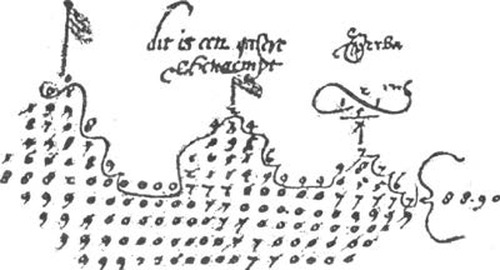
Fol. 10r from the manuscript of Josse Verniers (ms. 694, 1584, Ghent University Library): a galley division, with the characteristic upward-pointing "tail" of figures. Source: Beckers & Kool, 2004
Josse's manuscript thus resurfaced more than four centuries later — as teaching material. In their scholarly edition of the famous arithmetic book De Cijfferinghe (1604) by Willem Bartjens, Danny Beckers and Marjolein Kool use precisely this page from Josse's manuscript to illustrate the so-called galley division (Beckers & Kool, 2004). That method of calculation resembles today's long division, but looks quite different: the divisor is written below and to the left of the dividend, and after each step crossed out and rewritten one place to the right, while the intermediate remainders are written on top, forming an upward-running "tail" of digits. In larger divisions, sixteenth-century arithmetic masters recognized in that shape a sailing ship — hence the name: the quotient came to stand on the "rudder". It was the standard method of division at the time, and Bartjens's arithmetic book itself mainly prepared pupils for calculating with coins, measures and weights for trade and crafts — including, alongside the Amsterdam standards, Flemish coins too, not by coincidence, since many arithmetic masters of that time originally came from the Southern Netherlands, just like the Verniers.
That same manuscript (Ghent, University Library, ms. 694, also designated H-GeU-1584) opens with an ownership statement, which Josse wrote in two languages: "Ceste livre appertient a moy, Josse Verniers, anno 1584" and, further on, in Dutch: "Desen bouck behoort toe Josse Verniers, anno 1584." Arithmetic historian Marjolein Kool points out that this is exactly the same kind of ownership formula that opens two other sixteenth-century arithmetic manuscripts: that of Heyndrik Nouts ("Ceste livre appertient a moy, Heyndrik Nouts, 1562") and that of Cornelis Pijck ("Dese sijfferboeck behoort toe Cornelis Pijck, 1584"). Such personal ownership marks do occur in other kinds of manuscripts, but never in printed arithmetic books — an indication that these three manuscripts, including Josse's, were not written as teaching material for pupils, but as a personal workbook: a collection of problems and solutions the maker kept for himself, rather than as a teacher for others (Kool, 1999).
Four learned citizens of Ghent
Sanderus does not place Jan Verniers alone in 1624: in the same work he also names Pieter de Buck, Pieter Cathoir and Lieven van Thuyne as citizens of Ghent known for their learning. Pieter de Buck receives the most extensive praise, probably because of his work as an astrologer. All four are named as compilers of ephemerides or astrological tables — the arithmetical basis on which almanacs were built, but also used for quite different purposes, such as navigation and meteorology. In other words: Jan Verniers belonged to a small, recognizable company of Ghent almanac-makers with a certain name and reputation.
That reputation did not end with Sanderus. Later in the seventeenth century, Philips de Dyn was a renowned surveyor, licensed throughout the Southern Netherlands, whose work was sold in both Ghent and Antwerp. His almanacs kept circulating for years after his death in 1665, and were probably even illegally reprinted in Antwerp — a sign of how sought-after such work could remain, long after the original maker had died.
Forgeries and competition in the almanac market
The early modern almanac trade was a busy and poorly regulated market, and Jan Verniers was not the only one whose name was exploited by others for profit. The best-known example is Pieter de Buck, whose title changed from edition to edition: in 1569, from Gillis van den Rade, still correctly as "sworn land surveyor", but already in 1570 as "Pieter de Bock, doctor of the seven liberal arts, philosophy and medicine" — an academic degree that did not exist. In 1571 his name was spelled differently again, "Pieter de Buc", with the same false title; in 1573 and 1574 he was called, both by Ghileyn Manilius in Ghent and Guillaume van Parijs in Antwerp, "doctor of medicine". All of this points to unauthorized reprints trying to suggest ever greater authority with an ever more impressive-sounding name.
The same thing happened to Jan Verniers in 1592: his Antwerp almanac of that year calls him "doctor of the seven liberal arts", likewise a non-existent title. Pieter Cathoir's almanac too appeared in 1572 both in Ghent, from the widow of Gheeraert van Salenson, and in Antwerp, from Jan Verwilthagen — and it is precisely the Antwerp version that claims to hold the official printing privilege. Such double and mutually contradictory editions point to outright competition between the almanac markets of Ghent and Antwerp. Another trace of that same rivalry: in 1558 the Ghent printers Hendrik van de Keere and Cornelius Manilius made an agreement with the famous Antwerp printer Christoffel Plantijn, who would supply them with a hundred French and a hundred Dutch almanacs — on condition that they themselves refrain from printing almanacs.
Origins and background
Most Ghent almanac authors of this period came from East Flanders or Ghent itself, with one exception from France and one from Germany, and generally came from the urban middle class. Michiels was able to reconstruct the origins of four families to some extent. Gillis vanden Hoecke had an uncle who earned his doctor's cap in philosophy at the University of Paris in the fifteenth century and ran a Latin school on the Zandberg, where Gillis probably also worked. Victor le Dayn was a bookseller, printer and compass-maker in Ghent, active from 1540 and deceased before 1557; he was a citizen (poorter), printed an almanac together with Joos Lambrecht in 1551, and married Anna van Gansbeke, from a prominent family of Geraardsbergen — his son Philips de Deyn (later probably the celebrated surveyor Philips de Dyn) inherited that network.
The third family Michiels could reconstruct is that of Jan, Gillis and Joos Verniers themselves. Their almanacs were printed by the Manilius family of printers — Gualterus, Servaes and Baudewijn Manilius all three also printed almanacs commissioned by the Ghent city government, which points to a certain professional standing. Combined with their own trade as schoolmaster and land surveyor, Michiels assumes that the Verniers family too belonged at least to the urban middle class.
Researchers for De Gulden Passer (2013), who further investigated the story of Abraham's 1603 Middelburg almanac, raised the same question that mainly appeared in older texts from the end of the nineteenth century: could Abraham be a son of this very Jan Verniers of Ghent? My own research has meanwhile shown that Abraham is a son of our stamvader Laurens Verniers. Whether, via another line, a kinship still exists between this Ghent schoolmaster family and our own remains a question under further investigation. Read the full story of Abraham's almanac →
A "boecksken van Monsieur Vernier" in Erycius Puteanus (1631)
A quite different, not yet identified mention of the name Verniers turns up in the Dutch-language correspondence between the Leuven humanist Erycius Puteanus and the astronomer Michael Florent van Langren, published by J.J. Moreau (Puteanus/Moreau, 1957). In a letter of 24 May 1631, written at Leuven Castle, Puteanus reports that he will send Wendelinus (the astronomer Godefroy Wendelin) a copy of his own writing on longitude, together with "a little book by Monsieur Vernier". Which Verniers is meant here is unclear — the letter gives no first name or further indication, so a link with the Ghent schoolmaster family above is by no means established. Still, it is an intriguing find: somewhere in the learned, scholarly circles around Van Langren and Puteanus, a little book by a Verniers was circulating in 1631.
Seer gunstige Heer ende Vriendt,
Ick bedancke V.L. op nieuwe mynen naem by Don Emanuel soo verre gebracht te hebben. Sal toonen dattet niet te vergeefs en sal geschiet syn. Ommers sal myn beste doen, ende alle middelen aenwenden, op dat wy tot een goet ende kort eynde komen. Al en hebbe ick geen besonder kennisse met den Raetsheer Semerpont, sal de selve maecken: daerom sal ick Maendach aen hem brieven senden, ende raccomandeerense aen V.L. Mergen is 't Sondach, ende de boden syn stil: de voormans syn quade boden. Aenden Marquis de Aytona sal ick met alle neersticheyt van V.L. saecke vande Longitude schryven, op den selfsten Maendach. Het waer goet dat V.L. my noch een halve dozyn exemplaren sondt vanden brief aenden heer Finia. Ick ben verwondert van't schryven van onsen goeden vriendt Delagarbe. De saecke sal gedaen syn. Maer hoe? op wat maniere? met wat conditien? Dat sal dunkt my, dat noch al onseker gaet. Ick hadde wel gewilt, dat hy my eenyge informatie gesonden hadde; op dat ick met brieven hadde mogen helpen. V.L. soude hem noch myn begeerte voor, ende goede affectie. V.L. kent myn herte. Wat sal hy met de konste om op't water te gaen, willen uytrechten? Dit gaet syne professie te buyten: ende byaventueren meer als dit. Sal gaerne hooren wat D. Chiffletius met de Marquis de Aytona gesproken heeft. Ick en hoor niet meer van Monsieur vanden Wouwere. Oock op mynen brief ende boeck laestmael gesonden en heb ick geen antwoort. Van Wendelinus en hoor ick oock niet: ick sal aen hem een exemplaer vanden brief op de Longitude senden met een boecksken van Monsieur Vernier. Tot noch toe en heb ick sooveel tyts niet gehadt, om de linie der dagen op't Ertryck af te schryven. Noch-tans alle myn sinnen trecken hier toe. Ende sal hier nae oock de handen afdoen. Dan moet gaen dencken, of dit secreet oock wat profyts soude konnen inbrengen, om wederom aende studien te imploeyeeren. Wat sal ick meer seggen? Nu de tiende gerenuncieert is, sal de saecke eens voort komen: waer oock nu van nooden, dat wy wisten wat Monsieur Delagarbe by den keyser heeft uytgerecht: soude ons hier te pas komen. Ist dat V.L. yt nieuws heeft, bidde ick dat ick mach deelachtig syn. Wy en hebben hier niet, noch en weten wat den viandt sal aengrypen: of wat wy selve doen sullen. hier mede wensche ick V.L. ende V.L. huysvrouwe met de kinderen alle contentement. Bedancke V.L. van een copye van't memoriael gesonden te hebben. Tis soo kort ende wel gestelt. Godt geve een goede apostille.
In Loven, den 24. Mey 1631. Op't Casteel.
V.L. van herten toegeswooren vriendt als broeder
E. Puteanus.
Myne eerbiedinge aen D. Emanuel met alle ootmoedicheyt ende danckbaerheyt.
Letter XXIX (fol. 36–37), Erycius Puteanus to Michael Florent van Langren, 24 May 1631 ("V.L." = Van Langren; shown here in the original Dutch, as a primary source). Source: Puteanus/Moreau, 1957
This is a first, extensive account. More will follow later — with additional information and sources, down to street level, in the hope of still being able to connect this Ghent family to the rest of the family on the basis of further information.