Note: this story is still being developed and will be filled out step by step — including the sons of Pieter Lourens Verniers, who likewise worked as surgeons in Weesp, and the apothecary's shop the family ran there.
Why Weesp?
Exactly how the Verniers family came to Weesp cannot yet be established with certainty — but there is an attractive hypothesis. In many towns of the Republic, after the Alteratie the sitting Catholic administrators were removed from office, creating a need for new, trustworthy administrators. In various towns that role was filled by Mennonite men — precisely the faith community that the Verniers family, through stamvader Laurens Verniers, was itself at the heart of. It is conceivable that the family in Weesp followed the example of other, better-known Mennonite figures who held administrative positions there. For now this is a working hypothesis, not an established fact — further archival research must show whether, and how exactly, this came about. A more concrete explanation, via the Mennonite Anslo and Schouten families, is worked out in story #17 →
Mr. Pieter Lourens Verniers: surgeon and administrator
The first Verniers found by name in Weesp is Mr. Pieter Lourens Verniers. He is probably the son of Louwerens (Laurens) Verniers — the nephew whom Trijntgen Verniers named as heir in her 1622 will (read that story →). This same Pieter Lourensz Verniers appears in 1656 as sitting alderman of Weesp, when he renounces his share of the money of his deceased great-aunt Trijntgen Verniers (read the 1656 deed →).
By trade he was a surgeon. On 3 March 1648 he passed his master's examination in Amsterdam and paid his guild dues — the final step to being allowed to work as an independent surgeon. At his examination, the examining masters present were Mr. Joannes Judocus and Mr. Dirck Jansen, and the guild elders were Mr. Cornelis Fredericxsen, Mr. Jacob Colevelt, Mr. Jacob Cruijs and Isaac Lauwerens (Source 70). He married Marretje Dircksdr, and the couple settled in Weesp, where alongside his work as a surgeon Pieter also held various administrative offices.
The deed of the master's examination, 1648
Amsterdam City Archives, Surgeons' Guild Archive, inventory number A13594, register of surgeons' master examinations, 3 March 1648. Source 70.
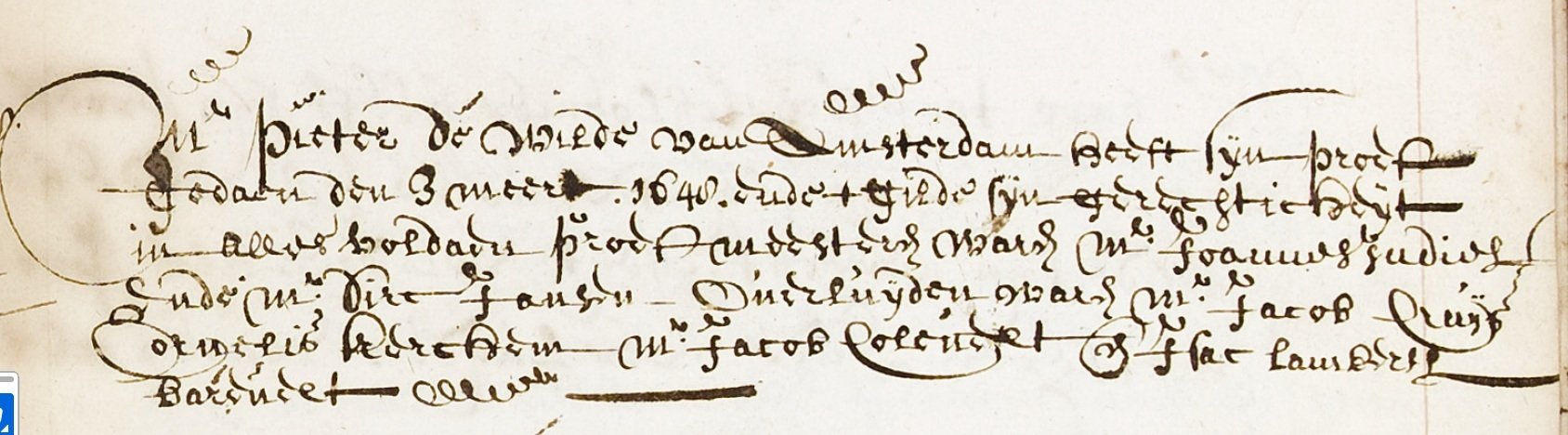
Mr. Pieter Verniers, master's examination passed, 3 March 1648 — Amsterdam City Archives, Surgeons' Guild Archive, inv. no. A13594
Transcription (original spelling, shown here in the original Dutch as a primary source):
Mr. Pieter Verniers van Amsterdam heeft syn proeff
gedaen den 3 Maert 1648 ende gilde sijn gerechticheyt
betaelt, in alles voldaen. Proeffmeesters waren Mr.
Joannes Judocus ende Mr. Dirck Jansen. Ouderluyden
waren Mr. Cornelis Fredericxsen, Mr. Jacob Colevelt,
Mr. Jacob Cruijs & Isaac Lauwerens.
In modern English: master Pieter Verniers of Amsterdam passed his master's examination on 3 March 1648 and paid the guild dues (his guild rights) — everything settled in full. The examining masters were master Joannes Judocus and master Dirck Jansen; the guild elders were master Cornelis Fredericxsen, master Jacob Colevelt, master Jacob Cruijs and Isaac Lauwerens.
The sons: surgeons in Weesp
Still to be filled in. The sons of Pieter Lourens Verniers and Marretje Dircksdr are likewise described as surgeons at Weesp — this section will be developed further later.
The apothecary's shop
Still to be filled in. Alongside the surgeon's trade, the family in Weesp also ran an apothecary's shop — this section too will follow later.
A hypothesis: the family coat of arms and the bean lottery
A cautious working hypothesis, still to be investigated, concerns the family coat of arms itself, which among other things features three bean-shaped figures. In various towns of the Republic, administrators (aldermen) were at that time not elected but chosen by lot, using white and brown beans — the so-called "boneloting" (bean lottery) or a similar drawing of lots. My working hypothesis is that the beans in the family coat of arms refer to this administrative lottery, given the administrative offices the family held in Weesp. I formulated this explanation myself on the basis of the situation at the time; it is not yet an established fact — and deserves, in time, a fully worked-out story of its own.
To be continued — this story will be filled out step by step in the coming period.