Het familiewapen van de Verniers-en is in de loop van de tijd twee keer met de hand getekend. Het oudste exemplaar is het ex libris van R.M. Verniers, in de jaren zeventig getekend door Karel van den Sigtenhorst. Recent is het wapen opnieuw, in hoge resolutie, getekend door heraldicus Piet Bultsma-Vos. Hieronder staan beide versies naast elkaar.
The Verniers family coat of arms has been hand-drawn twice over time. The oldest example is the ex libris of R.M. Verniers, drawn in the 1970s by Karel van den Sigtenhorst. Recently, the coat of arms was drawn anew, in high resolution, by heraldic artist Piet Bultsma-Vos. Below are both versions side by side.
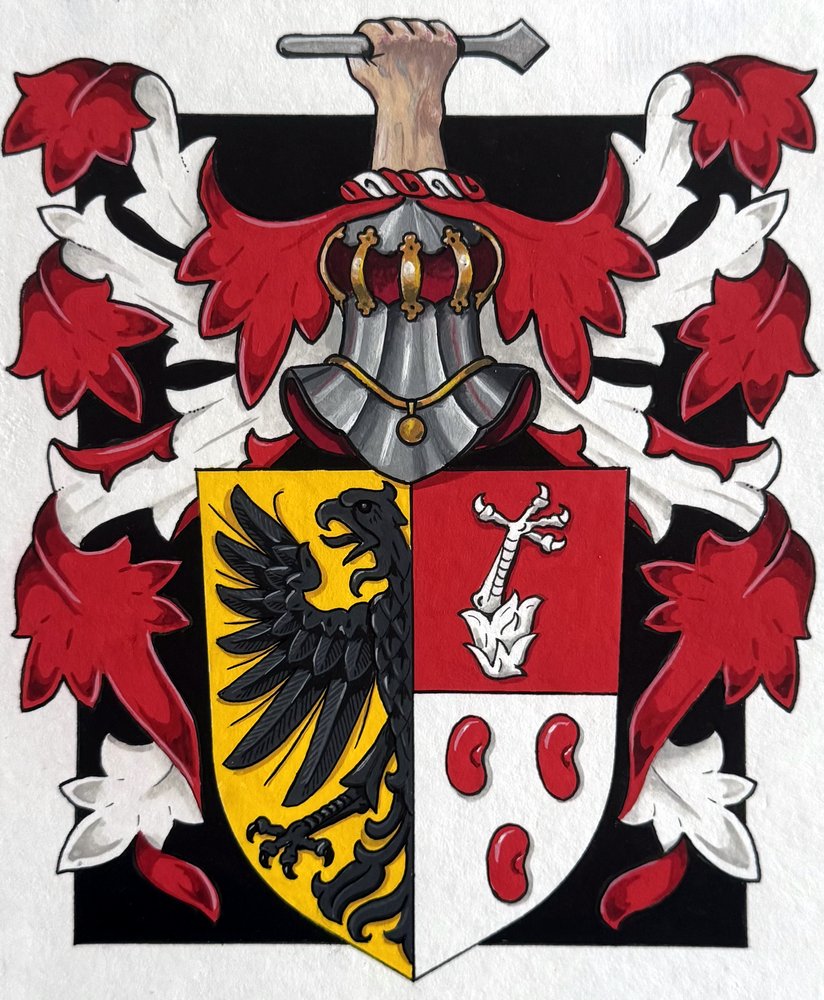
Nieuwe tekening, Piet Bultsma-Vos (A3, gesigneerd; privébibliotheek)New drawing, Piet Bultsma-Vos (A3, signed; private library)
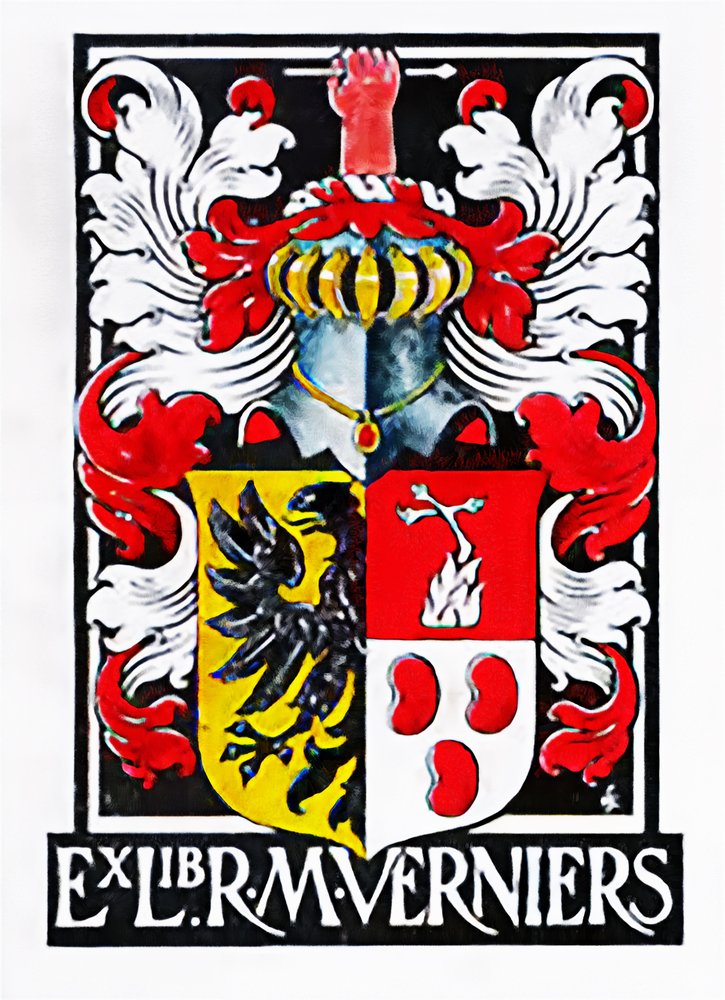
Ex libris R.M. Verniers, Karel van den Sigtenhorst (jaren '70)Ex libris of R.M. Verniers, Karel van den Sigtenhorst (1970s)
Beide tekeningen tonen hetzelfde wapen: een gedeeld schild met links een zwarte adelaar op goud, en rechts, boven drie rode bonen op zilver, een rood veld met een witte klauw. Boven de helm staan een kroon en het helmteken: een gepantserde arm waarvan de vuist een instrument vasthoudt. Helmteken, kroon en rood-wit dekkleed komen in beide versies terug, al verschilt de precieze uitvoering per tekenaar en periode.
Duiding van de symbolen
Het wapen is voor het eerst aantoonbaar door de familie gevoerd rond 1680 in Weesp, na een periode van vlucht voor oorlogsgeweld. De familie was op dat moment bestuurder, chirurgijn en koopman, en genoot aanzien — onder meer als heemraad van Muiden. Het wapen staat afgebeeld op de zilveren hensbeker van het Hoogheemraadschap Zeeburg en Diemerdijk (de voorloper van het huidige Waterschap Amstel, Gooi en Vecht), gemaakt in 1717 door zilversmid Jan Lankhorst. Op het deksel van deze beker staat het opschrift "Adversus mare luctor" ("mij verzettend worstel ik met de zee"), gedragen door de Romeinse zeegod Neptunus; onderaan staan de zee, zeewezens en de vier windstreken, en op het deksel houdt een leeuw de wapens van Holland en Utrecht vast. Toen het hoogheemraadschap in 1795 zilver moest inleveren om er munten van te laten slaan, koos het bestuur ervoor de beker af te kopen in plaats van hem te laten omsmelten — zo is hij bewaard gebleven en staat hij tegenwoordig in het kantoor van Waterschap AGV. De nieuwe tekening van Piet Bultsma-Vos is bewust in overeenstemming gebracht met dit oudere wapenbeeld.
Both drawings show the same coat of arms: a per-pale (vertically divided) shield with a black eagle on gold on the left, and, on the right, above three red beans on silver, a red field with a white claw. Above the helmet are a crown and the crest: an armoured arm whose fist holds an instrument. Crest, crown and red-and-white mantling recur in both versions, though the precise execution differs by artist and period.
Interpretation of the symbols
The coat of arms was first demonstrably borne by the family around 1680 in Weesp, after a period of fleeing from the violence of war. At that time the family were administrators, surgeons and merchants, and enjoyed standing — among other things as heemraad (water-board official) of Muiden. The coat of arms is depicted on the silver hensbeker (ceremonial cup) of the Hoogheemraadschap of Zeeburg and Diemerdijk (the predecessor of today's Waterschap Amstel, Gooi en Vecht), made in 1717 by silversmith Jan Lankhorst. The lid of this cup bears the inscription "Adversus mare luctor" ("struggling, I wrestle with the sea"), carried by the Roman sea god Neptune; at the base are the sea, sea creatures and the four points of the compass, and on the lid a lion holds the arms of Holland and Utrecht. When the water authority had to hand in silver in 1795 to have it struck into coins, the board chose to buy back the cup rather than have it melted down — this is how it survived, and today it stands in the office of Waterschap AGV. Piet Bultsma-Vos's new drawing was deliberately brought into line with this older depiction of the coat of arms.
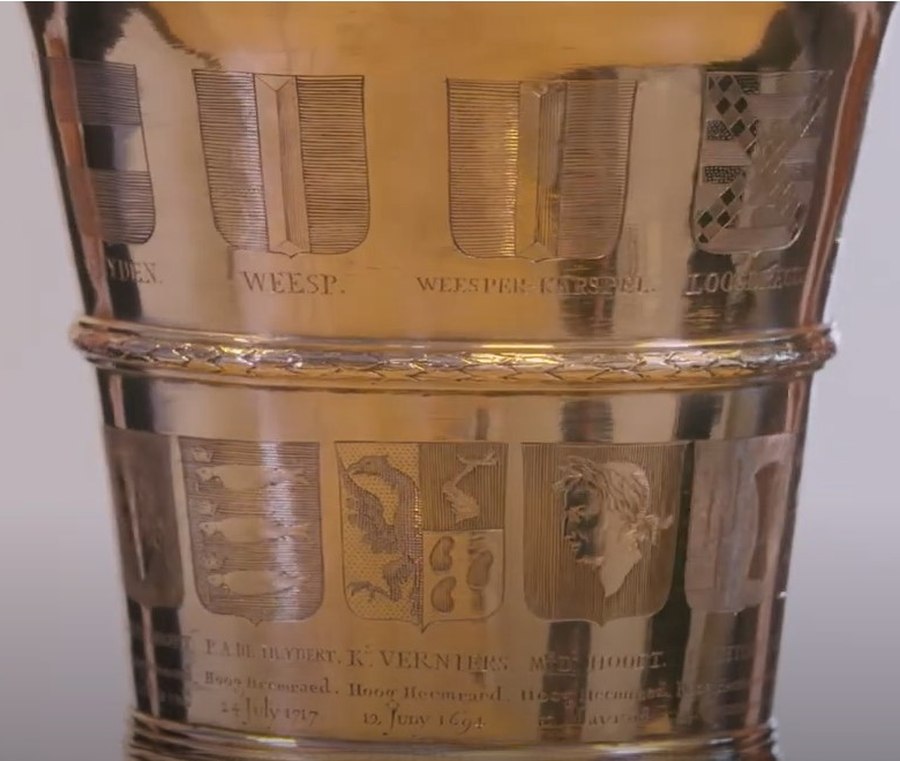
Detail van de hensbeker van het Hoogheemraadschap Zeeburg en Diemerdijk: het wapen van de familie Verniers, gegraveerd met de datum 12 juni 1694 en de naam "K. Verniers, Hoog Heemraed". Zie het volledige verhaal van deze beker bij Waterschap Amstel, Gooi en Vecht.Detail of the hensbeker of the Hoogheemraadschap of Zeeburg and Diemerdijk: the coat of arms of the Verniers family, engraved with the date 12 June 1694 and the name "K. Verniers, Hoog Heemraed". See the full story of this cup at Waterschap Amstel, Gooi en Vecht.
Een tweede document bevestigt deze plek in het bestuur: een beschilderd bord met de titel "Wapens en Naamen der Heeren Dykgraven, Hoogheemraaden en Secretarissen, van den Zeeburg en Diemerdijk, sedert den jaare 1675". Het bord toont, gerangschikt per plaats, de wapenschildjes en namen van alle dijkgraven, hoogheemraden en secretarissen van het hoogheemraadschap vanaf 1675. Onder de hoogheemraden van Muiden staan de namen en de familiewapens van Cornelis Verniers, Pieter Verniers en Willem Verniers.
A second document confirms this position in the administration: a painted board titled "Wapens en Naamen der Heeren Dykgraven, Hoogheemraaden en Secretarissen, van den Zeeburg en Diemerdijk, sedert den jaare 1675" (Arms and names of the lords dike-reeves, water-board officials and secretaries of Zeeburg and Diemerdijk, since the year 1675). The board shows, arranged by place, the small coat-of-arms shields and names of all dike-reeves, water-board officials and secretaries of the water authority from 1675 onward. Under the water-board officials of Muiden are the names and family coats of arms of Cornelis Verniers, Pieter Verniers and Willem Verniers.
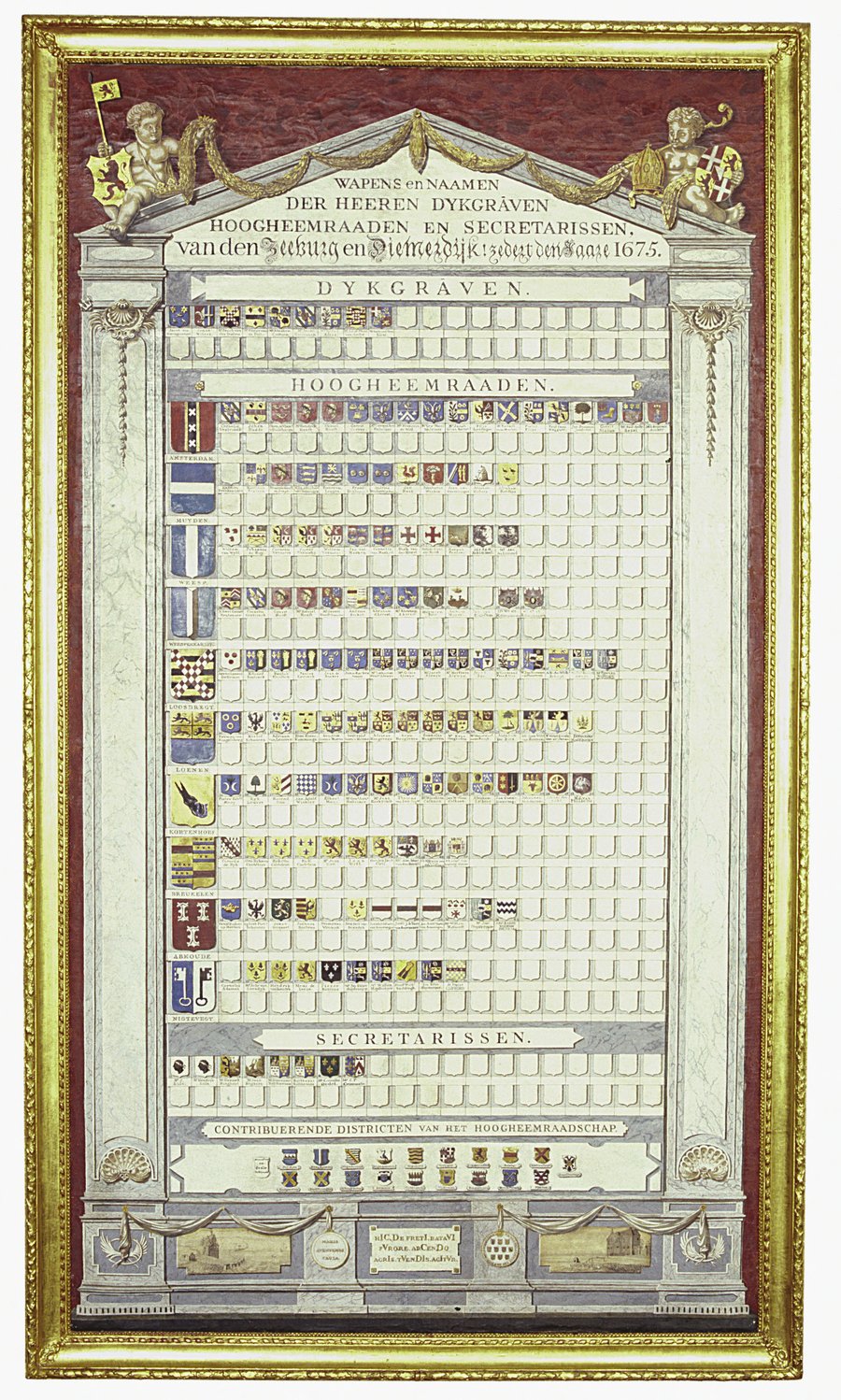
"Wapens en Naamen der Heeren Dykgraven, Hoogheemraaden en Secretarissen, van den Zeeburg en Diemerdijk, sedert den jaare 1675"."Wapens en Naamen der Heeren Dykgraven, Hoogheemraaden en Secretarissen, van den Zeeburg en Diemerdijk, sedert den jaare 1675" (shown here in the original Dutch, as a primary source).

Detail van de rij Muiden, met de namen en wapens van de hoogheemraden.Detail of the Muiden row, with the names and coats of arms of the water-board officials.
Het schild. Het schild is gedeeld: een verticale lijn splitst het in twee gelijke velden. De accoladevorm die in beide tekeningen is gebruikt — rechthoekig, met een ronde insnijding aan de onderzijde — raakte pas aan het einde van de achttiende eeuw in gebruik en wordt tot op heden veel toegepast.
De Friese adelaar (linkerhelft). Een zwarte adelaar op een gouden veld die de helft van een gedeeld schild vult, is in de Nederlandse heraldiek een specifiek benoemd motief: de Friese adelaar. De oudste bekende wapens met deze figuur dateren uit de vroege zestiende eeuw, toen Friesland onder het gezag van de Stad Groningen en de Saksische en Oost-Friese graven stond; na de Habsburgse inlijving van Friesland verspreidde het motief zich verder. In de zeventiende eeuw voerden ook Friese boerenfamilies en advocatengeslachten — dus niet uitsluitend adel — de Friese adelaar, en in de achttiende eeuw was het gebruik zo algemeen dat heraldici erover spreken als een "gezonken cultuurgoed": een oorspronkelijk aan een bepaalde stand voorbehouden motief dat breed gemeengoed werd. Een veelgehoorde verklaring dat de adelaar zou verwijzen naar een middeleeuws rechters- of grietmansambt, of naar de Keizerlijke Adelaar van het Heilige Roomse Rijk, wordt door de Fryske Rie foar Heraldyk niet langer onderschreven — bewijs daarvoor ontbreekt. Algemeen staat de adelaar in de heraldiek voor kracht, macht en autoriteit. In de klassieke beschrijving vult de Friese adelaar doorgaans de rechterhelft van een gedeeld schild; in het Verniers-wapen is dit gespiegeld naar de linkerhelft.
De klauw (rechterhelft). Boven de drie bonen staat, in het rode veld, een klauw. Algemeen staat een grijpende klauw in de heraldiek voor kracht en gezag, vasthoudendheid, weerbaarheid en moed, en kan hij een overwinning of triomf over een tegenstander verbeelden. Mijn werkhypothese is dat de klauw verwijst naar het welslagen van de familie in een tijd van geloofsvervolging, oorlog en vlucht: als doopsgezinde vluchtelingenfamilie bouwde zij in de Noordelijke Nederlanden een nieuw, succesvol bestaan op en bereikte zij uiteindelijk de bestuurslaag — een triomf op de omstandigheden, niet op een concrete vijand. Deze verklaring heb ik zelf opgesteld aan de hand van de omstandigheden van die tijd; een bron die haar bevestigt, is (nog) niet gevonden. In de nieuwe tekening van Bultsma-Vos zijn de klauw en de drie bonen, anders dan in het ex libris van Karel van den Sigtenhorst, in de richting gezet die overeenkomt met de vroegste bekende afbeelding van het wapen, op de hensbeker.
Het helmteken: de arm met vuist en instrument. Een ander onderdeel van het wapen staat niet in het schild, maar torent boven de helm uit: een gepantserde arm waarvan de vuist een instrument vasthoudt. Arm en klauw zijn dus twee verschillende figuren — de klauw hoort bij het schild, de arm bij het helmteken. Een gepantserde arm of vuist is als helmteken in de heraldiek veelvoorkomend en staat doorgaans voor kracht, daadkracht en bescherming.
Het instrument: een cauteriseerijzer. Het instrument in de vuist van het helmteken is vermoedelijk een cauteriseerijzer, een gloeiend heet ijzer waarmee wonden werden dichtgeschroeid en dat chirurgijns ook als "bloedeloos mes" gebruikten om te snijden zonder veel bloedverlies — een toepassing die al door de Romeinse arts Galenus (ca. 138–203 n.Chr.) is beschreven. Dit detail lijkt niet in het oudst bekende wapenbeeld voor te komen en is vermoedelijk pas door Karel van den Sigtenhorst toegevoegd. In de nieuwe tekening is het bewust behouden, als eerbetoon aan de chirurgijns en de apothekerswinkel die de familie in Weesp dreef — en, minstens zo zeer, aan het werk dat R.M. Verniers in de jaren zeventig verzette om deze familiegeschiedenis te ontsluiten, ver voor het tijdperk van gedigitaliseerde archieven.
De drie bonen. Drie is in de heraldiek een populair aantal: twee stuks boven en één eronder vullen een schildvlak met een brede bovenkant en smallere onderkant goed, en drie herhaalde figuren ogen rijker dan één enkel stuk. Mijn werkhypothese is dat de bonen verwijzen naar het bestuurlijke aanzien dat de familie in Weesp bereikte. Ook deze verklaring heb ik zelf opgesteld om het wapen te duiden vanuit de situatie van die tijd; bevestiging in de bronnen ontbreekt (nog). De gedachte erachter: bonen werden in sommige steden letterlijk gebruikt bij de boneloting, de loting waarmee (rijke, aanzienlijke) burgers — boongangers — als magistraat (boonheer) werden aangewezen, met behulp van witte en bruine bonen; de bijeenkomst na afloop van zo'n loting heette het boonmael. Lees meer over de vestiging in Weesp →
Kleuren. In de heraldische traditie wordt rood (keel) doorgaans geassocieerd met moed en dapperheid, en goud (or) met grootheid, rijkdom en macht — associaties die vaker als vuistregel dan als vaste wet worden gehanteerd, want strikt genomen kent geen enkele heraldische kleur een universeel vastgelegde betekenis.
Helm, kroon en dekkleed. De traliehelm boven het schild is van oudsher de meest gebruikte helmvorm in de Nederlandse heraldiek en werd vanaf de veertiende eeuw een vast onderdeel van het wapen. Het dekkleed — de ingesneden doek die vanaf de helm langs het schild afhangt — gaat terug op een lap stof die ter bescherming tegen de zon over de helm werd gedragen.
Bronnen: rinkes.nl — Heraldiek; H.K. Nagtegaal, Heraldisch vademecum, Centraal Bureau voor Genealogie, 2003; Waterschap Amstel, Gooi en Vecht — De hensbeker 300 jaar.
Over Piet Bultsma-Vos
De recente tekening is gemaakt door Piet Bultsma-Vos, heraldicus en oprichter van Heraldisch Atelier Bultsma. Bultsma-Vos houdt zich sinds de jaren zeventig bezig met heraldiek, aanvankelijk als hobby naast een reguliere baan. Sinds begin jaren negentig doet hij dit voltijds, onder de naam Heraldisch Atelier Bultsma — al zijn werk wordt met de hand geschilderd, getekend en ontworpen. Hij ontving opdrachten van onder meer de Orde van Malta, het Ministerie van Buitenlandse Zaken en de Kanselarij der Nederlandse Orden, en werd in de jaren negentig aangesteld als wapentekenaar van de Hoge Raad van Adel — onder meer verantwoordelijk voor de wapens op de laatste perkamenten adelsdiploma's. Ook diverse gemeenten en waterschappen hebben een wapendiploma van zijn hand. Sinds 2012 is hij lid van de Society of Heraldic Arts.
Bron: wapenschilder.nl — Heraldisch Atelier Bultsma
Over Karel van den Sigtenhorst
Het oudere ex libris is getekend door Karel van den Sigtenhorst (Den Haag, 22 juli 1925 — 20 november 2014), een Nederlands wapentekenaar. Hij volgde een opleiding tot reclametekenaar aan de Academie van Beeldende Kunsten in Den Haag, maar legde zich daarna vooral toe op de heraldiek, met de oud-kolonel J.C.P.W.A. Steenkamp als leermeester. In 1943 won hij de gedeelde tweede prijs in de Rietstap-prijsvraag, samen met Paul van Alff, zijn latere voorganger als wapentekenaar bij de Hoge Raad van Adel. Van 1947 tot aan zijn overlijden was Van den Sigtenhorst zelf wapentekenaar voor de Hoge Raad van Adel en het Centraal Bureau voor Genealogie, en leverde hij talloze wapentekeningen voor de jaarlijkse uitgaven van het Nederland's Adelsboek en Nederland's Patriciaat.
Bron: Wikipedia — Karel van den Sigtenhorst
The shield. The shield is divided per pale: a vertical line splits it into two equal fields. The bracket shape (accolade) used in both drawings — rectangular, with a rounded notch at the bottom — only came into use at the end of the eighteenth century and remains widely used to this day.
The Frisian eagle (left half). A black eagle on a gold field filling half of a per-pale shield is a specifically named motif in Dutch heraldry: the Frisian eagle. The oldest known coats of arms with this figure date from the early sixteenth century, when Friesland was under the authority of the City of Groningen and the Saxon and East Frisian counts; after the Habsburg annexation of Friesland the motif spread further. In the seventeenth century Frisian farming families and legal families — so not exclusively nobility — also bore the Frisian eagle, and by the eighteenth century its use was so widespread that heraldists speak of it as a "sunken cultural good": a motif originally reserved for a particular class that became broadly common property. A frequently heard explanation that the eagle would refer to a medieval judicial or grietman's office, or to the Imperial Eagle of the Holy Roman Empire, is no longer endorsed by the Fryske Rie foar Heraldyk — evidence for it is lacking. Generally, the eagle stands in heraldry for strength, power and authority. In the classic description the Frisian eagle usually fills the right half of a per-pale shield; in the Verniers coat of arms this is mirrored to the left half.
The claw (right half). Above the three beans, in the red field, is a claw. Generally, a grasping claw stands in heraldry for strength and authority, tenacity, resilience and courage, and can represent a victory or triumph over an opponent. My working hypothesis is that the claw refers to the family's success in a time of religious persecution, war and flight: as a Mennonite refugee family it built a new, successful existence in the Northern Netherlands and eventually reached the governing class — a triumph over circumstances, not over a specific enemy. I formulated this explanation myself on the basis of the circumstances of the time; a source confirming it has not (yet) been found. In Bultsma-Vos's new drawing, the claw and the three beans, unlike in Karel van den Sigtenhorst's ex libris, are oriented to match the earliest known depiction of the coat of arms, on the hensbeker.
The crest: the arm with fist and instrument. Another element of the coat of arms is not in the shield but towers above the helmet: an armoured arm whose fist holds an instrument. Arm and claw are therefore two different figures — the claw belongs to the shield, the arm to the crest. An armoured arm or fist is a common crest in heraldry and generally stands for strength, resolve and protection.
The instrument: a cauterizing iron. The instrument in the fist of the crest is presumably a cauterizing iron, a red-hot iron used to sear wounds shut, which surgeons also used as a "bloodless knife" to cut without much loss of blood — a use already described by the Roman physician Galen (c. 138–203 AD). This detail does not appear to occur in the oldest known depiction of the coat of arms and was presumably only added by Karel van den Sigtenhorst. In the new drawing it has been deliberately kept, as a tribute to the surgeons and the apothecary's shop the family ran in Weesp — and, at least as much, to the work R.M. Verniers put in during the 1970s to uncover this family history, long before the era of digitized archives.
The three beans. Three is a popular number in heraldry: two above and one below fill a shield field with a wide top and narrower bottom well, and three repeated figures look richer than a single one. My working hypothesis is that the beans refer to the administrative standing the family reached in Weesp. This explanation, too, is one I formulated myself to interpret the coat of arms from the situation of the time; confirmation in the sources is (still) lacking. The idea behind it: beans were literally used in some towns for the boneloting (bean drawing), the lottery by which (wealthy, prominent) citizens — boongangers — were appointed as magistrate (boonheer), using white and brown beans; the gathering after such a drawing was called the boonmael. Read more about the settlement in Weesp →
Colours. In heraldic tradition, red (gules) is generally associated with courage and bravery, and gold (or) with greatness, wealth and power — associations more often treated as rules of thumb than as fixed law, since strictly speaking no heraldic colour has a universally fixed meaning.
Helmet, crown and mantling. The barred helmet above the shield has traditionally been the most commonly used helmet form in Dutch heraldry and became a fixed part of the coat of arms from the fourteenth century onward. The mantling — the slashed cloth hanging from the helmet alongside the shield — goes back to a piece of fabric worn over the helmet for protection against the sun.
Sources: rinkes.nl — Heraldiek; H.K. Nagtegaal, Heraldisch vademecum, Centraal Bureau voor Genealogie, 2003; Waterschap Amstel, Gooi en Vecht — De hensbeker 300 jaar.
About Piet Bultsma-Vos
The recent drawing was made by Piet Bultsma-Vos, heraldic artist and founder of Heraldisch Atelier Bultsma. Bultsma-Vos has been engaged in heraldry since the 1970s, initially as a hobby alongside a regular job. Since the early 1990s he has done this full-time, under the name Heraldisch Atelier Bultsma — all his work is painted, drawn and designed by hand. He has received commissions from, among others, the Order of Malta, the Ministry of Foreign Affairs and the Chancellery of the Netherlands Orders, and was appointed in the 1990s as coat-of-arms artist for the Hoge Raad van Adel (High Council of Nobility) — responsible, among other things, for the arms on the last parchment nobility diplomas. Various municipalities and water boards also have a coat-of-arms diploma made by him. Since 2012 he has been a member of the Society of Heraldic Arts.
Source: wapenschilder.nl — Heraldisch Atelier Bultsma
About Karel van den Sigtenhorst
The older ex libris was drawn by Karel van den Sigtenhorst (The Hague, 22 July 1925 — 20 November 2014), a Dutch coat-of-arms artist. He trained as a commercial artist at the Academy of Fine Arts in The Hague, but afterwards devoted himself mainly to heraldry, with former colonel J.C.P.W.A. Steenkamp as his mentor. In 1943 he won joint second prize in the Rietstap competition, together with Paul van Alff, his later predecessor as coat-of-arms artist at the Hoge Raad van Adel. From 1947 until his death, Van den Sigtenhorst was himself coat-of-arms artist for the Hoge Raad van Adel and the Centraal Bureau voor Genealogie, and supplied countless coat-of-arms drawings for the annual editions of the Nederland's Adelsboek and Nederland's Patriciaat.
Source: Wikipedia — Karel van den Sigtenhorst