Verhaal #31 · Verborgen VerhaalStory #31 · Hidden Story
Zegel en gemaal: belasting, molens en bakkers in Weesp (1720)Stamp and mill: taxes, mills and bakers in Weesp (1720)
Gezegeld papier, een nieuwe pachter, een peiling op tien molens en een verdacht gemaalboekStamped paper, a new tax farmer, an inspection of ten mills and a suspect milling ledger
In de zomer van 1720, de zomer waarin de secretaris Pieter Verniers en zijn moeder kort na elkaar stierven (verhaal #30), laten de akten van de Weesper notarissen ook zien hoe de stad werkte. Bijna alles was belast. Wie een akte liet opmaken, betaalde voor het papier. Wie graan liet malen, betaalde aan de pachter van de impost op het gemaal. En de overheid hield in de gaten of daarbij werd gesjoemeld. Dit verhaal volgt beide belastingen in één zomer, met de mensen die erbij betrokken waren.
Papier met een stempel
Sinds 1624 moesten akten in Holland op gezegeld papier worden geschreven: vellen met een droogstempel, het "klein zegel", waarop de belasting al was betaald. Het papier werd verkocht door plaatselijke verkopers, en in Weesp zetten die hun naam naast het stempel. Op tientallen akten van notaris Cornelis Hoet uit 1720 staat zo rechtsboven "P: Verniers" (Bron 328). Dat was de secretaris zelf: in zijn boedel werden "de zegels van de overledene" voor f 257,10 overgedaan aan zijn opvolger, de secretaris Hendrik van der Poort (Bron 325). Omdat de vellen al getekend waren, bleven ze na zijn dood op 1 augustus gewoon in gebruik, tot eind september toe (Bron 331)(Bron 333).
Er was nog een verkoper. Op de akten van notaris Theodorus Elout, en op een akte van Hoet van 1 augustus, staat bij het zegel "B. Heumen" (Bron 334). Dat is Baltus van Heumen, zelf notaris in Weesp; hij tekende zijn eigen akten met precies dezelfde krul (Bron 338). Een voorschrift dat de verkoper bij het zegel moest tekenen, hebben we nog niet gevonden; de verklaring rust op de akten zelf.
Twee namen bij het zegel: links "P: Verniers" (akte van 11 augustus 1720), rechts "Heumen" (akte van 1 augustus 1720) (Bron 329)(Bron 331).Two names by the stamp: left "P: Verniers" (deed of 11 August 1720), right "Heumen" (deed of 1 August 1720) (Source 329)(Source 331).
Een nieuwe pachter: 1 augustus 1720
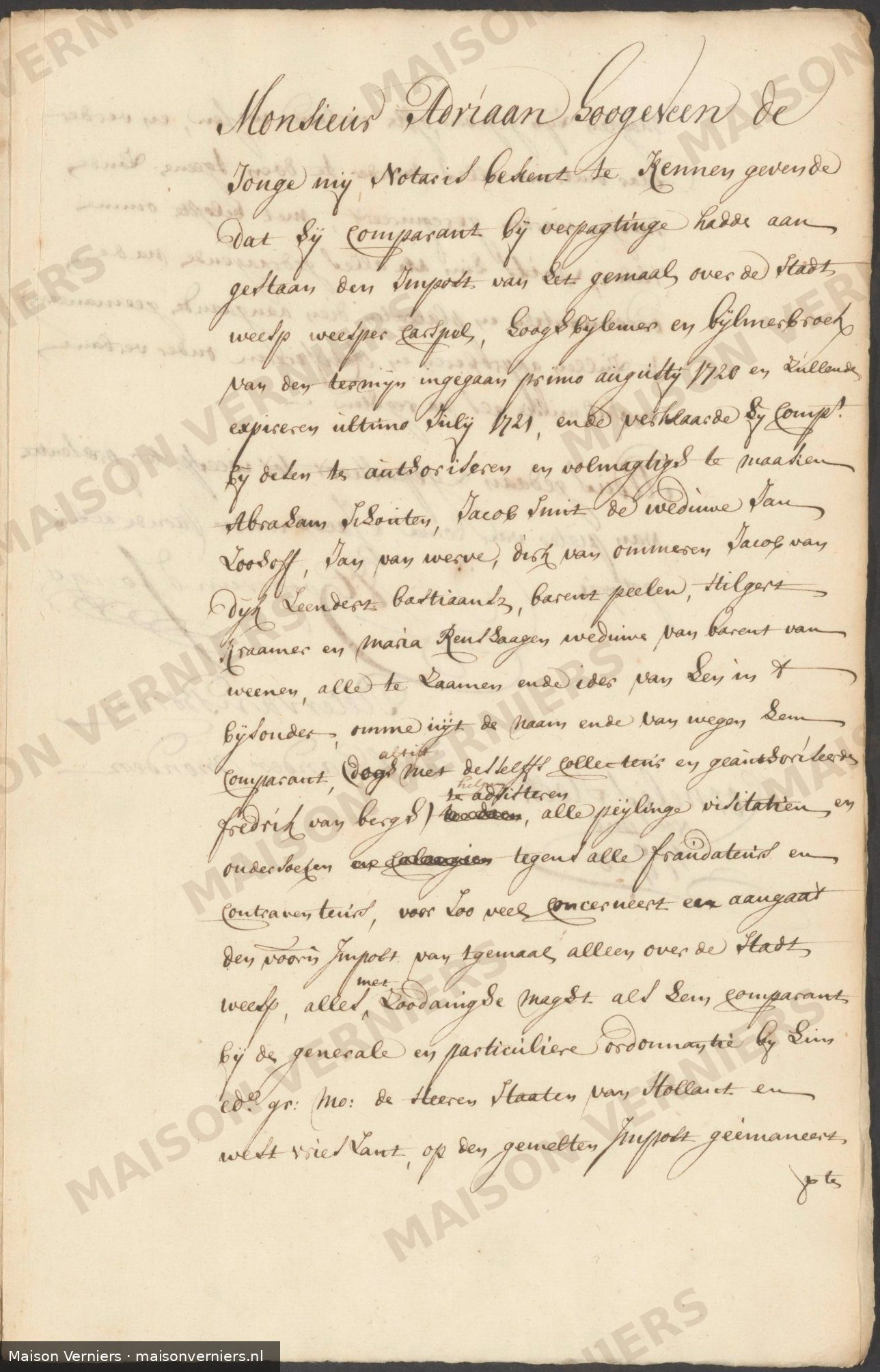
De impost op het gemaal werd niet door de stad zelf geïnd, maar elk jaar verpacht. Wie de pacht kocht, mocht de belasting innen en moest zelf zorgen dat niemand graan liet malen zonder te betalen. Op 1 augustus 1720, dezelfde dag waarop Pieter Verniers stierf, begon een nieuwe pachttermijn. De nieuwe pachter was "Monsieur Adriaan Hoogeveen de Jonge", voor de stad Weesp, Weesper Carspel, Hoog-Bijlmer en Bijlmerbroek, tot eind juli 1721 (Bron 333).
Op 17 september 1720 ging Hoogeveen naar notaris Hoet. Hij machtigde een rij Weesper bakkers, onder wie Jacob Smit, de weduwe Jan Lohoff, Jan van Werve, Dirk van Ommeren, Jacob van Dijk, Barent Peelen, Hilgert Kraamer en de weduwe van Barent van Weenen, om samen met zijn collecteur Fredrik van Bergh mee te doen aan "alle peylinge, visitatien en ondersoeken tegens alle fraudateurs en contraventeurs", voor zover het de impost op het gemaal in de stad betrof. Vooraan in die rij staat Abraham Schouten. Daar komen we op terug.
De volmacht van 17 september 1720: "Monsieur Adriaan Hoogeveen de Jonge" had "by verpagtinge" de impost van het gemaal over Weesp, Weesper Carspel, Hoog-Bijlmer en Bijlmerbroek aangenomen, "ingegaan primo augusty 1720", en machtigt de bakkers van Weesp om met collecteur Fredrik van Bergh mee te doen aan "alle peylinge, visitatien en ondersoeken tegens alle fraudateurs" (Bron 333).The power of attorney of 17 September 1720: "Monsieur Adriaan Hoogeveen de Jonge" had taken on "by verpagtinge" (by farm) the tax on milling over Weesp, Weesper Carspel, Hoog-Bijlmer and Bijlmerbroek, "ingegaan primo augusty 1720", and empowers the bakers of Weesp to join the collector Fredrik van Bergh in "alle peylinge, visitatien en ondersoeken tegens alle fraudateurs" (all inspections, visits and investigations against all fraudsters) (Source 333).
De peiling: tien molens en de bakkers
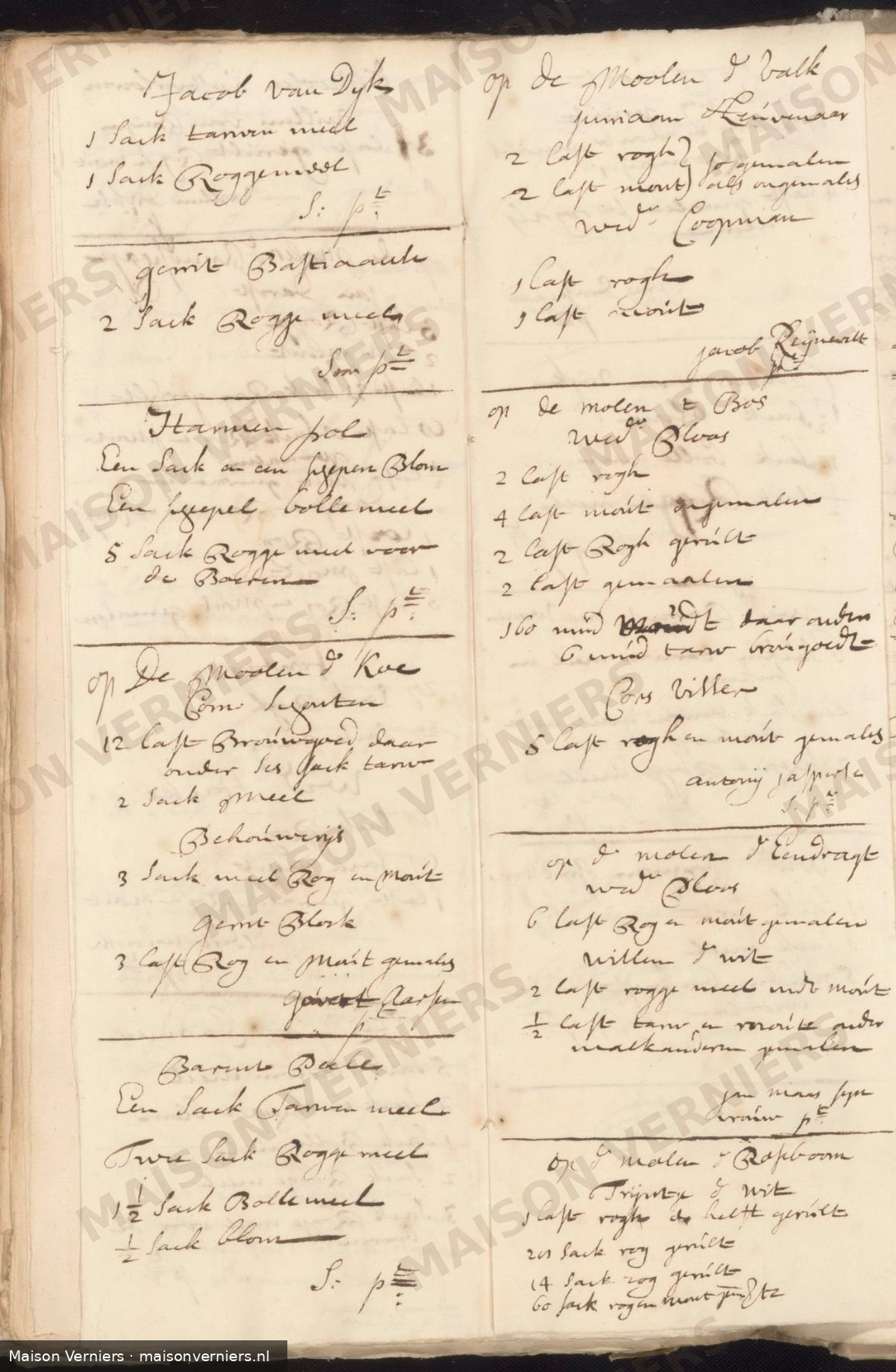
In het protocol van notaris Elout zit een lijst die laat zien wat er in die zomer op de Weesper molens en bij de bakkers lag. Deurwaarder L. van Paddenburgh en gerechtsbode J. van Paddenburgh gingen langs en schreven per molen op van wie het graan was en hoeveel: rogge, mout, tarwe en spelt, "so gemalen als ongemalen", en "brouwgoed" voor de brouwers. Bij elke post tekende de molenaar of zijn knecht, of de eigenaar zelf ("S. pr.", zelf present). De datum op de eerste bladzijde hebben we nog niet gezien, maar de lijst zit direct vóór een akte van 19 augustus 1720 en past bij het begin van de nieuwe pacht: bij een wisseling legde men vast wat er nog lag (Bron 335).
Molen
Wat er lag
De Koe
12 last brouwgoed (waaronder zes zak tarwe) en 2 zak meel; Gerrit Blok 3 last rogge en mout, gemalen; nog 3 zak meel van rogge en mout
De Vijf Zinnen
roggemeel en tarwemeel met mout; juffrouw Duyts 30 zak meel; Jan van Marken 3 last rogge en mout, ongemalen; Claes van Marken 2 last, gemalen
De Haan
Willem van Bruggen 3 last mout en rogge, "so gemalen als ongemalen", en 1 last brouwgoed
Kostverloren
Willem van Bruggen 3½ last "gerilt" rogge en mout
De Vriendschap
ruim 15 last rogge, mout en spelt van één eigenaar en zijn compagnons; Fonteyn 27 zak rogge en 27 zak mout; de weduwe Hacke 10 zak rogge, 10 zak mout en 1 last gemalen
De Valk
2 last rogge en 2 last mout; de weduwe Coopman 1 last rogge en 1 last mout
't Bos
rogge en mout, gemalen en ongemalen, en 160 mud mout met 6 mud tarwe als brouwgoed; nog 5 last rogge en mout van een tweede eigenaar
De Eendragt
6 last rogge en mout, gemalen; Willem de Wit 2 last roggemeel met mout en ½ last tarwe en mout "onder malkanderen gemalen"
De Rapboom
Trijntje de Wit 1 last rogge, de helft gerild, en tientallen zakken gerilde rogge en rogge met mout
De Achtkant
70 zak rogge en mout, "gemalen en gemengt", en 11 zak mout ongemalen
De lijst geeft een beeld van de molens van Weesp in 1720. Er staan tien namen in: De Koe, De Vijf Zinnen, De Haan, Kostverloren, De Vriendschap, De Valk, 't Bos, De Eendragt, De Rapboom en De Achtkant. De meeste zijn verdwenen. De naam De Vriendschap draagt nog altijd een korenmolen aan de Utrechtseweg (Bron 339); de huidige d'Eendracht ernaast is in 1743 gebouwd, dus de Eendragt van 1720 was een voorganger (Bron 340). Op De Haan en Kostverloren lag het graan van de brander Willem van Bruggen, wiens testament van augustus 1720 in verhaal #27 staat (Bron 331). De grote hoeveelheden rogge en mout laten zien waar het graan naartoe ging: naar de branderijen en brouwerijen.
De peiling van 1720: links de bakkers met hun meel, rechts "Op de Moolen de Valk", "op de molen 't Bos", "op de molen de Eendragt" en "op de molen de Rapboom" (Bron 335).The inspection of 1720: left the bakers with their meal, right "Op de Moolen de Valk", "op de molen 't Bos", "op de molen de Eendragt" and "op de molen de Rapboom" (Source 335).
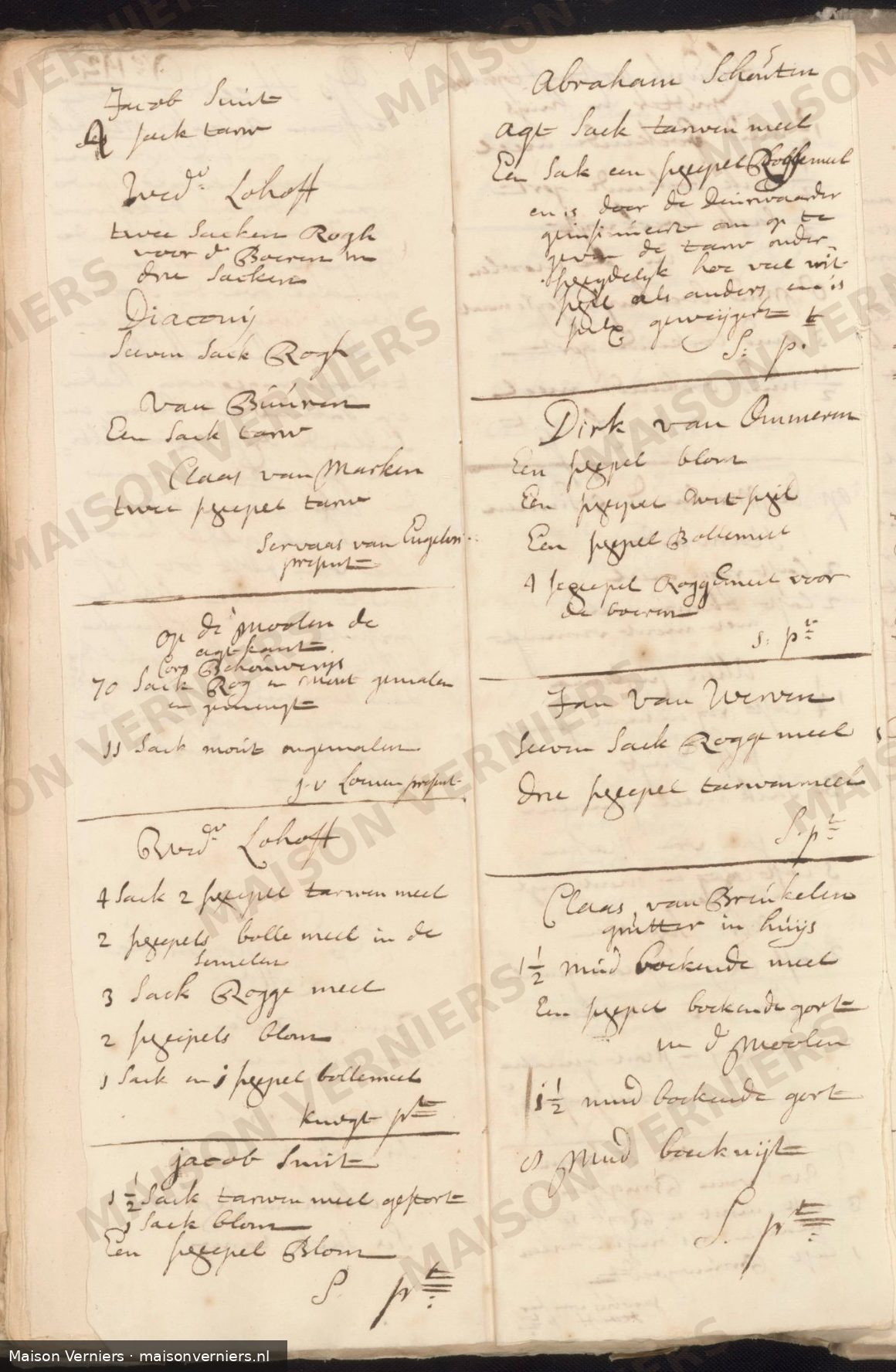
Daarna volgden de bakkers en grutters, met het meel dat zij in huis hadden: tarwemeel, roggemeel, bloem, bollemeel, boekweit en gort. Sommigen hadden roggemeel "voor de boeren" klaarstaan. Ook de diaconie had zeven zak rogge. Bij de grutters Hendrik [...] en Claas van Breukelen werd onderscheiden wat "in huys" lag en wat nog "in de moolen".
Abraham Schouten weigert
Bij één bakker liep het anders. Abraham Schouten had acht zak tarwemeel en een zak en een schepel bollemeel, "en is door de deurwaarder geinsinueert om op te geven de tarw onderscheydelyk hoe veel wit, spelt als anders, en is sulx geweygert". Hij weigerde dus te zeggen hoeveel van zijn tarwe wit was en hoeveel spelt of iets anders.
Rechtsboven Abraham Schouten: acht zak tarwemeel, en "is door de deurwaarder geinsinueert om op te geven de tarw ... en is sulx geweygert". Links onder meer de diaconie, de weduwe Lohoff en Claas van Marken, en de molen De Achtkant (Bron 335).Top right Abraham Schouten: eight sacks of wheat meal, and "is door de deurwaarder geinsinueert om op te geven de tarw ... en is sulx geweygert" (was summoned by the bailiff to declare the wheat ... and refused). Left among others the deaconry, the widow Lohoff and Claas van Marken, and the mill De Achtkant (Source 335).
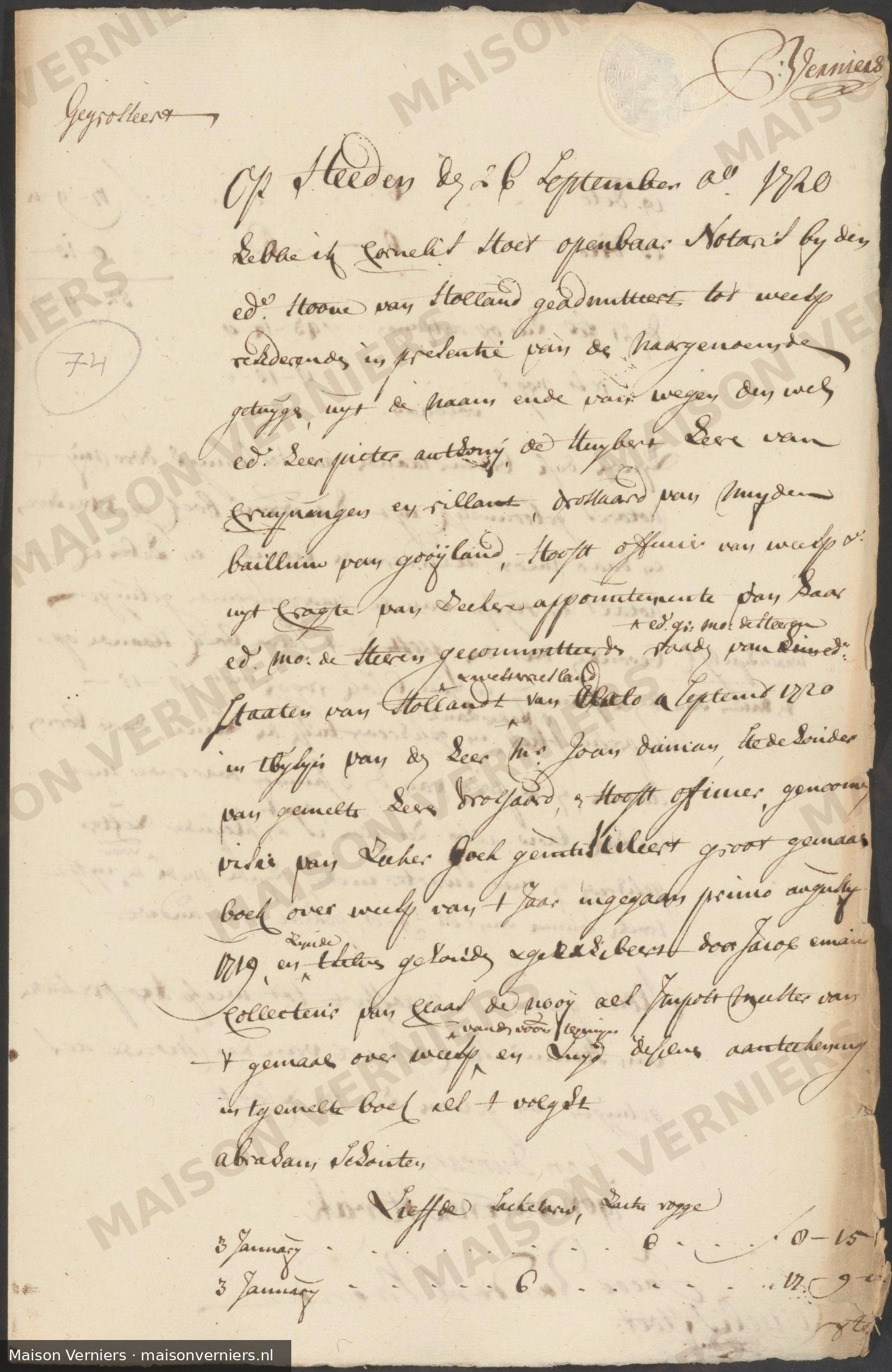
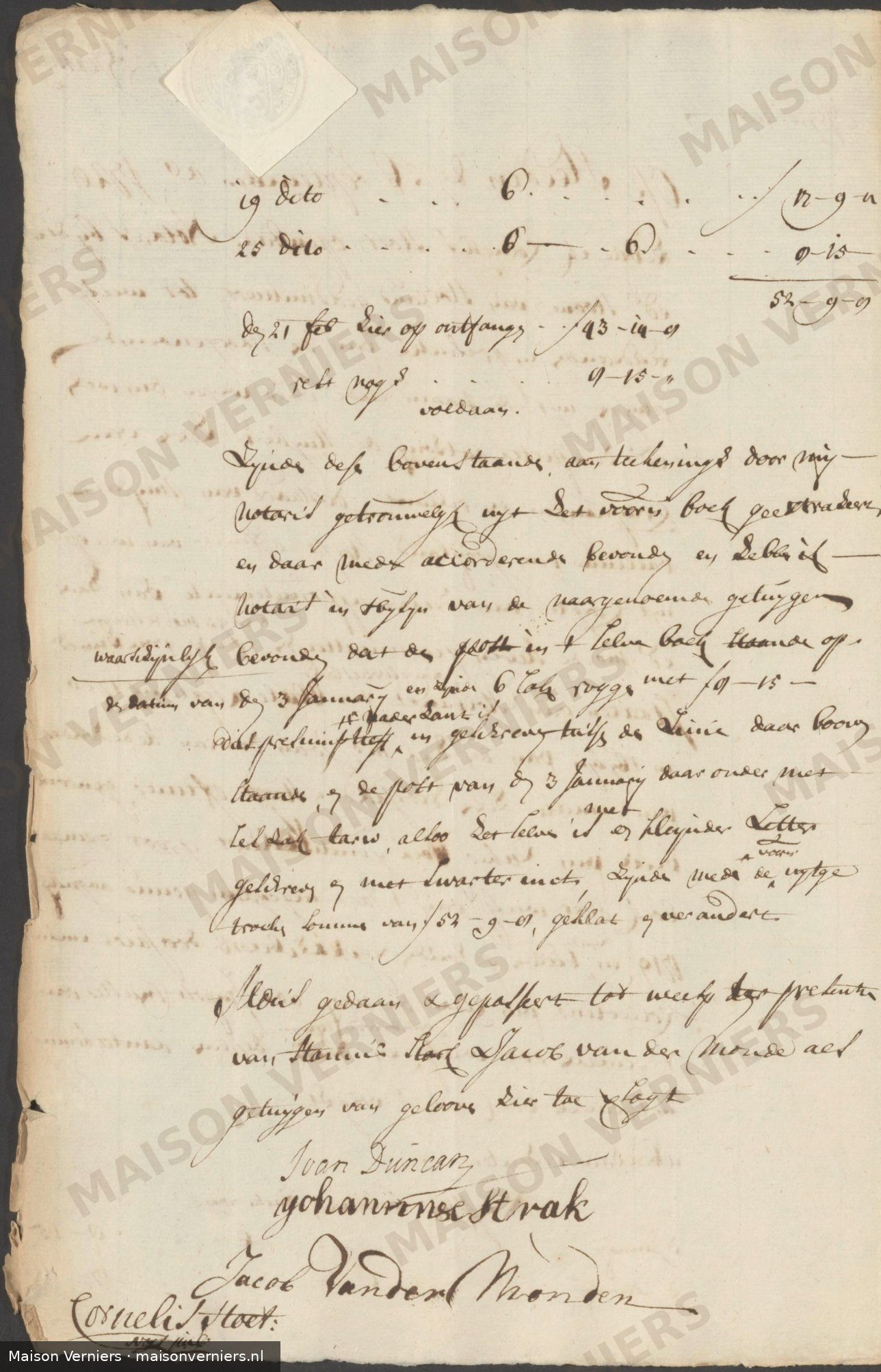
Op 26 september 1720 kwam het vervolg. In opdracht van de drossaard van Muiden, baljuw van Gooiland en hoofdofficier van Weesp, Pieter Anthony de Huybert, op last van de Gecommitteerde Raden van de Staten van Holland en in bijzijn van zijn stedehouder, schreef notaris Hoet de rekening van Abraham Schouten over uit het gemaalboek van Weesp over het jaar dat op 1 augustus 1719 was begonnen (Bron 333). Het boek werd bijgehouden door de collecteur van impostmeester Claas de Nooy. Abraham Schouten had in januari 1720 rogge laten malen, in posten van zes last, samen f 52-9-9; op 21 februari had hij f 43-14 betaald en de rest van f 9-15 later voldaan. Maar de notaris zag iets vreemds: de post van 3 januari, zes last rogge voor f 9-15, was tussen de regels "ingeschoven", "met kleynder letter geschreven en met swarter inct", en het totaal was "geklat en verandert".
26 september 1720: in opdracht van de drossaard schrijft notaris Hoet de rekening van Abraham Schouten over uit het gemaalboek van 1719–1720 (Bron 333).26 September 1720: on the orders of the drost, the notary Hoet copies Abraham Schouten's account from the milling ledger of 1719–1720 (Source 333).Het vervolg: de post van 3 januari is "ingeschoven", "met kleynder letter geschreven en met swarter inct", en het totaal "geklat en verandert" (Bron 333).The continuation: the entry of 3 January has been "ingeschoven" (squeezed in), "met kleynder letter geschreven en met swarter inct" (in smaller letters and blacker ink), and the total "geklat en verandert" (blotted and altered) (Source 333).
Wie er in het boek had geknoeid en waarom, zegt de akte niet. Het onderzoek kwam van hoog: de drossaard trad op in opdracht van de Gecommitteerde Raden, het dagelijks bestuur van de Staten. Opvallend is dat Abraham Schouten negen dagen eerder vooraan stond in de rij bakkers die de nieuwe pachter moesten helpen fraude op te sporen. De naam Schouten is in Weesp bekend uit de brouwerswereld (verhaal #27), maar of Abraham bij die familie hoorde, is nog niet uitgezocht.
De Verniers in deze zomer
Voor de familie gaat dit verhaal over meer dan papier. Pieter Verniers was als secretaris betrokken bij de belastingen van de stad: zijn boedel noemt grote bedragen aan de 20e, 40e en 80e penning die hij nog moest afdragen (Bron 325), en zijn naam staat op het gezegelde papier waarop de akten over die belastingen geschreven werden. De akte van Hoogeveen, de peiling en het onderzoek naar het gemaalboek zijn allemaal op zulk papier gezet: de laatste sporen van zijn werk, weken na zijn dood.
Twee stukken uit de peiling en het gemaalboek uitgeschreven, in de oorspronkelijke spelling; onzekere lezingen staan tussen vierkante haken:
[Bij Abraham Schouten:] agt sack tarwenmeel, een sak een schepel bollemeel, en is door de deurwaarder geinsinueert om op te geven de tarw onderscheydelyk hoe veel wit, spelt als anders, en is sulx geweygert. S[elfs] pr[esent].
[Slot:] Aldus gedaan en gepeylt ten overstaan als in 't hooft deses en ter presentie van ons ondergeschreven, actum ut supra. [getekend:] L. van Paddenburgh, deurwaarder — J. v. Paddenburgh, gerechtsbode — Elout, Nots. publ. 1720
Op heeden den 26 September Ao 1720 hebbe ik Cornelis Hoet, openbaar notaris [...], uyt de naam ende van wegen den wel ed. Heer Pieter Anthony de Huybert, [...] drossaard van Muyden, bailluw van Gooyland, hooft officier van Weesp etc., uyt kragte van seker appointement van haar Ed. Mo. de Heeren Gecommitteerde Raaden van haar Ed. Gr. Mo. de Heeren Staaten van Hollandt en Westvrieslandt van dato [.] September 1720, in 't bysyn van den Heer Mr. [Joan Duncan], stedehouder van gemelte Heer drossaard en hooft officier, [gevidimeert] uyt seker boek genaamt gemaalboek over Weesp van 't jaar ingegaan primo augusty 1719, en zynde gehouden en geadministreert door [Jacob Emans], collecteur van Claas de Nooy als impostmeester van 't gemaal over Weesp [...], desen aanteekening in 't gemelte boek als 't volgt:
Abraham Schouten [...] rogge 3 January — 6 — f 9-15 3 January — 6 — f 12-9 [...] 19 dito — 6 — f 12-9 25 dito — 6 — 6 — f 9-15 [totaal] f 52-9-9 den 21 feb. hier op ontfangen f 43-14 rest nogh f 9-15 — voldaan.
Zynde dese bovenstaande aanteekeninge door my notaris getrouwelyk uyt het voorsz. boek geextraheert en daar mede accorderende bevonden, en hebbe ik notaris in 't byzyn van de naargenoemde getuygen [waarschijnlijk] bevonden dat de post in 't selve boek staande op de datum van den 3 January en zynde 6 last rogge met f 9-15 daar ingeschoven is en geschreven tusschen de lyne daar boven staande en de post van den 3 January daar onder staande, alsoo het selve is met kleynder letter geschreven en met swarter inct, zynde mede de voorsz. uytgetrocken somme van f 52-9-9 geklat en verandert.
Aldus gedaan en gepasseert tot Weesp ter presentie van [Hendrick] Strak en Jacob van der Monde als getuygen van geloove hier toe versogt. [getekend:] [Joan Duncan] — Johannes Strak — Jacob van der Monden — Cornelis Hoet, Not. publ.
Wordt vervolgd
De eerste bladzijde van de peiling, met de datum en de opdrachtgever, moet nog worden opgezocht in het protocol van notaris Elout, net als het gemaalboek zelf en de afloop van de zaak tegen Abraham Schouten.
In the summer of 1720, the summer in which the secretary Pieter Verniers and his mother died within a day of each other (story #30), the deeds of the Weesp notaries also show how the town worked. Almost everything was taxed. Whoever had a deed drawn up paid for the paper. Whoever had grain milled paid the farmer of the tax on milling. And the authorities watched for cheating. This story follows both taxes through one summer, with the people involved.
Paper with a stamp
From 1624 deeds in Holland had to be written on stamped paper: sheets with an embossed stamp, the "klein zegel", on which the tax had already been paid. The paper was sold by local sellers, and in Weesp they put their name next to the stamp. On dozens of deeds of the notary Cornelis Hoet from 1720 the top right thus reads "P: Verniers" (Source 328). That was the secretary himself: in his estate "de zegels van de overledene" (the deceased's stamped paper) were handed over for f 257.10 to his successor, the secretary Hendrik van der Poort (Source 325). Because the sheets had already been signed, they simply stayed in use after his death on 1 August, until the end of September (Source 331)(Source 333).
There was another seller. On the deeds of the notary Theodorus Elout, and on a deed of Hoet of 1 August, the name by the stamp is "B. Heumen" (Source 334). That is Baltus van Heumen, himself a notary in Weesp; he signed his own deeds with exactly the same flourish (Source 338). We have not yet found a regulation requiring the seller to sign by the stamp; the explanation rests on the deeds themselves.
Twee namen bij het zegel: links "P: Verniers" (akte van 11 augustus 1720), rechts "Heumen" (akte van 1 augustus 1720) (Bron 329)(Bron 331).Two names by the stamp: left "P: Verniers" (deed of 11 August 1720), right "Heumen" (deed of 1 August 1720) (Source 329)(Source 331).
A new tax farmer: 1 August 1720
The tax on milling was not collected by the town itself but farmed out every year. Whoever bought the farm could collect the tax and had to make sure himself that no one had grain milled without paying. On 1 August 1720, the very day Pieter Verniers died, a new term began. The new farmer was "Monsieur Adriaan Hoogeveen de Jonge", for the town of Weesp, Weesper Carspel, Hoog-Bijlmer and Bijlmerbroek, until the end of July 1721 (Source 333).
On 17 September 1720 Hoogeveen went to the notary Hoet. He empowered a row of Weesp bakers, among them Jacob Smit, the widow of Jan Lohoff, Jan van Werve, Dirk van Ommeren, Jacob van Dijk, Barent Peelen, Hilgert Kraamer and the widow of Barent van Weenen, to join his collector Fredrik van Bergh in "alle peylinge, visitatien en ondersoeken tegens alle fraudateurs en contraventeurs" (all inspections, visits and investigations against all fraudsters and offenders), as far as the milling tax in the town was concerned. At the head of that row stands Abraham Schouten. We will come back to him.
De volmacht van 17 september 1720: "Monsieur Adriaan Hoogeveen de Jonge" had "by verpagtinge" de impost van het gemaal over Weesp, Weesper Carspel, Hoog-Bijlmer en Bijlmerbroek aangenomen, "ingegaan primo augusty 1720", en machtigt de bakkers van Weesp om met collecteur Fredrik van Bergh mee te doen aan "alle peylinge, visitatien en ondersoeken tegens alle fraudateurs" (Bron 333).The power of attorney of 17 September 1720: "Monsieur Adriaan Hoogeveen de Jonge" had taken on "by verpagtinge" (by farm) the tax on milling over Weesp, Weesper Carspel, Hoog-Bijlmer and Bijlmerbroek, "ingegaan primo augusty 1720", and empowers the bakers of Weesp to join the collector Fredrik van Bergh in "alle peylinge, visitatien en ondersoeken tegens alle fraudateurs" (all inspections, visits and investigations against all fraudsters) (Source 333).
The inspection: ten mills and the bakers
The records of the notary Elout contain a list showing what lay in the mills and with the bakers of Weesp that summer. The bailiff L. van Paddenburgh and the court messenger J. van Paddenburgh went round and wrote down, mill by mill, whose grain it was and how much: rye, malt, wheat and spelt, "so gemalen als ongemalen" (ground and unground), and "brouwgoed" (brewing grain) for the brewers. For each entry the miller or his servant, or the owner himself ("S. pr.", self present), signed. We have not yet seen the date on the first page, but the list sits directly before a deed of 19 August 1720 and fits the start of the new farm: at a changeover one recorded what was still in stock (Source 335).
Mill
What was there
De Koe
12 last of brewing grain (including six sacks of wheat) and 2 sacks of meal; Gerrit Blok 3 last of rye and malt, ground; another 3 sacks of rye and malt meal
De Vijf Zinnen
rye meal and wheat meal mixed with malt; Miss Duyts 30 sacks of meal; Jan van Marken 3 last of rye and malt, unground; Claes van Marken 2 last, ground
De Haan
Willem van Bruggen 3 last of malt and rye, "so gemalen als ongemalen" (ground and unground), and 1 last of brewing grain
Kostverloren
Willem van Bruggen 3½ last of "gerilt" rye and malt
De Vriendschap
more than 15 last of rye, malt and spelt from one owner and his partners; Fonteyn 27 sacks of rye and 27 of malt; the widow Hacke 10 sacks of rye, 10 of malt and 1 last ground
De Valk
2 last of rye and 2 of malt; the widow Coopman 1 last of rye and 1 of malt
't Bos
rye and malt, ground and unground, and 160 mud of malt with 6 mud of wheat as brewing grain; another 5 last of rye and malt from a second owner
De Eendragt
6 last of rye and malt, ground; Willem de Wit 2 last of rye meal with malt and ½ last of wheat and malt "onder malkanderen gemalen" (ground together)
De Rapboom
Trijntje de Wit 1 last of rye, half of it "gerild", and dozens of sacks of "gerild" rye and rye with malt
De Achtkant
70 sacks of rye and malt, "gemalen en gemengt" (ground and mixed), and 11 sacks of malt unground
The list gives a picture of the mills of Weesp in 1720. It names ten: De Koe, De Vijf Zinnen, De Haan, Kostverloren, De Vriendschap, De Valk, 't Bos, De Eendragt, De Rapboom and De Achtkant. Most have disappeared. The name De Vriendschap is still borne by a corn mill on the Utrechtseweg (Source 339); the present d'Eendracht beside it was built in 1743, so the Eendragt of 1720 was a predecessor (Source 340). At De Haan and Kostverloren lay the grain of the distiller Willem van Bruggen, whose will of August 1720 is described in story #27(Source 331). The large quantities of rye and malt show where the grain went: to the distilleries and breweries.
De peiling van 1720: links de bakkers met hun meel, rechts "Op de Moolen de Valk", "op de molen 't Bos", "op de molen de Eendragt" en "op de molen de Rapboom" (Bron 335).The inspection of 1720: left the bakers with their meal, right "Op de Moolen de Valk", "op de molen 't Bos", "op de molen de Eendragt" and "op de molen de Rapboom" (Source 335).
Then came the bakers and grain dealers, with the meal they had in the house: wheat meal, rye meal, flour, bollemeel, buckwheat and groats. Some had rye meal ready "voor de boeren" (for the farmers). The deaconry, too, had seven sacks of rye. For the grain dealers Hendrik [...] and Claas van Breukelen a distinction was made between what lay "in huys" (in the house) and what was still "in de moolen" (at the mill).
Abraham Schouten refuses
With one baker things went differently. Abraham Schouten had eight sacks of wheat meal and a sack and a schepel of bollemeel, "en is door de deurwaarder geinsinueert om op te geven de tarw onderscheydelyk hoe veel wit, spelt als anders, en is sulx geweygert". He refused, in other words, to say how much of his wheat was white and how much spelt or other.
Rechtsboven Abraham Schouten: acht zak tarwemeel, en "is door de deurwaarder geinsinueert om op te geven de tarw ... en is sulx geweygert". Links onder meer de diaconie, de weduwe Lohoff en Claas van Marken, en de molen De Achtkant (Bron 335).Top right Abraham Schouten: eight sacks of wheat meal, and "is door de deurwaarder geinsinueert om op te geven de tarw ... en is sulx geweygert" (was summoned by the bailiff to declare the wheat ... and refused). Left among others the deaconry, the widow Lohoff and Claas van Marken, and the mill De Achtkant (Source 335).
On 26 September 1720 came the sequel. On the orders of the drost of Muiden, bailiff of Gooiland and chief officer of Weesp, Pieter Anthony de Huybert, acting for the Gecommitteerde Raden of the States of Holland and in the presence of his deputy, the notary Hoet copied Abraham Schouten's account from the milling ledger of Weesp for the year that had begun on 1 August 1719 (Source 333). The ledger was kept by the collector of the tax master Claas de Nooy. In January 1720 Abraham Schouten had had rye milled, in entries of six last, together f 52-9-9; on 21 February he had paid f 43-14 and the remaining f 9-15 later. But the notary noticed something odd: the entry of 3 January, six last of rye for f 9-15, had been "ingeschoven" (squeezed in) between the lines, "met kleynder letter geschreven en met swarter inct" (in smaller letters and blacker ink), and the total had been "geklat en verandert" (blotted and altered).
26 september 1720: in opdracht van de drossaard schrijft notaris Hoet de rekening van Abraham Schouten over uit het gemaalboek van 1719–1720 (Bron 333).26 September 1720: on the orders of the drost, the notary Hoet copies Abraham Schouten's account from the milling ledger of 1719–1720 (Source 333).Het vervolg: de post van 3 januari is "ingeschoven", "met kleynder letter geschreven en met swarter inct", en het totaal "geklat en verandert" (Bron 333).The continuation: the entry of 3 January has been "ingeschoven" (squeezed in), "met kleynder letter geschreven en met swarter inct" (in smaller letters and blacker ink), and the total "geklat en verandert" (blotted and altered) (Source 333).
Who had tampered with the ledger, and why, the deed does not say. The investigation came from high up: the drost acted on the orders of the Gecommitteerde Raden, the standing executive of the States. It is striking that nine days earlier Abraham Schouten had headed the row of bakers who were to help the new farmer detect fraud. The name Schouten is known in Weesp from the brewing world (story #27), but whether Abraham belonged to that family has not yet been established.
The Verniers in this summer
For the family this story is about more than paper. As secretary, Pieter Verniers was involved in the town's taxes: his estate names large sums in the 20th, 40th and 80th penny that he still had to hand over (Source 325), and his name stands on the stamped paper on which the deeds about those taxes were written. Hoogeveen's deed, the inspection and the investigation into the milling ledger were all set down on such paper: the last traces of his work, weeks after his death.
Two passages from the inspection and the milling ledger transcribed, in the original Dutch spelling; uncertain readings in square brackets:
[Bij Abraham Schouten:] agt sack tarwenmeel, een sak een schepel bollemeel, en is door de deurwaarder geinsinueert om op te geven de tarw onderscheydelyk hoe veel wit, spelt als anders, en is sulx geweygert. S[elfs] pr[esent].
[Slot:] Aldus gedaan en gepeylt ten overstaan als in 't hooft deses en ter presentie van ons ondergeschreven, actum ut supra. [getekend:] L. van Paddenburgh, deurwaarder — J. v. Paddenburgh, gerechtsbode — Elout, Nots. publ. 1720
Op heeden den 26 September Ao 1720 hebbe ik Cornelis Hoet, openbaar notaris [...], uyt de naam ende van wegen den wel ed. Heer Pieter Anthony de Huybert, [...] drossaard van Muyden, bailluw van Gooyland, hooft officier van Weesp etc., uyt kragte van seker appointement van haar Ed. Mo. de Heeren Gecommitteerde Raaden van haar Ed. Gr. Mo. de Heeren Staaten van Hollandt en Westvrieslandt van dato [.] September 1720, in 't bysyn van den Heer Mr. [Joan Duncan], stedehouder van gemelte Heer drossaard en hooft officier, [gevidimeert] uyt seker boek genaamt gemaalboek over Weesp van 't jaar ingegaan primo augusty 1719, en zynde gehouden en geadministreert door [Jacob Emans], collecteur van Claas de Nooy als impostmeester van 't gemaal over Weesp [...], desen aanteekening in 't gemelte boek als 't volgt:
Abraham Schouten [...] rogge 3 January — 6 — f 9-15 3 January — 6 — f 12-9 [...] 19 dito — 6 — f 12-9 25 dito — 6 — 6 — f 9-15 [totaal] f 52-9-9 den 21 feb. hier op ontfangen f 43-14 rest nogh f 9-15 — voldaan.
Zynde dese bovenstaande aanteekeninge door my notaris getrouwelyk uyt het voorsz. boek geextraheert en daar mede accorderende bevonden, en hebbe ik notaris in 't byzyn van de naargenoemde getuygen [waarschijnlijk] bevonden dat de post in 't selve boek staande op de datum van den 3 January en zynde 6 last rogge met f 9-15 daar ingeschoven is en geschreven tusschen de lyne daar boven staande en de post van den 3 January daar onder staande, alsoo het selve is met kleynder letter geschreven en met swarter inct, zynde mede de voorsz. uytgetrocken somme van f 52-9-9 geklat en verandert.
Aldus gedaan en gepasseert tot Weesp ter presentie van [Hendrick] Strak en Jacob van der Monde als getuygen van geloove hier toe versogt. [getekend:] [Joan Duncan] — Johannes Strak — Jacob van der Monden — Cornelis Hoet, Not. publ.
To be continued
The first page of the inspection, with the date and who ordered it, has yet to be traced in the records of the notary Elout, as have the milling ledger itself and the outcome of the case against Abraham Schouten.