Verhaal #26 · Verborgen VerhaalStory #26 · Hidden Story
Rond de Verniers in Weesp: families in de akten van notaris Johan van Leyden (1661–1680)Around the Verniers in Weesp: families in the deeds of the notary Johan van Leyden (1661–1680)
De Garsts, de Huygens, de Gooyers, de Schoutens en de Dells, en een stadsbestuur in conflictThe Garsts, the Huygens, the Gooyers, the Schoutens and the Dells, and a town government in conflict
Op 29 mei 1668 legde stadschirurgijn Lourens Verniers in Weesp een verklaring af bij notaris Johan van Leyden over een matroos die bij Chatham gewond was geraakt (verhaal #18). De protocollen van deze notaris zijn bewaard in het archief Notarissen te Weesp (GAW138) bij het Stadsarchief Amsterdam. Wie ze doorneemt, komt telkens families tegen waarmee de Verniersen trouwden, zaken deden of samen bestuurden.
Dit verhaal brengt die akten bijeen, familie voor familie. Het is een begin: de bedoeling is om op den duur alle belangrijke families van Weesp rond de Verniersen uit te schrijven. Waar een verband met de Verniersen nog niet is bewezen, staat dat erbij.
De notaris en zijn boeken
Van Johan van Leyden zijn vijf protocollen bewaard: inventarisnummer 5200 (1661–1664), 5201 (1665–1667), 5202 (1668–1670), 5203 (1671–1673) en 5204 (1674–1680). Drie hebben een klapper, een register op namen. Alle vijf zijn voor dit verhaal doorgenomen, akte voor akte op datum, partijen en onderwerp; de akten over de families hieronder zijn volledig gelezen. De Chatham-akte staat in 5202 (Bron 265). Over de brouwers van Weesp, die in deze boeken telkens terugkomen, gaat een apart verhaal: verhaal #27.
On 29 May 1668 the town surgeon Lourens Verniers made a declaration in Weesp before the notary Johan van Leyden about a sailor wounded at Chatham (story #18). This notary's records are kept in the archive Notarissen te Weesp (GAW138) at the Amsterdam City Archives. Going through them, one keeps meeting families with whom the Verniers married, did business or governed the town.
This story brings those deeds together, family by family. It is a beginning: the aim is eventually to write out all the important Weesp families around the Verniers. Where a link with the Verniers has not yet been proven, this is stated.
The notary and his books
Five of Johan van Leyden's records survive: inventory numbers 5200 (1661–1664), 5201 (1665–1667), 5202 (1668–1670), 5203 (1671–1673) and 5204 (1674–1680). Three have a klapper, an index of names. All five have been gone through for this story, deed by deed for date, parties and subject; the deeds about the families below have been read in full. The Chatham deed is in 5202 (Source 265). The brewers of Weesp, who keep appearing in these books, have a story of their own: story #27.
Mr. Lourens Verniers: chirurgijn in 1665, schepen in 1667
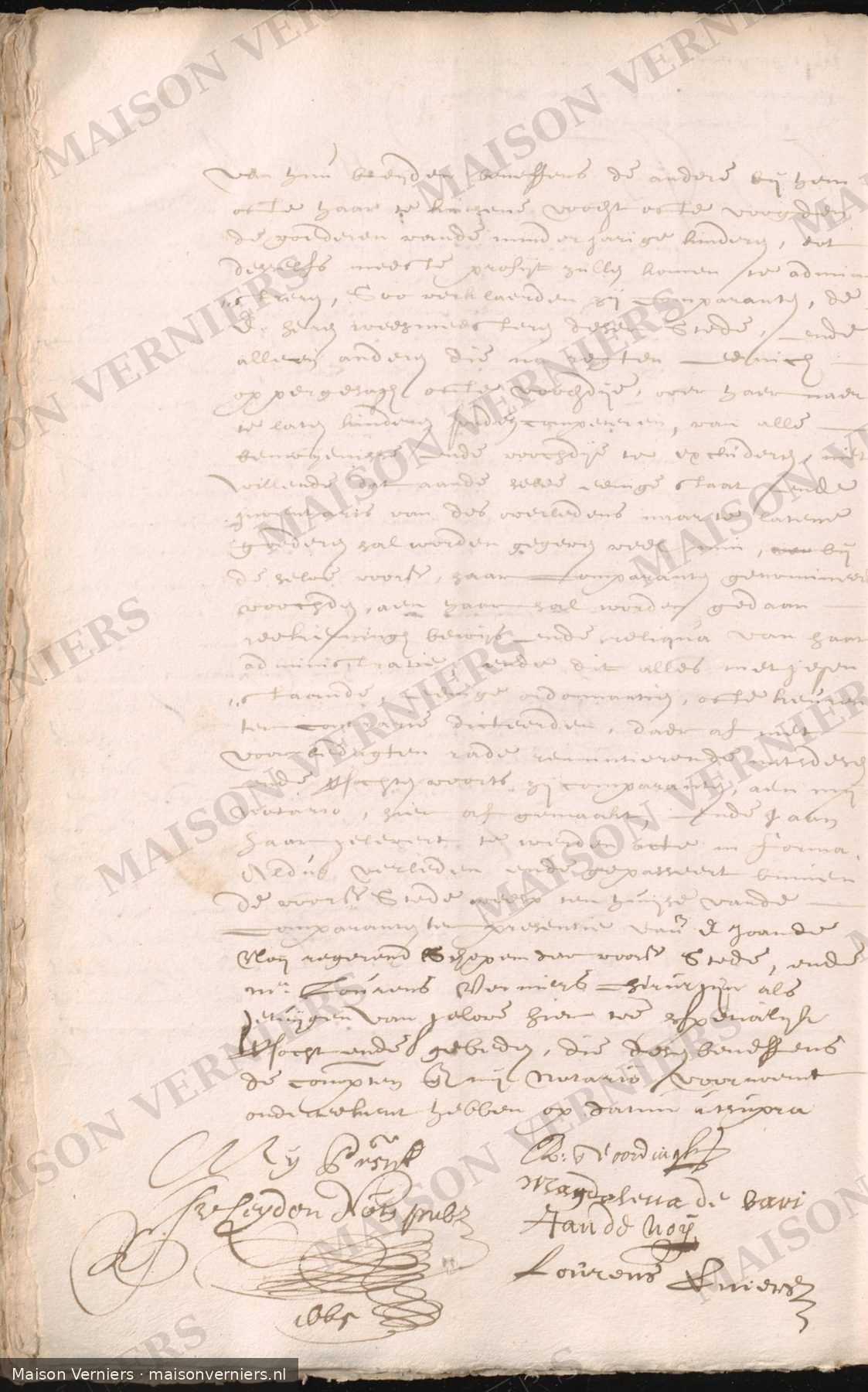
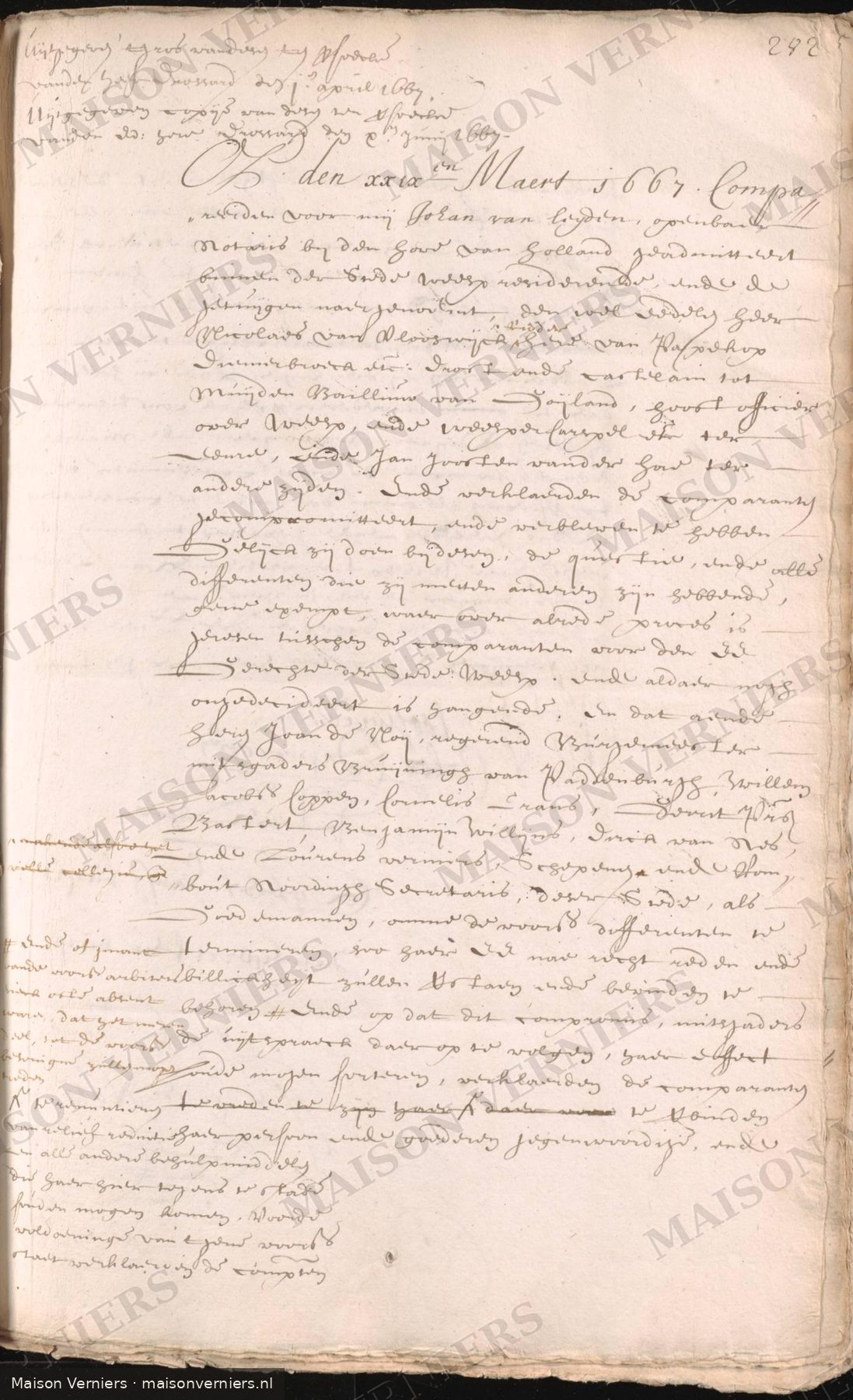
Twee akten verschuiven het beeld van Mr. Lourens Verniers. Op 26 maart 1665 was "Mr. Lourens Verniers, chirurgijn" getuige bij een akte van burgemeester Rombout Noordingh, naast regerend schepen Joan de Moy; hij tekende zelf (Bron 289). Op 29 maart 1667 trad hij op als een van de schepenen van Weesp, als goede man in een geschil tussen de drost van Muiden en Jan Joosten van der Haa (Bron 290).
Dat past niet bij het familiedossier van 1984, dat Lourens omstreeks 1671 "op 19-jarige leeftijd" laat trouwen en zo rond 1652 laat geboren zijn. Een meester-chirurgijn in 1665 en een schepen in 1667 was een volwassen man; Lourens moet dus eerder geboren zijn, waarschijnlijk vóór 1645. Wanneer precies, en hoe dat zich verhoudt tot het huwelijk van zijn ouders, moet nog worden uitgezocht.
Mr. Lourens Verniers: surgeon in 1665, alderman in 1667
Two deeds change the picture of Mr. Lourens Verniers. On 26 March 1665 "Mr. Lourens Verniers, chirurgijn" (surgeon) was a witness to a deed of burgomaster Rombout Noordingh, alongside the sitting alderman Joan de Moy; he signed himself (Source 289). On 29 March 1667 he acted as one of the aldermen of Weesp, as an arbiter in a dispute between the drost of Muiden and Jan Joosten van der Haa (Source 290).
This does not fit the 1984 family dossier, which has Lourens marry around 1671 "at age 19" and so be born around 1652. A master surgeon in 1665 and an alderman in 1667 was a grown man; Lourens must therefore have been born earlier, probably before 1645. When exactly, and how this relates to his parents' marriage, is still to be worked out.
Onderaan de akte van 26 maart 1665 de handtekening "Lourens Verniers", als getuige naast schepen Joan de Moy. Notarissen te Weesp (GAW138), inv. 5201, fol. 34 (Bron 289).At the foot of the deed of 26 March 1665 the signature "Lourens Verniers", as a witness alongside alderman Joan de Moy. Notarissen te Weesp (GAW138), inv. 5201, fol. 34 (Source 289).Het compromis van 29 maart 1667; onder de goede mannen staat "Lourens Verniers" bij de schepenen van Weesp. Inv. 5201, fol. 282 (Bron 290).The compromise of 29 March 1667; among the arbiters "Lourens Verniers" is listed with the aldermen of Weesp. Inv. 5201, fol. 282 (Source 290).
De weduwe en haar winkel, 1672
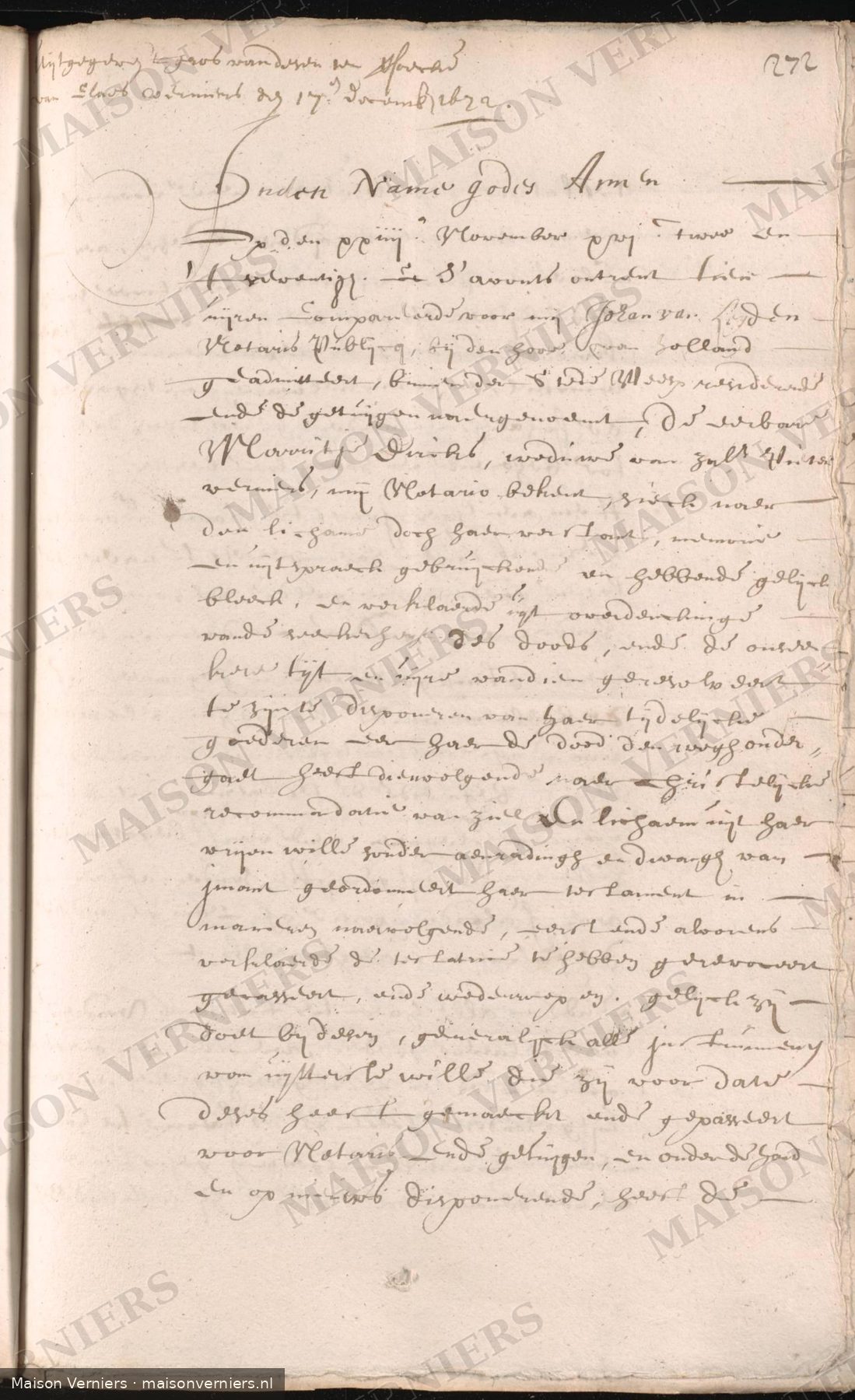
Op 23 november 1672, 's avonds, liet Marritje Dircks, "weduwe van zal. Pieter Verniers", notaris Van Leyden bij zich thuis komen. Zij was "siecke naer den lichame", maar bij haar verstand. Zij was de weduwe van Mr. Pieter Lourens Verniers, chirurgijn in Weesp, en de moeder van de broers in dit verhaal (zie de stamboom) (Bron 281).
Haar testament laat zien wat er in huis was. Aan haar zonen Claes en Pieter liet zij vooraf "de winckel en winckelwaren, mitsgaders de schalen en verder gereetschap daertoe behorende" na, en haar zilveren beker. Het gezin had dus een winkel met weegschalen; wat er verkocht werd, staat er niet bij. Haar jongste zoon Cornelis kreeg honderd gulden, vier zilveren lepels en "seecker stuck gouts daer in gegraven de beeltenis vande Coninginne Elisabeth van Engeland": een gouden munt of penning met het portret van koningin Elizabeth I. Haar erfgenamen in gelijke delen waren Lourens, Claes, Pieter en Cornelis. Tot voogden over de minderjarigen benoemde zij Coenraet Mersenier en Bruyningh (?) van Marken, met uitsluiting van de Weeskamer. Zelf schrijven kon of deed zij niet meer: zij zette een kruisje, "dit merck + is gestelt by Marritje Dircks".
Twee dingen vallen op. Het familiedossier van 1984 dateert het testament op 17 december 1672; die datum staat in de marge, als de dag waarop een afschrift werd uitgegeven, en kan erop wijzen dat zij toen al overleden was. En haar zoon Dirck wordt niet genoemd.
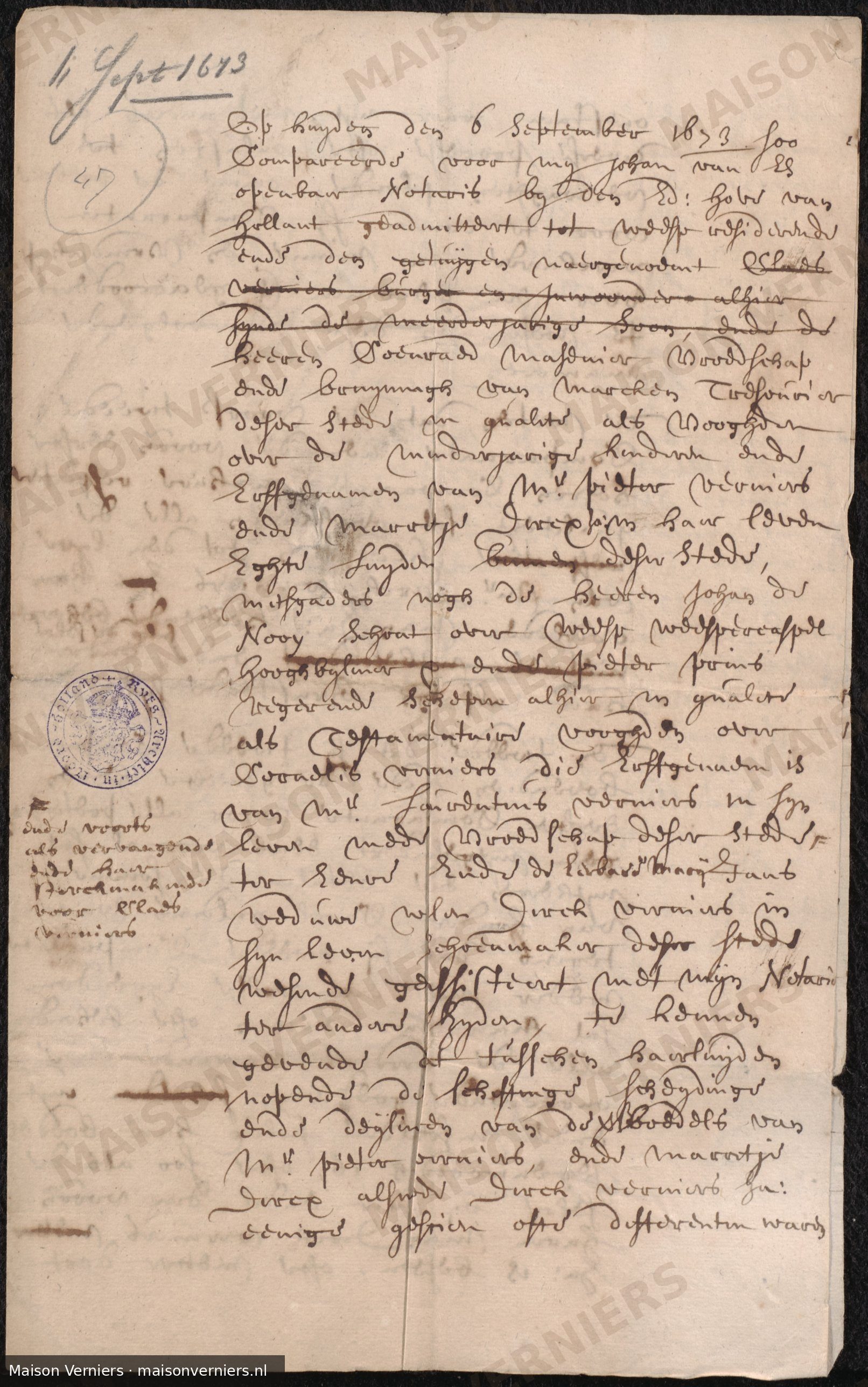
De vraag over Dirck opgelost. Een boedelscheiding van 6 september 1673 bij notaris Johan van Es geeft het antwoord (Bron 327). Op die dag troffen de voogden van de kinderen van Mr. Pieter Verniers en Marritje Dircx, toen beiden overleden, een schikking met "Mary Jans, weduwe wylen Dirck Verniers, in syn leven schoenmaker deser stede". Dirck was dus op 6 september 1673 al overleden, en die datum is niet die van zijn huwelijk, zoals de stamboom zei, maar die van deze akte. Mary Jans tekende als "marritye Garst": het is Marritye Jans Garst. Dirck moet vóór 1672 zijn getrouwd en vóór september 1673 zijn overleden, waarschijnlijk al vóór het testament van zijn moeder in november 1672, wat verklaart waarom zij hem niet noemt.
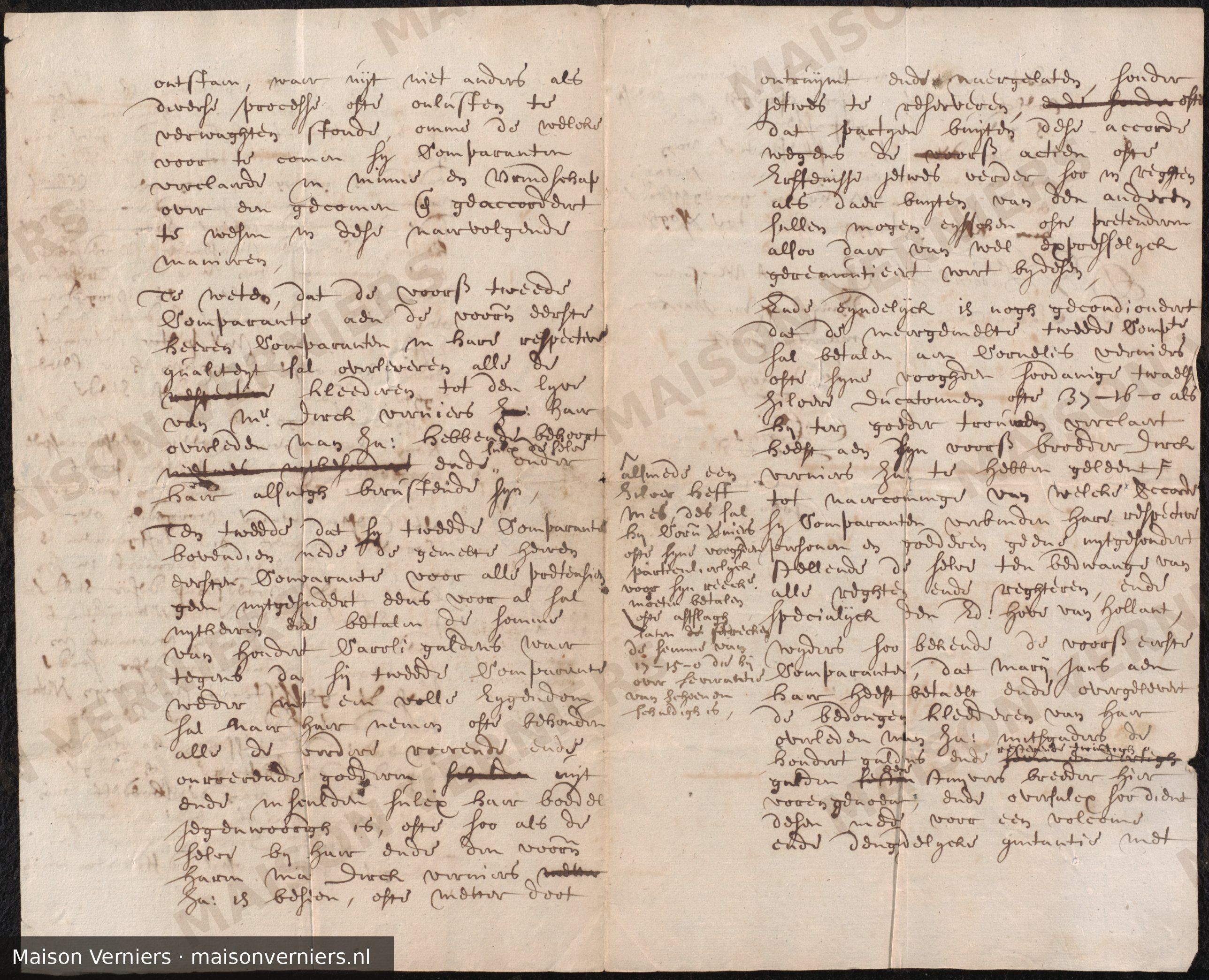
Er waren "eenige geschillen" over de boedels van de ouders en van Dirck, en om processen te voorkomen kwamen de partijen "in minne ende vrundschap" overeen. Mary Jans gaf Dircks kleren terug en betaalde honderd gulden aan de erfgenamen; daarvoor mocht zij alles houden wat zij en Dirck samen hadden bezeten. Aan Cornelis betaalde zij bovendien de twaalf zilveren dukatons (f 37-16-0) die hij Dirck had geleend. De akte laat ook zien hoe de familie er in 1673 voor stond:
Mr. Pieter Verniers en Marritje Dircx waren beiden overleden; hun minderjarige kinderen hadden als voogden Coenraed Masenier (vroedschap) en Bruyningh van Marcken (tresorier van de stad). Zijn naam was Coenraet Mersenier (ook Mesenier): de notaris schreef "Coenraed Masenier" en zelf tekende hij "Coenraet Mesenier". Op deze site stond hij eerder als Coenraet Marcelis, een verkeerde lezing; het is dezelfde voogd als in het testament van 1672.
Mr. Laurentius (Lourens) Verniers, vroedschap, was overleden, kort na zijn testament van 20 maart 1673. Zijn erfgenaam was zijn jongste broer Cornelis, die nog minderjarig was en als testamentaire voogden schout Johan de Nooy en schepen Pieter Prins had.
Claes was meerderjarig; zijn naam werd eerst als partij genoemd en daarna doorgehaald.
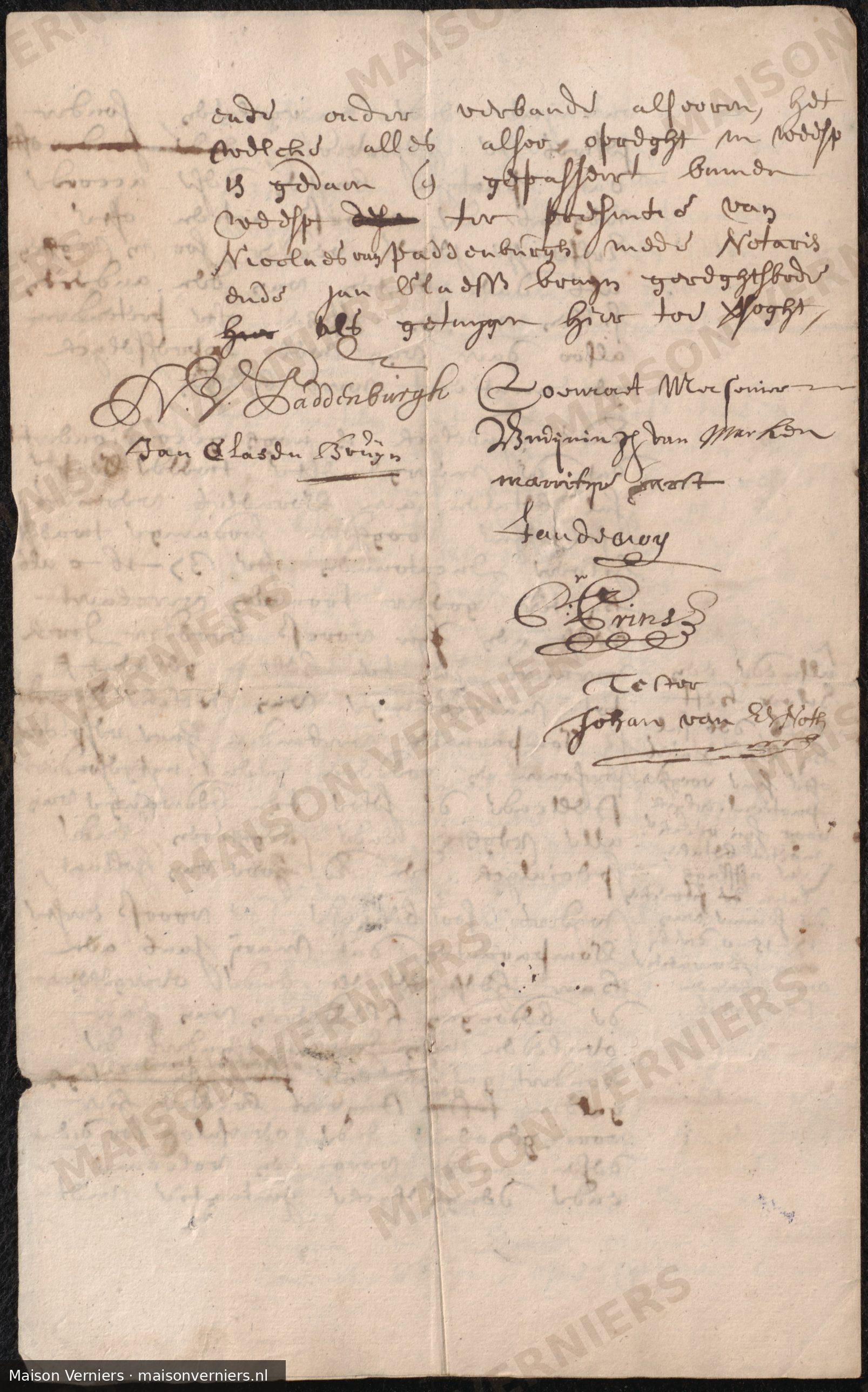
De boedelscheiding van 6 september 1673, eerste bladzijde: de voogden van de kinderen van Mr. Pieter Verniers en Marritje Dircx, de voogden van Cornelis Verniers als erfgenaam van Mr. Laurentius Verniers, en Mary Jans, weduwe van Dirck Verniers, schoenmaker (Bron 327).The settlement of 6 September 1673, first page: the guardians of the children of Mr. Pieter Verniers and Marritje Dircx, the guardians of Cornelis Verniers as heir of Mr. Laurentius Verniers, and Mary Jans, widow of Dirck Verniers, shoemaker (Source 327).De tweede en derde bladzijde, met de afspraken over de kleren van Dirck, de honderd gulden en de twaalf zilveren dukatons die Cornelis zijn broer had geleend (Bron 327).The second and third pages, with the terms about Dirck's clothes, the hundred guilders and the twelve silver ducatons Cornelis had lent his brother (Source 327).De laatste bladzijde met de handtekeningen, onder wie Coenraet Mesenier, Bruyningh van Marken, "marritye Garst", Jan de Nooy, Pieter Prins en notaris Johan van Es (Bron 327).The last page with the signatures, among them Coenraet Mesenier, Bruyningh van Marken, "marritye Garst", Jan de Nooy, Pieter Prins and the notary Johan van Es (Source 327).
De akte uitgeschreven, in de oorspronkelijke spelling; afkortingen zijn uitgeschreven, leestekens spaarzaam toegevoegd, onzekere lezingen staan tussen vierkante haken:
Op huyden den 6 September 1673 soo compareerde voor my Johan van Es, openbaer notaris by den Ed. Hove van Hollant geadmitteert, tot Weesp residerende, ende den getuygen naegenoemt, [doorgehaald: Claes Verniers, burger en inwoonder alhier, synde de meerderjarige soon, ende] de heeren Coenraed Masenier, vroedschap, ende Bruyningh van Marcken, tresorier deser stede, in qualite als voogden over de minderjarige kinderen ende erffgenamen van Mr. Pieter Verniers ende Marritje Dircx, in haer leven echte luyden deser stede, mitsgaders noch de heeren Johan de Nooy, schout over Weesp, Weespercarspel [ende] Hooghbylmer, ende Pieter Prins, regerende schepen alhier, in qualite als testamentaire voogden over Cornelis Verniers, die erffgenaem is van Mr. Laurentius Verniers, in syn leven mede vroedschap deser stede [in de marge: ende voorts als vervangende ende haer sterckmakende voor Claes Verniers], ter eenre, ende de eerbare Mary Jans, weduwe wylen Dirck Verniers, in syn leven schoenmaker deser stede woonende, geassisteert met mijn notaris, ter andere syde, te kennen gevende dat tusschen haerluyden nopende de scheydinge ende deylinge van de boedels van Mr. Pieter Verniers ende Marritje Dircx, alsmede Dirck Verniers zal., eenige geschillen ofte differenten waren ontstaen, waer uyt niet anders als diverse processen ofte onlusten te verwagten stonde; omme de welcke voor te comen sy comparanten verclaerden in minne ende vrundschap over een gecomen ende geaccordeert te wesen in deser naervolgende maniere:
Te weten, dat de voorsz. tweede comparante aen de voorn. eerste heeren comparanten in haer respective qualiteyt sal overleveren alle de cleederen tot den lyve van Dirck Verniers zal., haer overleden man, behoort hebbende ende onder haer althans berustende syn.
Ten tweede, dat sy tweede comparante [aen] de gemelte heeren eerste comparanten voor alle pretensien, geen uytgesondert, eens voor al sal uytkeeren ende betalen de somme van hondert Carolus guldens, waer tegens dat sy tweede comparante weder met een volle eygendom sal hebben, nemen ofte behouden alle de verdere roerende ende onroerende goederen, uyt ende inhouden sulcx haer boedel jegenwoordigh is, ofte soo als de selve by haer ende den voorn. haren man Dirck Verniers zal. is beseten ofte metter doot ontruymt ende naergelaten, sonder yetwes te reserveren, ofte dat partyen buyten dese accorde wegens de voorsz. actien ofte erffenisse yetwes verder, soo in regten als daer buyten, van den anderen sullen mogen eysschen ofte pretenderen, alsoo daer van wel expresselyck gerenuntieert wort by desen.
Ende eyndelyck is noch geconditioneert, dat de meergemelte tweede comparante sal betalen aen Cornelis Verniers ofte syne voogden soodanige twaelff silvere ducatonnen ofte 37-16-0, als hy ten [?] verclaert heeft aen syn voorsz. broeder Dirck Verniers zal. te hebben geleent [in de marge: alsmede een silver heft mes, dat sal by Corn. Verniers ofte syne voogden particulierlyck voor syn reeck. moeten betalen ofte affslagh laten de somme van 17-15-0, die hy over [?] schuldigh is].
Tot naercominge van welcke accorde sy comparanten verbinden haer respective persoonen ende goederen, geene uytgesondert, stellende de selve ten bedwange van alle heeren, hoven ende regters, ende specialyck den Ed. Hove van Hollant. Wyders soo bekende de voorsz. eerste comparanten dat Mary Jans aen haer heeft betaelt ende overgelevert de bedongen cleederen van haer overleden man zal., mitsgaders de hondert guldens ende [doorgehaald] gulden aen [hun] voorsz. broeder hier vooren genoemd; ende over sulcx soo dient dese mede voor een volcomen ende eeuwige quitantie, met ende onder verbandt als vooren. Het welcke alles alsoo oprecht en waer is gedaen ende gepasseert binnen Weesp ter presentie van Nicolaes van Paddenburgh, mede notaris, ende Jan Claesz Bruyn, gerechtsbode, als getuygen hier toe versoght.
[getekend:] N. v. Paddenburgh — Jan Claesen Bruyn — Coenraet Mesenier — Bruyningh van Marken — marritye Garst — Jan de Nooy — P. Prins — Testor Johan van Es, Nots.
The widow and her shop, 1672
On the evening of 23 November 1672 Marritje Dircks, "widow of the late Pieter Verniers", had the notary Van Leyden come to her house. She was "sick in body" but of sound mind. She was the widow of Mr. Pieter Lourens Verniers, surgeon in Weesp, and the mother of the brothers in this story (see the family tree) (Source 281).
Her will shows what there was in the house. To her sons Claes and Pieter she left in advance "de winckel en winckelwaren, mitsgaders de schalen en verder gereetschap daertoe behorende" (the shop and its wares, with the scales and other equipment belonging to it), and her silver beaker. So the family had a shop with scales; what was sold there is not stated. Her youngest son Cornelis received a hundred guilders, four silver spoons and "a certain piece of gold engraved with the likeness of Queen Elizabeth of England": a gold coin or medal with the portrait of Elizabeth I. Her heirs in equal shares were Lourens, Claes, Pieter and Cornelis. As guardians of the minors she appointed Coenraet Mersenier and Bruyningh (?) van Marken, excluding the Orphan Chamber. She no longer signed herself, but made a cross: "dit merck + is gestelt by Marritje Dircks".
Two things stand out. The 1984 family dossier dates the will to 17 December 1672; that date is in the margin, as the day on which a copy was issued, and may indicate that she had died by then. And her son Dirck is not mentioned.
The question about Dirck resolved. A settlement of 6 September 1673 before the notary Johan van Es gives the answer (Source 327). On that day the guardians of the children of Mr. Pieter Verniers and Marritje Dircx, by then both dead, reached an agreement with "Mary Jans, weduwe wylen Dirck Verniers, in syn leven schoenmaker deser stede" (widow of the late Dirck Verniers, in his lifetime a shoemaker of this town). Dirck had therefore already died by 6 September 1673, and that date is not his wedding date, as the family tree said, but the date of this deed. Mary Jans signed as "marritye Garst": she is Marritye Jans Garst. Dirck must have married before 1672 and died before September 1673, probably even before his mother's will of November 1672, which explains why she does not mention him.
There were "some disputes" about the estates of the parents and of Dirck, and to avoid lawsuits the parties came to terms "in minne ende vrundschap" (amicably and in friendship). Mary Jans returned Dirck's clothes and paid a hundred guilders to the heirs; in return she could keep everything she and Dirck had owned together. She also paid Cornelis the twelve silver ducatons (f 37-16-0) he had lent Dirck. The deed also shows how the family stood in 1673:
Mr. Pieter Verniers and Marritje Dircx had both died; their minor children had as guardians Coenraed Masenier (town councillor) and Bruyningh van Marcken (town treasurer). His name was Coenraet Mersenier (also Mesenier): the notary wrote "Coenraed Masenier" and he signed himself "Coenraet Mesenier". This site previously called him Coenraet Marcelis, a misreading; he is the same guardian as in the 1672 will.
Mr. Laurentius (Lourens) Verniers, town councillor, had died, shortly after his will of 20 March 1673. His heir was his youngest brother Cornelis, who was still a minor and had as testamentary guardians the sheriff Johan de Nooy and the alderman Pieter Prins.
Claes was of age; his name was first entered as a party and then struck out.
De boedelscheiding van 6 september 1673, eerste bladzijde: de voogden van de kinderen van Mr. Pieter Verniers en Marritje Dircx, de voogden van Cornelis Verniers als erfgenaam van Mr. Laurentius Verniers, en Mary Jans, weduwe van Dirck Verniers, schoenmaker (Bron 327).The settlement of 6 September 1673, first page: the guardians of the children of Mr. Pieter Verniers and Marritje Dircx, the guardians of Cornelis Verniers as heir of Mr. Laurentius Verniers, and Mary Jans, widow of Dirck Verniers, shoemaker (Source 327).De tweede en derde bladzijde, met de afspraken over de kleren van Dirck, de honderd gulden en de twaalf zilveren dukatons die Cornelis zijn broer had geleend (Bron 327).The second and third pages, with the terms about Dirck's clothes, the hundred guilders and the twelve silver ducatons Cornelis had lent his brother (Source 327).De laatste bladzijde met de handtekeningen, onder wie Coenraet Mesenier, Bruyningh van Marken, "marritye Garst", Jan de Nooy, Pieter Prins en notaris Johan van Es (Bron 327).The last page with the signatures, among them Coenraet Mesenier, Bruyningh van Marken, "marritye Garst", Jan de Nooy, Pieter Prins and the notary Johan van Es (Source 327).
The deed transcribed, in the original Dutch spelling; abbreviations expanded, punctuation added sparingly, uncertain readings in square brackets:
Op huyden den 6 September 1673 soo compareerde voor my Johan van Es, openbaer notaris by den Ed. Hove van Hollant geadmitteert, tot Weesp residerende, ende den getuygen naegenoemt, [doorgehaald: Claes Verniers, burger en inwoonder alhier, synde de meerderjarige soon, ende] de heeren Coenraed Masenier, vroedschap, ende Bruyningh van Marcken, tresorier deser stede, in qualite als voogden over de minderjarige kinderen ende erffgenamen van Mr. Pieter Verniers ende Marritje Dircx, in haer leven echte luyden deser stede, mitsgaders noch de heeren Johan de Nooy, schout over Weesp, Weespercarspel [ende] Hooghbylmer, ende Pieter Prins, regerende schepen alhier, in qualite als testamentaire voogden over Cornelis Verniers, die erffgenaem is van Mr. Laurentius Verniers, in syn leven mede vroedschap deser stede [in de marge: ende voorts als vervangende ende haer sterckmakende voor Claes Verniers], ter eenre, ende de eerbare Mary Jans, weduwe wylen Dirck Verniers, in syn leven schoenmaker deser stede woonende, geassisteert met mijn notaris, ter andere syde, te kennen gevende dat tusschen haerluyden nopende de scheydinge ende deylinge van de boedels van Mr. Pieter Verniers ende Marritje Dircx, alsmede Dirck Verniers zal., eenige geschillen ofte differenten waren ontstaen, waer uyt niet anders als diverse processen ofte onlusten te verwagten stonde; omme de welcke voor te comen sy comparanten verclaerden in minne ende vrundschap over een gecomen ende geaccordeert te wesen in deser naervolgende maniere:
Te weten, dat de voorsz. tweede comparante aen de voorn. eerste heeren comparanten in haer respective qualiteyt sal overleveren alle de cleederen tot den lyve van Dirck Verniers zal., haer overleden man, behoort hebbende ende onder haer althans berustende syn.
Ten tweede, dat sy tweede comparante [aen] de gemelte heeren eerste comparanten voor alle pretensien, geen uytgesondert, eens voor al sal uytkeeren ende betalen de somme van hondert Carolus guldens, waer tegens dat sy tweede comparante weder met een volle eygendom sal hebben, nemen ofte behouden alle de verdere roerende ende onroerende goederen, uyt ende inhouden sulcx haer boedel jegenwoordigh is, ofte soo als de selve by haer ende den voorn. haren man Dirck Verniers zal. is beseten ofte metter doot ontruymt ende naergelaten, sonder yetwes te reserveren, ofte dat partyen buyten dese accorde wegens de voorsz. actien ofte erffenisse yetwes verder, soo in regten als daer buyten, van den anderen sullen mogen eysschen ofte pretenderen, alsoo daer van wel expresselyck gerenuntieert wort by desen.
Ende eyndelyck is noch geconditioneert, dat de meergemelte tweede comparante sal betalen aen Cornelis Verniers ofte syne voogden soodanige twaelff silvere ducatonnen ofte 37-16-0, als hy ten [?] verclaert heeft aen syn voorsz. broeder Dirck Verniers zal. te hebben geleent [in de marge: alsmede een silver heft mes, dat sal by Corn. Verniers ofte syne voogden particulierlyck voor syn reeck. moeten betalen ofte affslagh laten de somme van 17-15-0, die hy over [?] schuldigh is].
Tot naercominge van welcke accorde sy comparanten verbinden haer respective persoonen ende goederen, geene uytgesondert, stellende de selve ten bedwange van alle heeren, hoven ende regters, ende specialyck den Ed. Hove van Hollant. Wyders soo bekende de voorsz. eerste comparanten dat Mary Jans aen haer heeft betaelt ende overgelevert de bedongen cleederen van haer overleden man zal., mitsgaders de hondert guldens ende [doorgehaald] gulden aen [hun] voorsz. broeder hier vooren genoemd; ende over sulcx soo dient dese mede voor een volcomen ende eeuwige quitantie, met ende onder verbandt als vooren. Het welcke alles alsoo oprecht en waer is gedaen ende gepasseert binnen Weesp ter presentie van Nicolaes van Paddenburgh, mede notaris, ende Jan Claesz Bruyn, gerechtsbode, als getuygen hier toe versoght.
[getekend:] N. v. Paddenburgh — Jan Claesen Bruyn — Coenraet Mesenier — Bruyningh van Marken — marritye Garst — Jan de Nooy — P. Prins — Testor Johan van Es, Nots.
Het begin van het testament van Marritje Dircks, weduwe van Pieter Verniers, 23 november 1672, fol. 272. In de marge de aantekening over het afschrift van 17 december 1672. Notarissen te Weesp (GAW138), inv. 5203 (Bron 281).The opening of the will of Marritje Dircks, widow of Pieter Verniers, 23 November 1672, fol. 272. In the margin the note on the copy of 17 December 1672. Notarissen te Weesp (GAW138), inv. 5203 (Source 281).
De Garsts
Twee Verniersen trouwden een Garst: Mr. Lourens Verniers omstreeks 1671 met Lijsbet Jans Garst, en zijn broer Dirck vóór 1672 met Marritye Jans Garst, die in 1673 als zijn weduwe optrad (zie hierboven). Het familiedossier noemt Lijsbet "vermoedelijk een dochter van Jan Cornelisz. Garst" (zie de stamboom). In de akten van Van Leyden komen drie Garsts voor:
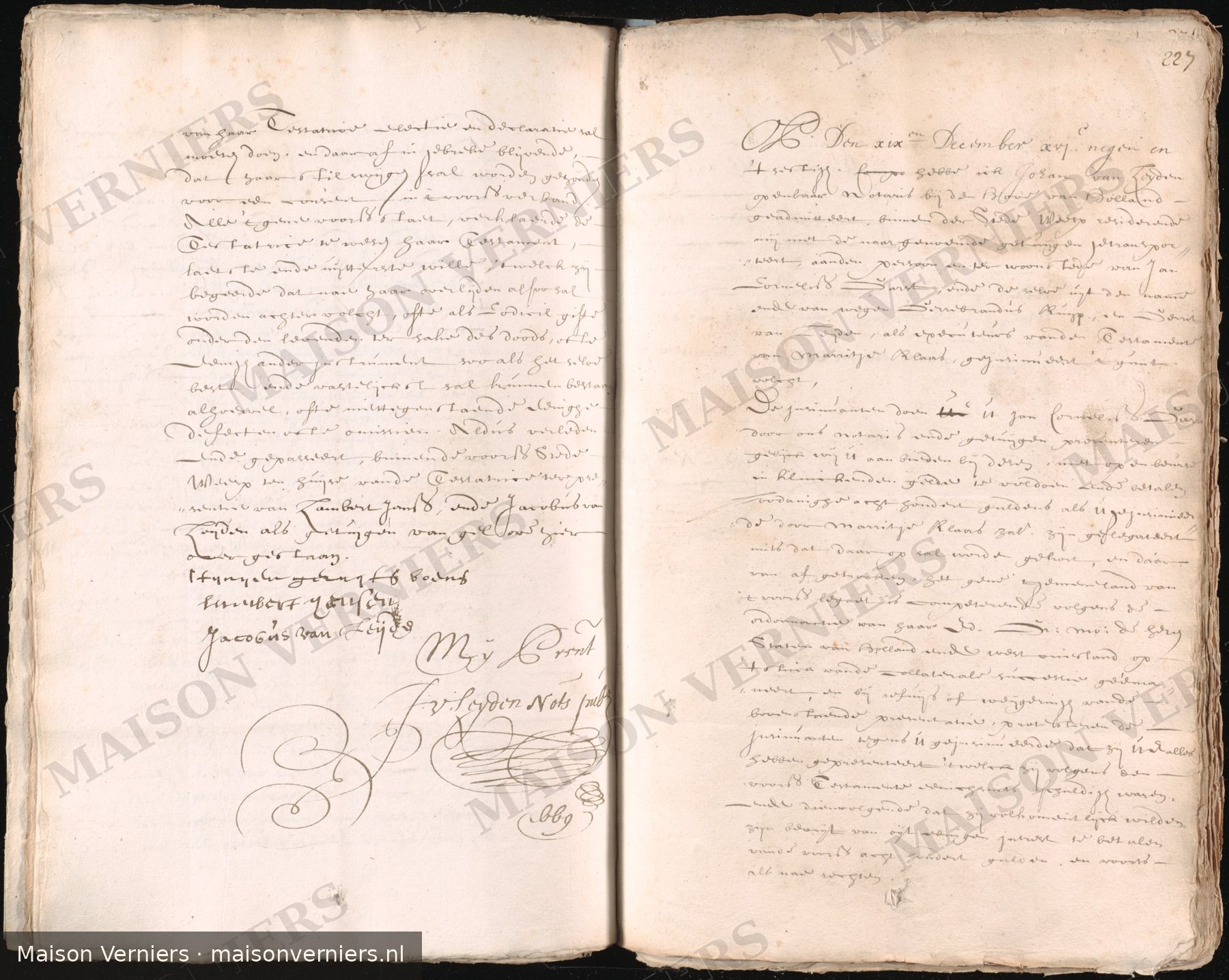
Jan Cornelisz Garst. Op 19 december 1669 ging de notaris met twee getuigen naar zijn huis, namens Gerbrandus Cuyp en Gerrit van Leyden, de executeurs van het testament van Maritje Klaas. Zij had Garst 800 gulden nagelaten. De executeurs wilden dat bedrag uitbetalen, na aftrek van de belasting op erfenissen buiten de rechte lijn (de collaterale successie) (Bron 275). Zijn antwoord is niet opgeschreven.
Jacob Claesz Garst, aan de Diemerbrug. In juni 1664 werd verklaard dat hem 500 gulden was betaald op een obligatie die hij had gegeven (Bron 273).
Wijlen Stoffel Garsten, molenaar. In november 1670 traden de voogden over zijn kinderen en erfgenamen op, in een zaak over de huur van een huis dat hem had toebehoord; een getuige verklaarde dat Dirck Fransz Voort het in 1654 en 1655 voor vijftig gulden per jaar had gehuurd (Bron 276).
De Garsts waren dus een uitgebreide familie rond Weesp en Diemen. Lijsbet en Marritye droegen de vadersnaam Jans, dochters van een Jan; dat maakt Jan Cornelisz Garst de meest voor de hand liggende vader. Bewezen is dat nog niet. In de klapper van het vierde boek (1671–1673) komt geen Garst voor (Bron 280).
Meer over de familie staat in een verdeling van 2 september 1667. De nalatenschap van Dirck Gysbertsz Dirk (?) werd in vijf loten verdeeld, met landerijen onder Weesp, Uitermeer en Muiden en een huis in Weesp. Erfgenamen waren onder anderen Jan Cornelisz Garst voor zichzelf, de minderjarige kinderen van zijn overleden broer Bruyn Cornelisz Garst, en zijn zuster Annitje Cornelis Garst; Jan tekende meermaals als voogd (Bron 293). Een jaar later stond Jan Cornelisz Garst in een proces tegenover Barbara Leeuw, de weduwe van burgemeester Cornelis Schouten, over 2900 gulden en de koop van huizen (Bron 311). Jan Cornelisz Garst was dus een man met bezit en een eigen plaats in Weesp; dat hij de vader van Lijsbet en Marritye was, staat ook in deze akten niet.
The Garsts
Two Verniers married a Garst: Mr. Lourens Verniers married Lijsbet Jans Garst around 1671, and his brother Dirck, before 1672, Marritye Jans Garst, who appeared as his widow in 1673 (see above). The family dossier calls Lijsbet "probably a daughter of Jan Cornelisz. Garst" (see the family tree). Three Garsts appear in Van Leyden's deeds:
Jan Cornelisz Garst. On 19 December 1669 the notary went to his house with two witnesses, on behalf of Gerbrandus Cuyp and Gerrit van Leyden, executors of the will of Maritje Klaas. She had left Garst 800 guilders. The executors wished to pay that sum, after deducting the tax on inheritances outside the direct line (the collateral succession duty) (Source 275). His answer was not recorded.
Jacob Claesz Garst, at the Diemerbrug. In June 1664 it was declared that 500 guilders had been paid to him on a bond he had given (Source 273).
The late Stoffel Garsten, miller. In November 1670 the guardians of his children and heirs acted in a matter about the rent of a house that had belonged to him; a witness declared that Dirck Fransz Voort had rented it in 1654 and 1655 for fifty guilders a year (Source 276).
So the Garsts were an extended family around Weesp and Diemen. Lijsbet and Marritye bore the patronymic Jans, daughters of a Jan; that makes Jan Cornelisz Garst the most likely father. This has not yet been proven. No Garst appears in the index of the fourth book (1671–1673) (Source 280).
More about the family appears in a partition of 2 September 1667. The estate of Dirck Gysbertsz Dirk (?) was divided into five lots, with land near Weesp, Uitermeer and Muiden and a house in Weesp. Among the heirs were Jan Cornelisz Garst for himself, the minor children of his late brother Bruyn Cornelisz Garst, and his sister Annitje Cornelis Garst; Jan signed several times as guardian (Source 293). A year later Jan Cornelisz Garst faced Barbara Leeuw, widow of burgomaster Cornelis Schouten, in a lawsuit about 2900 guilders and the purchase of houses (Source 311). Jan Cornelisz Garst was thus a man of property with a place of his own in Weesp; that he was the father of Lijsbet and Marritye is not stated in these deeds either.
Rechts: de insinuatie aan Jan Cornelisz Garst over het legaat van Maritje Klaas, 19 december 1669, fol. 227. Notarissen te Weesp (GAW138), inv. 5202 (Bron 275).Right: the notification to Jan Cornelisz Garst about Maritje Klaas's bequest, 19 December 1669, fol. 227. Notarissen te Weesp (GAW138), inv. 5202 (Source 275).
De Huygens
Op 24 september 1672 ging Claes Pieters Verniers in ondertrouw met Geurtje (Grietje) Huijgen, ongeveer 27 jaar oud; zij werd bijgestaan door haar oudste zuster Hilletje (zie de stamboom). In de akten van Van Leyden komen meerdere Huygens voor:
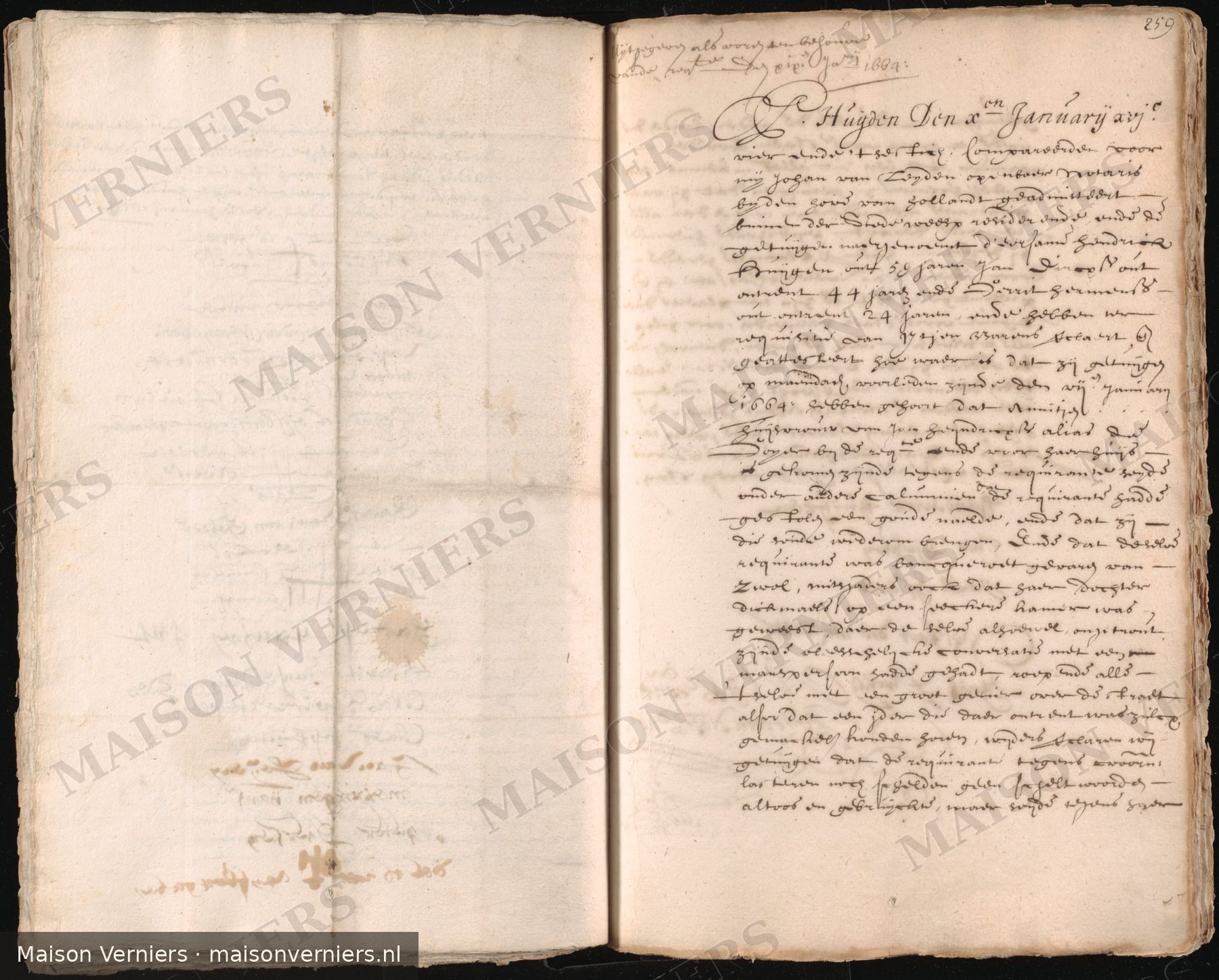
Hendrick Huygen, 59 jaar oud in januari 1664 en dus geboren omstreeks 1604/1605. Hij legde met twee anderen een verklaring af voor Ytjen Barens, die op straat was uitgescholden door Annitje, de vrouw van Jan Heyndricksz alias de Goyer; hij tekende zelf als "Hendrick Huijghen" (Bron 271). In april 1664 verklaarde hij opnieuw, nu met Stijntgen Jans, in een vergelijkbare zaak (Bron 272).
Sr. Henricus Huygen (?) machtigde op 10 november 1668 een procureur bij het Hof van Holland voor een hoger beroep tegen Pieter en Jan Klaasz (Bron 277). De achternaam is moeilijk te lezen; het kan ook Henricus Cuyp zijn, de brouwer van De Boog (zie verhaal #27).
Huyg Pietersz. In juli 1670 lieten burgemeester Jacob Dell en Elisabeth Schouten 25 gulden na aan "Annitje Huygen, nagelaten dochter van Huyg Pietersz" (Bron 298). Huyg Pietersz was toen dus al overleden.
Jan Huygen en Margareta Wenninga (?) maakten op 7 augustus 1669 samen een testament. Jan was ziek en zette een merk in plaats van een handtekening (Bron 278).
Hendrick Huygen is qua leeftijd een mogelijke vader van Geurtje, die rond 1645 geboren moet zijn. Dat Geurtje in 1672 door haar zuster werd bijgestaan en niet door een vader, kan erop wijzen dat haar vader toen al overleden was. Een tweede mogelijkheid is Huyg Pietersz: als Annitje Huygen een zuster van Geurtje en Hilletje was, heette hun vader Huyg Pietersz en was hij in 1670 al overleden. Een akte die de band legt, is voor geen van beide mannen gevonden.
The Huygens
On 24 September 1672 Claes Pieters Verniers was betrothed to Geurtje (Grietje) Huijgen, aged about 27; she was assisted by her eldest sister Hilletje (see the family tree). Several Huygens appear in Van Leyden's deeds:
Hendrick Huygen, aged 59 in January 1664 and thus born around 1604/1605. With two others he made a declaration for Ytjen Barens, who had been abused in the street by Annitje, the wife of Jan Heyndricksz alias de Goyer; he signed himself "Hendrick Huijghen" (Source 271). In April 1664 he testified again, now with Stijntgen Jans, in a similar matter (Source 272).
Sr. Henricus Huygen (?) on 10 November 1668 authorised a procurator at the Court of Holland for an appeal against Pieter and Jan Klaasz (Source 277). The surname is hard to read; it may also be Henricus Cuyp, the brewer of De Boog (see story #27).
Huyg Pietersz. In July 1670 burgomaster Jacob Dell and Elisabeth Schouten left 25 guilders to "Annitje Huygen, nagelaten dochter van Huyg Pietersz" (surviving daughter of Huyg Pietersz) (Source 298). Huyg Pietersz had therefore died by then.
Jan Huygen and Margareta Wenninga (?) made a joint will on 7 August 1669. Jan was ill and made a mark instead of a signature (Source 278).
By age, Hendrick Huygen is a possible father of Geurtje, who must have been born around 1645. That Geurtje was assisted by her sister in 1672 rather than by a father may suggest her father had died by then. A second possibility is Huyg Pietersz: if Annitje Huygen was a sister of Geurtje and Hilletje, their father was Huyg Pietersz, who had died by 1670. No deed establishing the link has been found for either man.
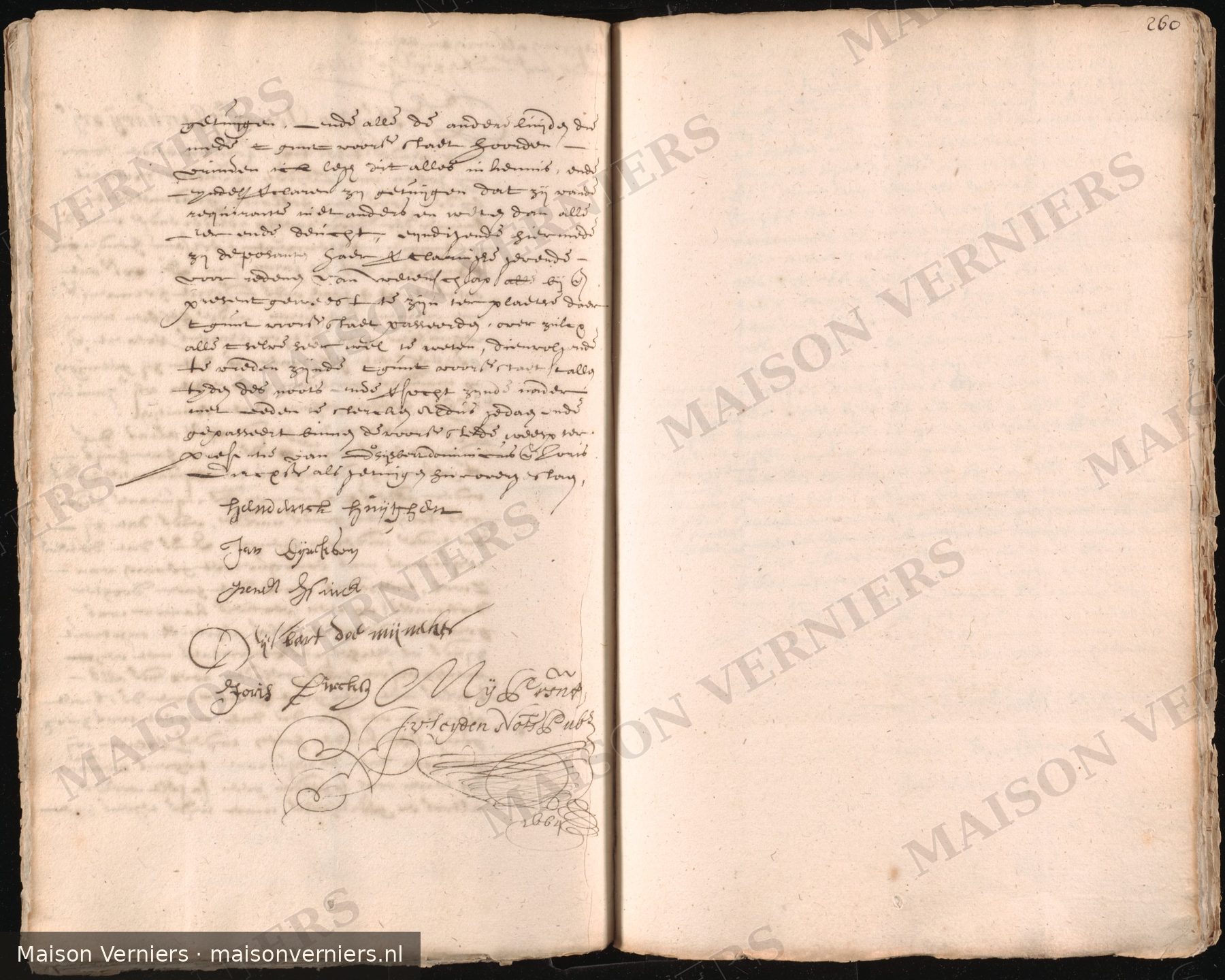
Het begin van de verklaring van "Hendrick Huygen, out 59 jaren", 10 januari 1664, fol. 259. Notarissen te Weesp (GAW138), eerste boek van Johan van Leyden (Bron 271).The opening of the declaration by "Hendrick Huygen, out 59 jaren" (aged 59), 10 January 1664, fol. 259. Notarissen te Weesp (GAW138), first book of Johan van Leyden (Source 271).Het slot van dezelfde akte, fol. 259v, met bovenaan de handtekening "Hendrick Huijghen" (Bron 271).The end of the same deed, fol. 259v, with the signature "Hendrick Huijghen" at the top (Source 271).
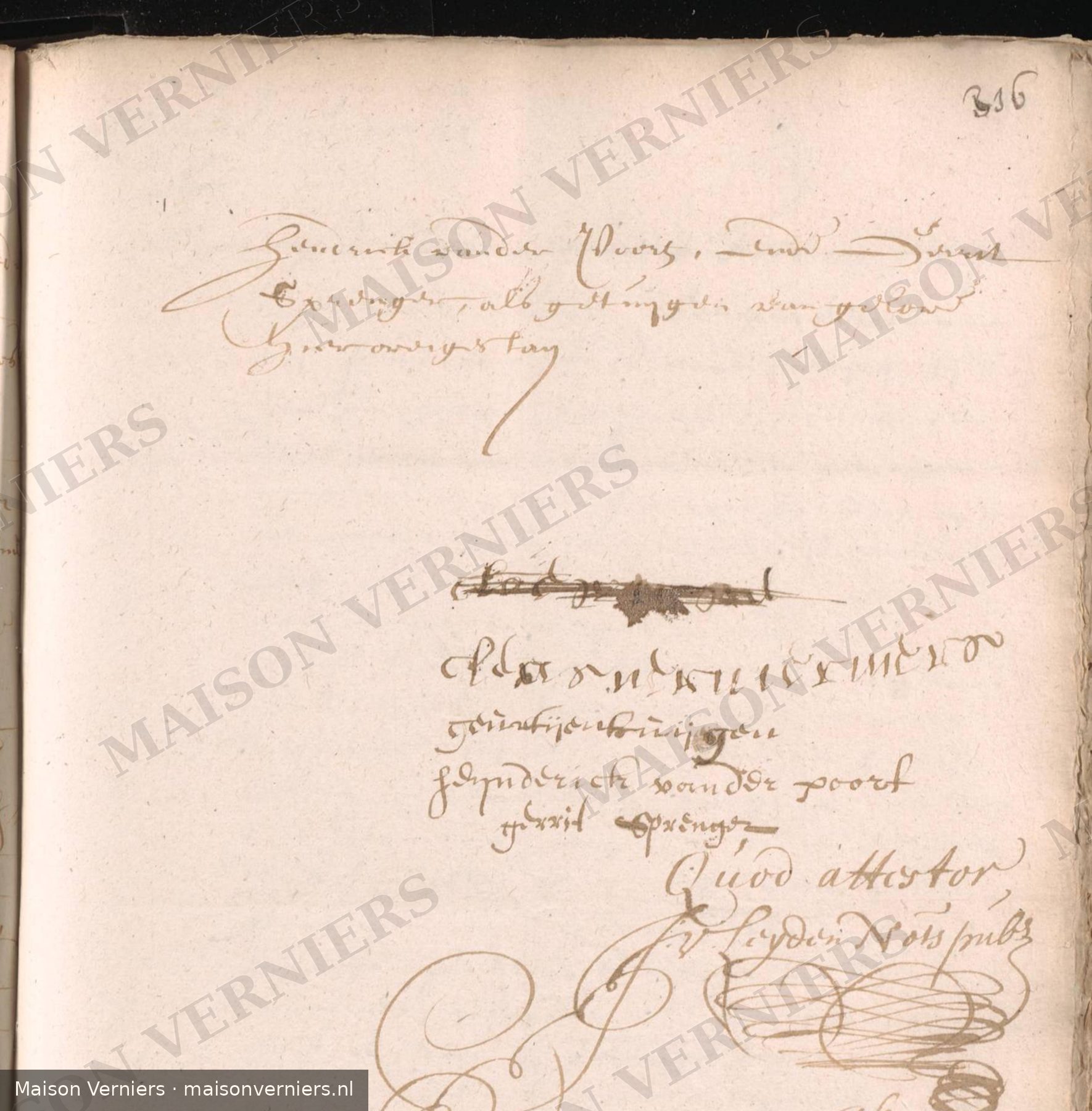
Een paar maanden na de ondertrouw maakten Claes Verniers en Geurtje Huygen samen hun testament, op 2 februari 1673. Een van beiden was ziek; de langstlevende zou alles erven, in vrije eigendom. Kinderen worden nog niet genoemd. Claes zette zijn naam in bevende letters, Geurtje schreef "Geurtjen Huijgen" met vaste hand. Getuigen waren Heyndrick van der Poort en Gerrit Sprenger (Bron 282).
A few months after their betrothal Claes Verniers and Geurtje Huygen made their joint will, on 2 February 1673. One of them was ill; the survivor would inherit everything outright. No children are mentioned yet. Claes wrote his name in shaky letters; Geurtje signed "Geurtjen Huijgen" in a steady hand. The witnesses were Heyndrick van der Poort and Gerrit Sprenger (Source 282).
Het slot van het testament van Claes Verniers en Geurtje Huygen, 2 februari 1673, fol. 316, met hun handtekeningen en die van de getuigen (Bron 282).The end of the will of Claes Verniers and Geurtje Huygen, 2 February 1673, fol. 316, with their signatures and those of the witnesses (Source 282).
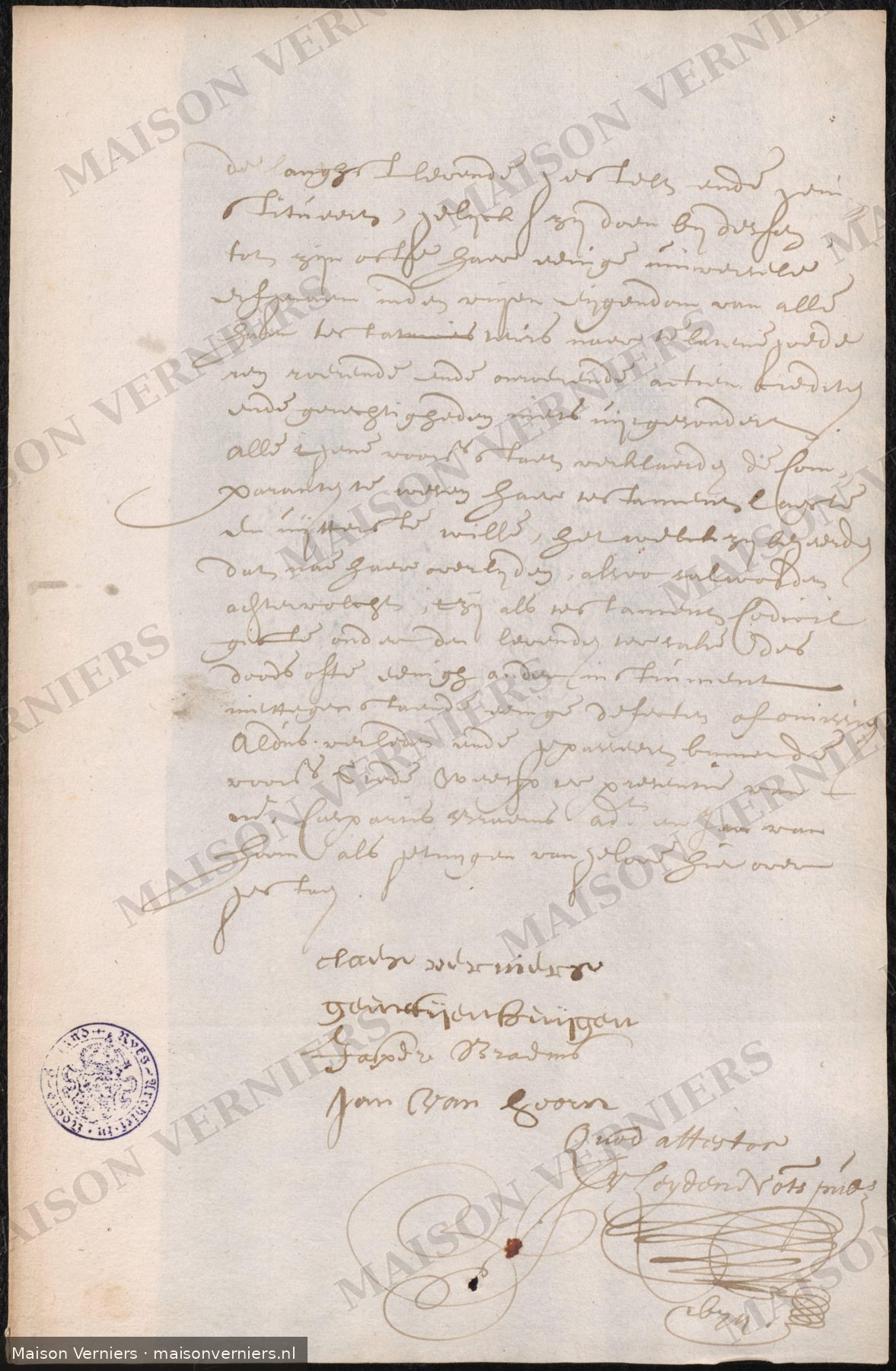
Op 2 maart 1674 vervingen Claes en Guurtje dit testament door een nieuw. Weer erfde de langstlevende, maar nu worden kinderen genoemd: de langstlevende moest "het kind of de kinderen" opvoeden, laten leren lezen en schrijven en een eerlijk ambacht laten leren tot hun huwelijk of meerderjarigheid. Dat is een gangbare formule, die ook kinderen omvat die nog geboren zouden worden. Claes tekende nu met vaste hand "Claes Verniers"; de getuigen waren Mr. Casparus Braems, advocaat, en Jan van Hoorn (Bron 305).
On 2 March 1674 Claes and Guurtje replaced this will with a new one. Again the survivor inherited, but now children are mentioned: the survivor was to bring up "the child or children", have them taught to read and write and an honest trade, until their marriage or majority. This is a standard formula that also covers children yet to be born. Claes now signed "Claes Verniers" in a steady hand; the witnesses were Mr. Casparus Braems, advocate, and Jan van Hoorn (Source 305).
Het slot van het testament van 2 maart 1674, met de handtekeningen "Claes Verniers" en "Geurtjen Huijgen". Inv. 5204 (Bron 305).The end of the will of 2 March 1674, with the signatures "Claes Verniers" and "Geurtjen Huijgen". Inv. 5204 (Source 305).
De Gooyers
Mr. Cornelis Verniers (1652–1719) trouwde met Grietje Pieters de Gooijer. Over de brouwersfamilie Gooyer uit Hoorn en Weesp staat meer in verhaal #17. Bij Van Leyden verschijnen Matthys de Goyer, die op 1 maart 1662 namens een jonkvrouw ongeveer 28 morgen land onder Weesp verhuurde voor ruim 500 gulden per jaar (Bron 270), en Jan Heyndricksz alias de Goyer, wiens vrouw in 1664 in de lasterzaak hierboven voorkomt (Bron 271). Hoe zij met Grietje Pieters verwant waren, wordt verder uitgewerkt.
The Gooyers
Mr. Cornelis Verniers (1652–1719) married Grietje Pieters de Gooijer. More about the Gooyer brewing family of Hoorn and Weesp is in story #17. In Van Leyden's records appear Matthys de Goyer, who on 1 March 1662 let about 28 morgen of land near Weesp on behalf of a young noblewoman for over 500 guilders a year (Source 270), and Jan Heyndricksz alias de Goyer, whose wife appears in the slander case above in 1664 (Source 271). How they were related to Grietje Pieters is being worked out further.
De Schoutens en de Dells: brouwerijen als huwelijksgoed
Twee keer binnen vijf jaar trouwden een Schouten en een Dell, en beide keren hoorde er een brouwerij bij. Op 18 mei 1664 werden de huwelijksvoorwaarden gemaakt van Sr. Jacob Dell en Juffr. Elisabeth Schouten, met de brouwerij bij de Muiderpoort; die akte staat uitgewerkt in verhaal #17(Bron 266).
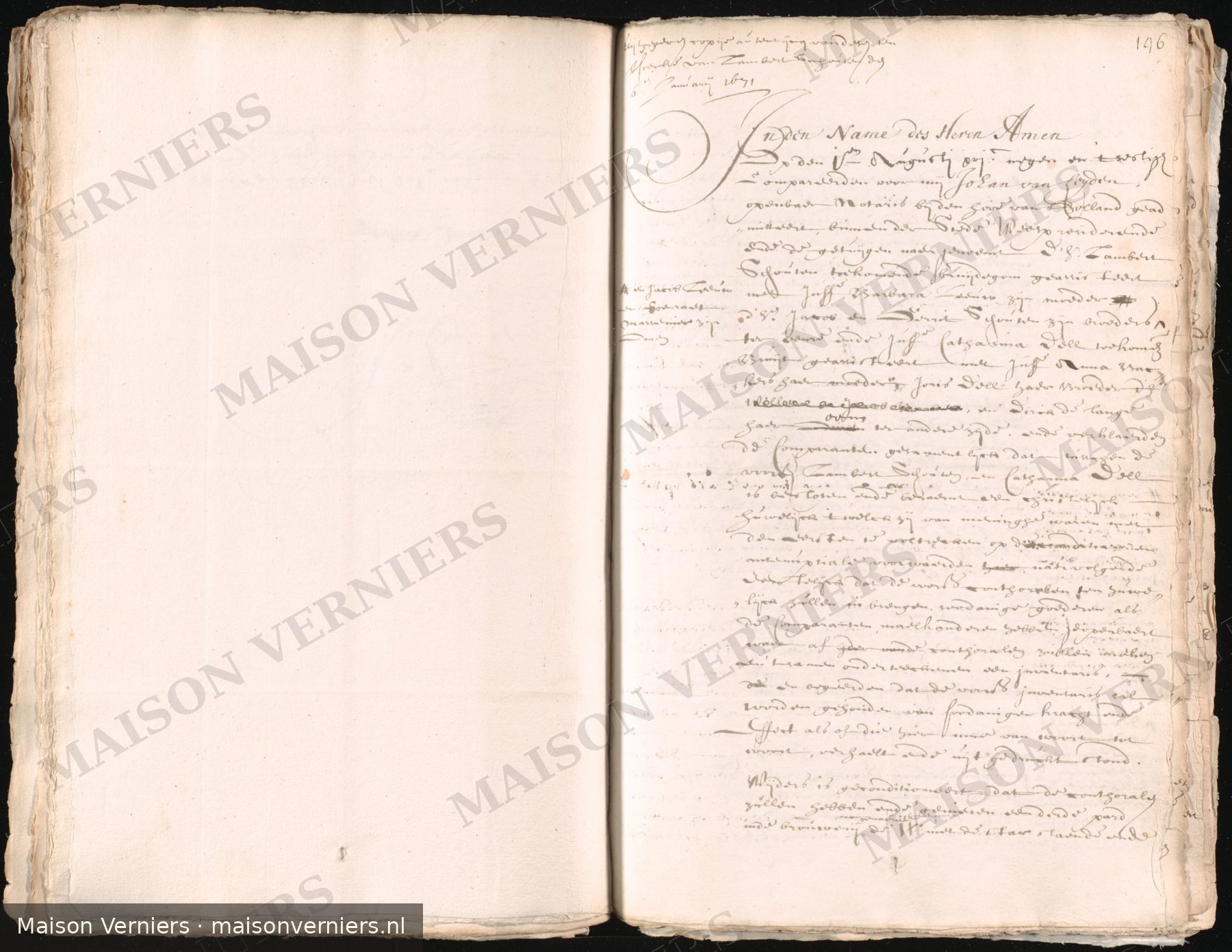
In augustus 1669 volgden de huwelijksvoorwaarden van Sr. Lambert Schouten en Juffr. Catharina Dell. Lambert werd bijgestaan door zijn moeder Juffr. Barbara Leeuw en zijn broers Jacob en Gerrit Schouten; Catharina door haar moeder Juffr. Anna Backers en haar broer Joris Dell. Het paar kreeg een derde part van een brouwerij, "de W. met de Star"; de andere twee derde parten zouden na de dood van de moeder naar Gerrit en Mathijs Schouten gaan (Bron 279). Of dit dezelfde brouwerij is als die van 1664 ("de W. met de kroon") moet nog worden uitgezocht.
The Schoutens and the Dells: breweries as marriage portion
Twice within five years a Schouten married a Dell, and both times a brewery was involved. On 18 May 1664 the marriage settlement of Sr. Jacob Dell and Juffr. Elisabeth Schouten was drawn up, with the brewery at the Muiderpoort; that deed is discussed in story #17(Source 266).
In August 1669 followed the marriage settlement of Sr. Lambert Schouten and Juffr. Catharina Dell. Lambert was assisted by his mother Juffr. Barbara Leeuw and his brothers Jacob and Gerrit Schouten; Catharina by her mother Juffr. Anna Backers and her brother Joris Dell. The couple received a third share of a brewery, "de W. met de Star"; the other two thirds were to pass to Gerrit and Mathijs Schouten after their mother's death (Source 279). Whether this is the same brewery as in 1664 ("de W. met de kroon") is still to be established.
De huwelijksvoorwaarden van Sr. Lambert Schouten en Juffr. Catharina Dell, augustus 1669, fol. 196. Notarissen te Weesp (GAW138), inv. 5202 (Bron 279).The marriage settlement of Sr. Lambert Schouten and Juffr. Catharina Dell, August 1669, fol. 196. Notarissen te Weesp (GAW138), inv. 5202 (Source 279).
Het vierde boek van de notaris maakt de familie compleet. In augustus 1671 trad Juffr. Barbara Leeuw op als "weduwe ende boedelhoudster van d'Hr. Cornelis Schouten, in zijn leven burgemeester der voorsz. stede" (Bron 283). Op 26 oktober 1671 werden de huwelijksvoorwaarden gemaakt van haar dochter Juffr. Geertruijd Schouten en Sr. Jacob Marchant, met haar broers Jacob Schouten, oud-burgemeester, en Lambert Schouten, en haar oom Coenraet Mersenier als getuigen aan haar kant (Bron 284).
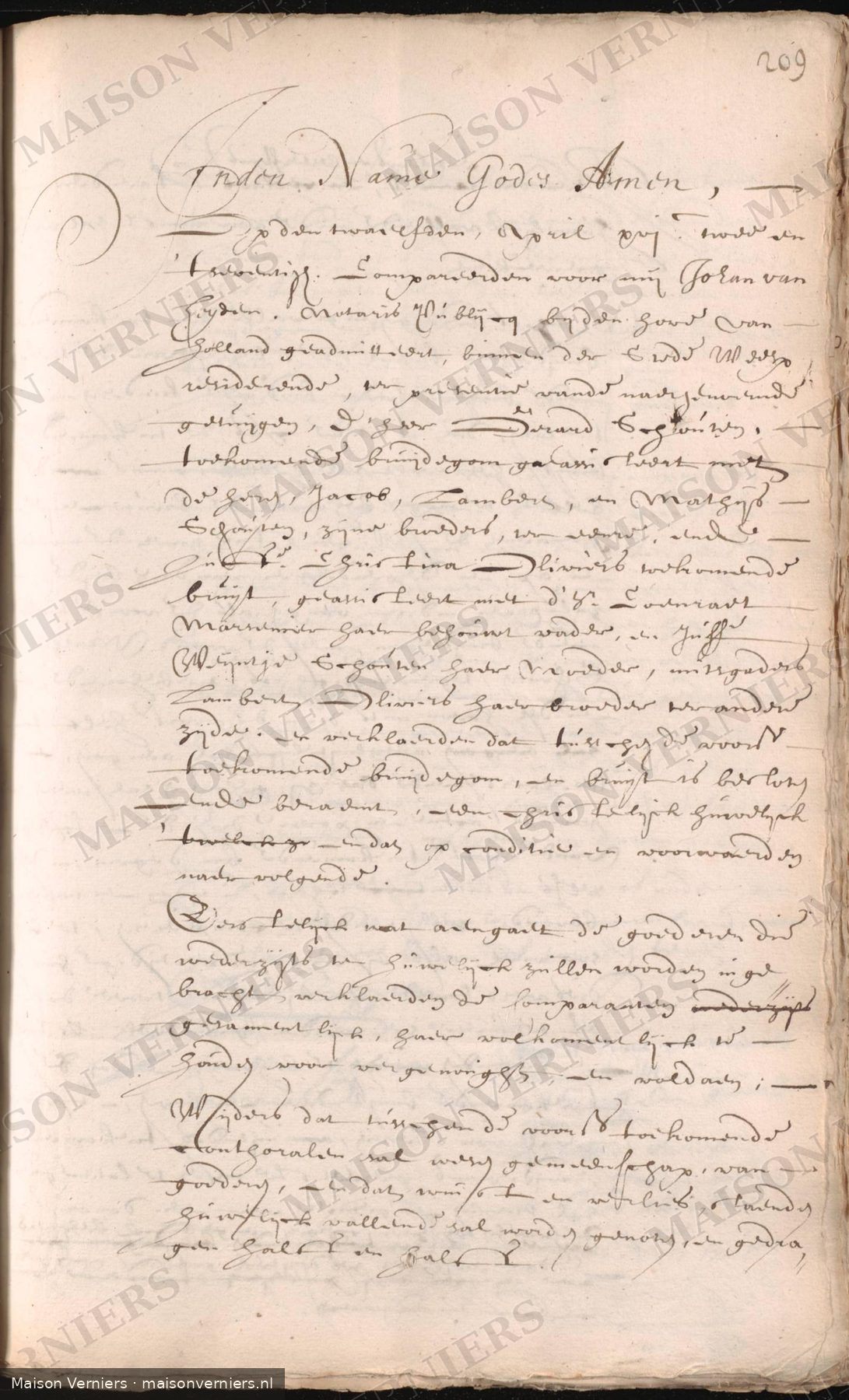
Op 16 april 1672 volgden die van Sr. Gerard (Gerrit) Schouten en Juffr. Christina Oliviers, dochter van Juffr. Weyntje Schouten en stiefdochter van Coenraet Mersenier. Weer ging het om de brouwerij: als Gerrit kinderloos zou sterven, mocht Christina "de brouwerije genaemt de W. en Star", met de mouterij, samen met Mathijs Schouten houden, tegen een schatting door onpartijdige mannen (Bron 285). Daarmee staat de lezing "Star" uit 1669 vast. Elf dagen later verklaarde "Christina Schouten" dat haar duivenhok, schutting en washuisje alleen bij gedogen tegen de muur van de mouterij van Coenraet Mersenier stonden (Bron 286).
Dezelfde Coenraet Mersenier benoemde Marritje Dircks een half jaar later tot voogd over haar zonen. De Verniersen vertrouwden hun kinderen dus toe aan een man uit de kring van de Schoutens en hun brouwerijen.
The notary's fourth book completes the family. In August 1671 Juffr. Barbara Leeuw acted as "widow and administrator of the estate of the late Cornelis Schouten, in his lifetime burgomaster of this town" (Source 283). On 26 October 1671 the marriage settlement was made of her daughter Juffr. Geertruijd Schouten and Sr. Jacob Marchant, with her brothers Jacob Schouten, former burgomaster, and Lambert Schouten, and her uncle Coenraet Mersenier on her side (Source 284).
On 16 April 1672 followed that of Sr. Gerard (Gerrit) Schouten and Juffr. Christina Oliviers, daughter of Juffr. Weyntje Schouten and stepdaughter of Coenraet Mersenier. Again the brewery was at stake: should Gerrit die childless, Christina might keep "the brewery called de W. en Star", with the malt-house, together with Mathijs Schouten, at a valuation by impartial men (Source 285). This settles the reading "Star" from 1669. Eleven days later "Christina Schouten" declared that her dovecote, fence and wash-house stood against the wall of Coenraet Mersenier's malt-house only on sufferance (Source 286).
Half a year later Marritje Dircks appointed the same Coenraet Mersenier guardian of her sons. The Verniers thus entrusted their children to a man from the circle of the Schoutens and their breweries.
De huwelijksvoorwaarden van Sr. Gerard Schouten en Juffr. Christina Oliviers, 16 april 1672, fol. 209. Notarissen te Weesp (GAW138), inv. 5203 (Bron 285).The marriage settlement of Sr. Gerard Schouten and Juffr. Christina Oliviers, 16 April 1672, fol. 209. Notarissen te Weesp (GAW138), inv. 5203 (Source 285).
Barbara Leeuw overleed in het najaar van 1671; op 7 december van dat jaar traden haar kinderen op als haar erfgenamen (Bron 310). Lambert Schouten overleed vóór maart 1680: toen trad zijn broer, burgemeester Jacobus Schouten, op als voogd over zijn zoon Gerard (Bron 309). Hoe de brouwerijen van de Schoutens en de Dells verder gingen, staat in verhaal #27.
Barbara Leeuw died in the autumn of 1671; on 7 December of that year her children acted as her heirs (Source 310). Lambert Schouten died before March 1680: by then his brother, burgomaster Jacobus Schouten, acted as guardian of his son Gerard (Source 309). How the breweries of the Schoutens and the Dells continued is told in story #27.
Een stadsbestuur in conflict, 1664
Begin februari 1664 botste het Weesper stadsbestuur met de drossaard, de vertegenwoordiger van het gewestelijk gezag. Getuigen verklaarden over een opstootje bij de Muiderpoort op 2 februari, en burgemeesters, schepenen en vroedschap verklaarden gezamenlijk dat zij de drossaard nooit last hadden willen bezorgen, maar alleen "onse privilegiën ende gerechticheden" wilden verdedigen tegen "violente manieren van procederen". Op 14 februari protesteerden de schepenen, onder wie Jacobus Schouten, Lourens Houtman en Arent Blanck, tegen hun schorsing (Bron 274). Een halve eeuw later zou Pieter Verniers als stadssecretaris zelf tegen zijn stad procederen (verhaal #22).
A town government in conflict, 1664
In early February 1664 the Weesp town government clashed with the drossaard, the representative of provincial authority. Witnesses testified about a disturbance at the Muiderpoort on 2 February, and the burgomasters, aldermen and council declared jointly that they had never wished to trouble the drossaard, but only to defend "onse privilegiën ende gerechticheden" (our privileges and rights) against "violente manieren van procederen" (violent ways of proceeding). On 14 February the aldermen, among them Jacobus Schouten, Lourens Houtman and Arent Blanck, protested against their suspension (Source 274). Half a century later Pieter Verniers, as town secretary, would himself go to law against his town (story #22).
Het Rampjaar in de akten, 1672–1673
In 1672 vielen Franse troepen de Republiek binnen en werd Weesp een garnizoensstad aan de waterlinie. Dat is in het vierde boek van Van Leyden te zien. Op 14 juli 1672 maakte een soldaat van de compagnie van kapitein Adriaen Wilbracht (?), "in garnizoen leggende binnen deze stede", zijn testament. In september legden de schout, een burgemeester en schepenen verklaringen af op verzoek van "Andreas van Waldenburgh, collonel ende commandant tot Weesp". Daarna volgen verklaringen van en voor officieren, onder wie een vaandrig van het regiment Stirum, de commandant van de constabels van Muiden en kapitein Boudewijn van Pompelaer (?) (Bron 304). Wat er precies in die verklaringen staat, wordt nog uitgewerkt. Over Weesp in het Rampjaar, de waterlinie en de vestingwerken: zie verhaal #28.
The Disaster Year in the deeds, 1672–1673
In 1672 French troops invaded the Republic and Weesp became a garrison town on the water line. This shows in Van Leyden's fourth book. On 14 July 1672 a soldier of the company of captain Adriaen Wilbracht (?), "in garrison within this town", made his will. In September the schout, a burgomaster and aldermen made declarations at the request of "Andreas van Waldenburgh, colonel and commander at Weesp". Declarations by and for officers follow, among them an ensign of the Stirum regiment, the commander of the gunners at Muiden and captain Boudewijn van Pompelaer (?) (Source 304). What exactly these declarations say is still to be worked out. On Weesp in the Disaster Year, the water line and the fortifications: see story #28.
Schilderijen aan de muur
Tussen de akten staan ook schilderijen. Op 8 november 1666 liet Joannes Voorst zijn broer, dominee Gerard Voorst, twee schilderijen na; bij een ervan noemt de notaris de schilder "Jan Asselijn alias Crabbetje", de Amsterdamse landschapschilder die in 1652 was overleden (Bron 295). In een nieuwe versie van het testament, in januari 1667, worden de stukken anders beschreven. In maart 1668 droeg Dionysius Geens uit Breukelen "alle de schilderijen en boeken" over die hij had, met een vordering op Sr. Pieter Schilder te Amsterdam (Bron 314). En in de boedel van Michiel Mol en Trijntje Barents hing in 1670, naast portretten van het echtpaar, boerenkermissen en een prent van Willem de Zwijger, ook "een print waarin het exploit door de Hollanders uitgevoerd op de rivier van Chattam": drie jaar na de tocht naar Chatham hing die al aan de muur (Bron 299) (zie verhaal #18).
Paintings on the wall
Paintings appear among the deeds too. On 8 November 1666 Joannes Voorst left two paintings to his brother, the minister Gerard Voorst; for one of them the notary names the painter as "Jan Asselijn alias Crabbetje", the Amsterdam landscape painter who had died in 1652 (Source 295). In a new version of the will, in January 1667, the pieces are described differently. In March 1668 Dionysius Geens of Breukelen transferred "alle de schilderijen en boeken" (all the paintings and books) he had, together with a claim on Sr. Pieter Schilder in Amsterdam (Source 314). And in the estate of Michiel Mol and Trijntje Barents in 1670, beside portraits of the couple, peasant fairs and a print of William the Silent, hung "een print waarin het exploit door de Hollanders uitgevoerd op de rivier van Chattam" (a print of the exploit carried out by the Dutch on the river at Chatham): three years after the raid it was already on the wall (Source 299) (see story #18).
Wordt vervolgd
Alle vijf de boeken van Johan van Leyden zijn nu doorgenomen. De volgende stap zijn de andere notarissen van Weesp uit deze jaren, zoals Rombout Noordingh en Johan van As. Nieuwe akten over deze en andere Weesper families worden hier toegevoegd, en de personen ook in het namenregister.
To be continued
All five of Johan van Leyden's books have now been gone through. The next step is the other notaries of Weesp in these years, such as Rombout Noordingh and Johan van As. New deeds about these and other Weesp families will be added here, and the people also in the name index.