Twee akten uit het Amsterdamse archief laten zien hoe hecht de familie Verniers met de familie Anslo verweven raakte. Op 19 december 1582 gaan Claes Claesz en Griet Hansdr. — de latere Claes Claesz Anslo en Grietges dochter Giert(e) Jans — in ondertrouw. Bijna negentien jaar later, op 19 april 1601, verschijnt Grietge Joosten zelf, weduwe van onze stamvader Laurens Verniers, voor de schepenen van Amsterdam om het huis en erf "De Witte Voet" aan de Oudezijds Voorburgwal te verkopen aan Johan Anthonisz, doctor in de medicijnen (Stadsarchief Amsterdam, archief 5062, inv.nr. 12) — daarbij terzijde gestaan door diezelfde schoonzoon.
Een weduwe met een voogd
Als weduwe kon Grietge destijds niet zomaar zelfstandig een huis verkopen: de akte van 1601 vermeldt dat zij optreedt "geassisteert met Claes Claesz, laeckencoper, haren swager ende voocht in desen gecoren" — bijgestaan door Claes Claesz, lakenkoper, haar zwager (schoonzoon) en in deze zaak gekozen voogd. Dat deze akte hem, al in 1601, als voogd en zwager van Grietge noemt, is een mooie onafhankelijke bevestiging van de familieband — amper een jaar na het overlijden van Laurens Verniers zelf.
Naast Claes Claesz treedt ook een zekere Hillebrant (of Herman) Jansz op, eveneens als naaste verwant die zijn toestemming voor de verkoop moet geven — de naam is op de scan lastig te ontcijferen.
Het huis en de koper
De Witte Voet stond aan de Oudezijds Voorburgwal, met een gedeelde muur met het huis van Dirck Boelissen aan de ene kant en dat van Jan Dircksz Maroussen aan de andere, en liep van de straat door tot achter het erf van Lysbet Pietersdr. De koper, Johan Anthonisz, wordt aangeduid als "doctor in medicynen" — een arts. Grietge behield na de verkoop een jaarlijkse grondrente uit het pand (het exacte bedrag is op de scan niet met zekerheid te lezen, mogelijk enkele tientallen stuivers per jaar); Claes Claesz en Hillebrant/Herman Jansz stelden zich garant ("borghen tsamen ende elcx besonder een voor al") dat het huis vrij was van oude schulden.
De ondertrouw zelf, 19 december 1582
Die datum stond al vermeld in het testament van 1625, als de datum van hun huwelijkse voorwaarden — en is nu rechtstreeks terug te vinden in het ondertrouwregister van Amsterdam (DTB 402, blz. 149). Op 19 december 1582 verschijnen Claes Claesz van Amsterdam, opgegeven als "oudt omtrent drieendertich jaer" (ongeveer 33 jaar oud — wat een geboortejaar rond 1549 suggereert) en zonder ouders meer in leven, en Griet Hans dr van Amsterdam — in deze akte dus als "Hansdr" genoteerd, waarbij "Hans" in die tijd een gangbare verbastering van Jan/Johannes was, wat naadloos aansluit op haar latere vermeldingen als "dochter van Jan". Zij verschijnt één op één met haar moeder, hier genoteerd als Griet(ge) Joosten — exact de naam die al bekend was. In de marge staan de namen nog eens kort genoteerd: "Philips", "Claes Claesz", "griet Hans dr", vermoedelijk verwijzend naar de dienstdoende ambtenaar of predikant.
De hoofdtekst volgt het vaste, formulaire stramien van een zestiende-eeuwse Amsterdamse ondertrouwakte: het paar verklaart vrije personen te zijn, niet in verboden graad aan elkaar verwant, en niet reeds elders verloofd, en verzoekt om de gebruikelijke (drievoudige) afkondiging in de kerk, zodat zij — als niemand daartegen bezwaar maakt — in het huwelijk bevestigd kunnen worden. Onderaan staan de namen nogmaals: Claes Claesz Anslo en Griet Hans[dr].
Two deeds from the Amsterdam archive show how closely the Verniers family became intertwined with the Anslo family. On 19 December 1582, Claes Claesz and Griet Hansdr. — the later Claes Claesz Anslo and Grietge's daughter Giert(e) Jans — register their intention to marry. Almost nineteen years later, on 19 April 1601, Grietge Joosten herself, widow of our stamvader Laurens Verniers, appears before the aldermen of Amsterdam to sell the house and lot "De Witte Voet" on the Oudezijds Voorburgwal to Johan Anthonisz, doctor of medicine (Amsterdam City Archives, archive 5062, inv. no. 12) — assisted, in the process, by that same son-in-law.
A widow with a guardian
As a widow, Grietge could not simply sell a house on her own authority at that time: the 1601 deed states that she acts "geassisteert met Claes Claesz, laeckencoper, haren swager ende voocht in desen gecoren" — assisted by Claes Claesz, cloth merchant, her son-in-law and guardian chosen for this matter. That this deed names him, already in 1601, as Grietge's guardian and son-in-law, is a fine independent confirmation of the family tie — barely a year after Laurens Verniers's own death.
Alongside Claes Claesz, a certain Hillebrant (or Herman) Jansz also appears, likewise as a close relative whose consent for the sale was required — the name is difficult to decipher on the scan.
The house and the buyer
De Witte Voet stood on the Oudezijds Voorburgwal, sharing a wall with the house of Dirck Boelissen on one side and that of Jan Dircksz Maroussen on the other, running from the street through to behind the lot of Lysbet Pietersdr. The buyer, Johan Anthonisz, is described as "doctor in medicynen" — a physician. After the sale Grietge retained an annual ground rent from the property (the exact amount cannot be read with certainty on the scan, possibly a few dozen stuivers a year); Claes Claesz and Hillebrant/Herman Jansz stood surety ("borghen tsamen ende elcx besonder een voor al") that the house was free of old debts.
The betrothal itself, 19 December 1582
That date was already recorded in the 1625 will, as the date of their marriage settlement — and can now be found directly in the Amsterdam betrothal register (DTB 402, p. 149). On 19 December 1582, Claes Claesz of Amsterdam appears, recorded as "oudt omtrent drieendertich jaer" (about 33 years old — suggesting a birth year around 1549) with no parents still living, and Griet Hans dr of Amsterdam — recorded in this deed as "Hansdr", "Hans" at the time being a common corruption of Jan/Johannes, which fits seamlessly with her later description as "daughter of Jan". She appears together with her mother, recorded here as Griet(ge) Joosten — exactly the name already known. In the margin the names are noted again briefly: "Philips", "Claes Claesz", "griet Hans dr", presumably referring to the officiating clerk or minister.
The main text follows the fixed, formulaic pattern of a sixteenth-century Amsterdam betrothal deed: the couple declare themselves to be free persons, not related within a forbidden degree, and not already betrothed elsewhere, and request the customary (threefold) proclamation in church, so that they — if no one objects — may in due course be joined in marriage. At the bottom the names appear once more: Claes Claesz Anslo and Griet Hans[dr].
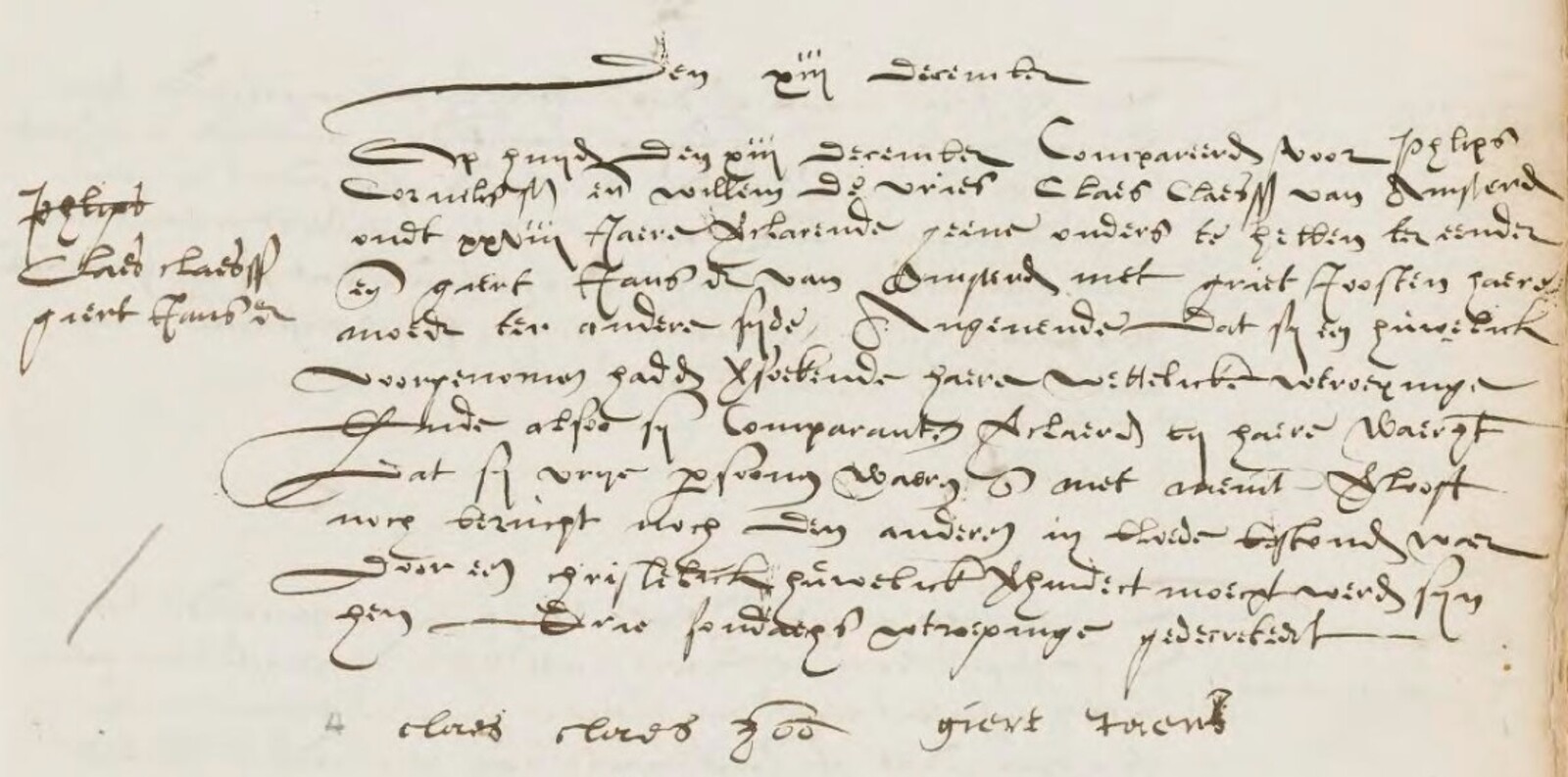
Ondertrouwinschrijving van Claes Claesz en Griet Hansdr., 19 december 1582 — Stadsarchief Amsterdam, DTB 402, blz. 149. Zie ook de naslagwerk.Betrothal registration of Claes Claesz and Griet Hansdr., 19 December 1582 — Amsterdam City Archives, DTB 402, p. 149. See also the Reference.
Best mogelijke transcriptie; de precieze bewoording van de formulaire (standaard) rechtstaal is op basis van deze scan niet in alle details met zekerheid vast te stellen — namen, datum en leeftijd zijn wel goed leesbaar.
Best possible transcription (shown here in the original Dutch, as a primary source); the precise wording of the formulaic (standard) legal language cannot be established with certainty in every detail from this scan — names, date and age are, however, clearly legible.
Den XIX decembris.
Op huyden den XIX decembris compareerden voor [ondergeschreven getuygen], de vrije Claes Claesz van Amsterdam, oudt omtrent drieendertich jaer, verclarende geen ouders [meer] te hebben, ter eenre zijde, ende Griet Hans dr van Amsterdam, met Griet(ge) Joosten haer moeder, ter andere zijde; betuygende dat zij [malcanderen] een oprechte, voorgenomen [houwelicksche] vrijagie toegedaen waren. Ende alsoo de comparanten verclaerden vrije persoonen te zijn, ende met malcanderen in echte noch versproken en waren, versochten zij dat hen [de gewoonlicke] proclamatien souden werden gedaen, om alsoo — indien niemant hem daer tegens en stelde — te rechter tijt christelick tsamen gevoecht te worden.
Claes Claesz Anslo — Griet Hans[dr]
De scans van de verkoopakte
Twee bladzijden uit het schepenkennisboek met de akte van 19 april 1601 — zie de volledige akte in de naslagwerk onder Bron 13.
The scans of the deed of sale
Two pages from the aldermen's deed book with the deed of 19 April 1601 — see the full deed in the Reference under Source 13.
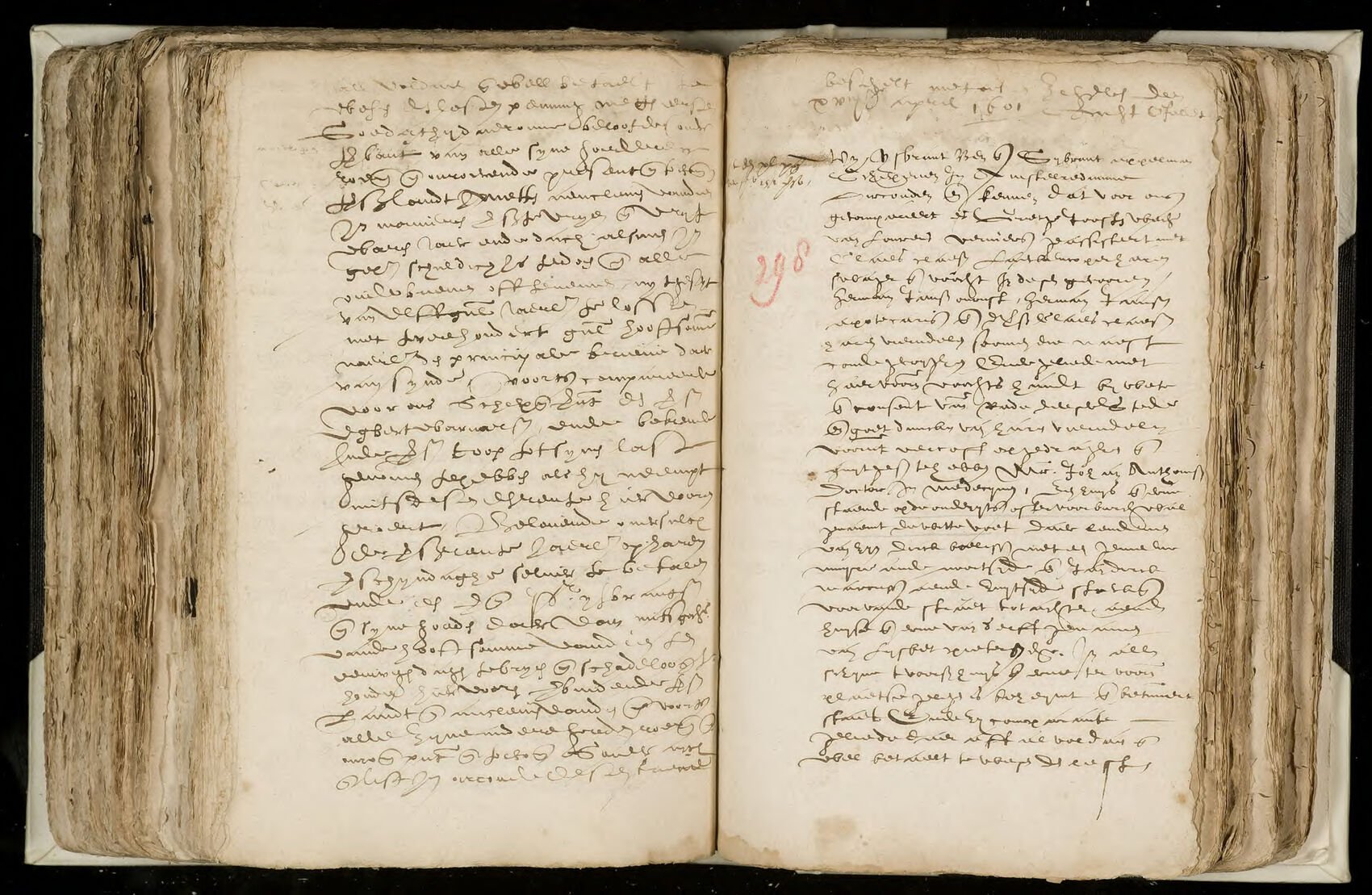
Schepenkennisboek Amsterdam, rond folio 297-298 — Stadsarchief Amsterdam, archief 5062, inv.nr. 12Amsterdam aldermen's deed book, around folio 297-298 — Amsterdam City Archives, archive 5062, inv. no. 12
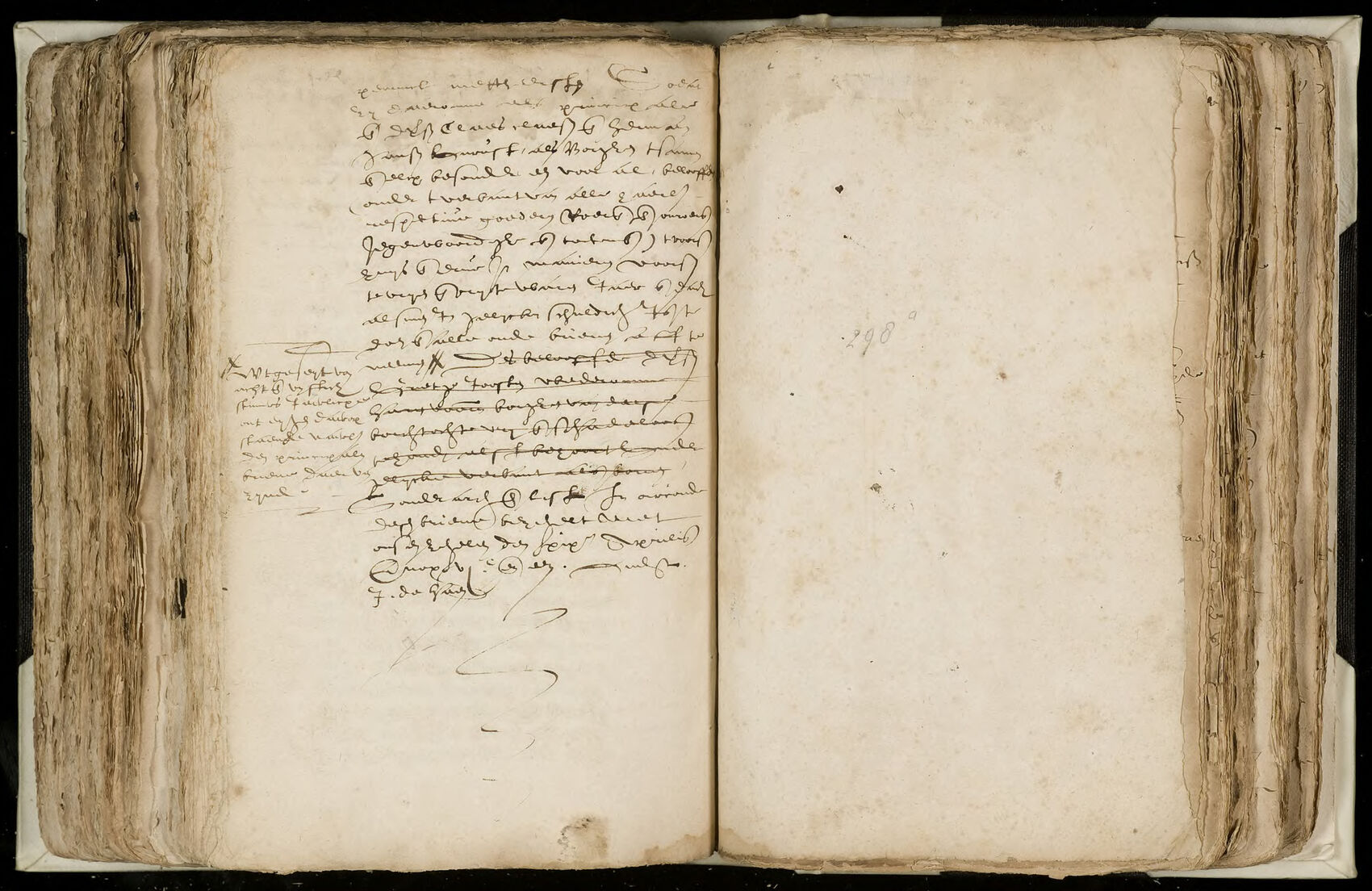
Schepenkennisboek Amsterdam, folio 298 — het begin van de akte van 19 april 1601, met Grietge Joosten, Claes Claesz en de verkoop van De Witte Voet — Stadsarchief Amsterdam, archief 5062, inv.nr. 12Amsterdam aldermen's deed book, folio 298 — the beginning of the 19 April 1601 deed, with Grietge Joosten, Claes Claesz and the sale of De Witte Voet — Amsterdam City Archives, archive 5062, inv. no. 12
De transcriptie
Best mogelijke transcriptie van de akte; enkele woorden en het exacte bedrag van de grondrente zijn door de staat van de scan onzeker.
The transcription
Best possible transcription of the deed (shown here in the original Dutch, as a primary source); a few words and the exact amount of the ground rent are uncertain due to the condition of the scan.
Actum den XIXen aprilis 1601. Isbrant Bem ende Sybrant Appelman, schepenen in Amstelredamme.
Oerconden ende kennen dat voor ons gecompareert es Gretge Joosten, weduwe van Louren Verniersz, geassisteert met Claes Claesz, laeckencoper, haren swager ende voocht in desen gecoren, Hillebrant Jansz, ende noch d'voors. Claes Claesz, ende dat aengaende soomen die naest conde geroychen, ende geliede met haerluijden voochts handt, bij wete ende consent van de Rade deser stede, ende goetduncken van huren vrienden voornt., vertoft opgedraghen ende uytgegeven te hebben aen Johan Anthonisz, doctor in medicynen, een huys ende erve staende opde Oudezijds Voorburchwal, genaemt De Witte Voet, daer aenden een zijde Dirck Boelissen met een gemeene muyre aende noortzijde, ende Jan Dircksz Maroussen aende suytzijde, streckende voor vande straet tot achter aenden huyse ende erve van selven geleghen, van Lysbet Pietersdr., in aller schyne t'voorss. huys ende erve ter voorn. plaetse gelegen is, betimmert ende bepaelt staet.
Ende zy comparante bekende daer af al voldaen ende wel betaelt te wesen, den laesten penninck metten eersten. Soo dat sy daeromme et principael, ende de voorss. Claes Claesz ende Hillebrant Jansz, kognoost, als borghen tsamen ende elcx besonder een voor al, beloofden onder t'verbant van alle haerluijder respective goederen, roerende ende onroerende, jegenwoordighe ende toecomende, t'voorss. huys ende erve in manieren voorss. te vrijen ende te waren jaer ende dach, gelijckmen in gelijcken schuldich is te doene, ende alle oude brieven daer af te nemen. Des beloofde zy, uytgezeyt van Gaetge Joosten wederomme, [acht ende vyftich?] stuyvers jaerlicx uut eyghen daerop staende, naerder haere lijftocht vry ende schadeloos, den principael schuldenaer behoort te dragen boven daer van gelijcke verbant als boven.
Sonder argh oft list. In oirconde desen brieve beseghelt met onsen zegele, den XXIXen aprilis anno XVIc ende een.
J. de Haen
De exacte lezing van het jaarlijkse bedrag ("acht ende vyftich stuyvers" of een andere waarde) en van de naam "Hillebrant/Herman Jansz" verdienen nadere controle aan de hand van het origineel.
The exact reading of the annual amount ("acht ende vyftich stuyvers" or another value) and of the name "Hillebrant/Herman Jansz" deserve further checking against the original.