In april 2016 meldde de PZC een bijzondere vondst: in de band van een 17e-eeuws belastingregister uit het archief van de Zeeuwse Rekenkamer bleken twee zeldzame almanakken verwerkt te zitten (PZC, 22 april 2016). De restaurator van het Zeeuws Archief had de registers gerestaureerd en daarbij ontdekt dat de ruggen verstevigd waren met oude, afgesneden almanakjes — kennelijk niet meer verkochte jaarboekjes die na afloop van het jaar hun waarde verloren en daarom werden hergebruikt als bindmateriaal.
Ik wist dat Abraham Verniers rond diezelfde tijd een almanak had geschreven, en nam eind 2024 daarom contact op met de restaurator. Zij bevestigde: een van de twee gevonden almanakken was inderdaad die van Abraham — de Middelburgse Almanach voor het jaar 1603, oorspronkelijk zo'n 90 bij 60 mm groot, gevonden in het archief van de Rekenkamer Zeeland (Gedeponeerde archieven II, toegangsnummer 512, inventarisnummer 134). Achter de almanak bleek ook nog een prognosticatie uit 1595 meegebonden te zijn.
In 2025 bracht het Zeeuws Archief, ter gelegenheid van zijn 25-jarig jubileum, het tijdschrift Een Zee van Tijd uit, met daarin een uitgebreide beschrijving van deze vondst (Zeeuws Archief, 2025, blz. 74–75). Daaruit blijkt dat de twee registers deel uitmaken van de rekeningenserie van de "ordinaris domeinen Bewesten Schelde" — in de middeleeuwen grondbezit en rechten van de Graven en Gravinnen van Zeeland, ruwweg vergelijkbaar met het huidige midden-Zeeland. De serie is afkomstig uit het bezit van rentmeester-generaal Pieter van der Hooghe, die rond 1600 verantwoordelijk was voor het financiële beheer van deze domeinen. De registers hebben een band van perkament (kalfsleer); normaal werd voor de verstijving van zo'n rug opgevouwen perkament of papier gebruikt, maar bij deze twee exemplaren had de boekbinder kleine almanakjes op maat gehakt en ingebonden — ongeveer een derde van elk almanakje werd daarbij afgesneden.
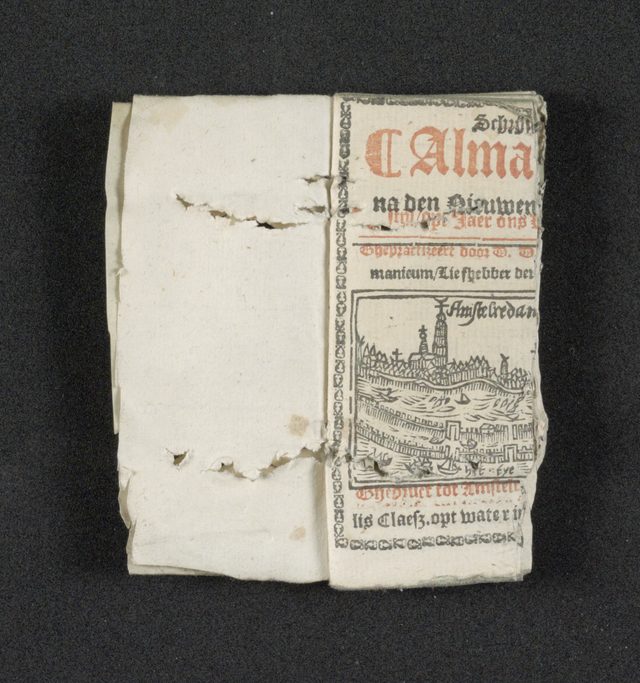
Fragment van de almanakband, teruggevonden in de rug van een 17e-eeuws belastingregister — foto: Zeeuws Archief
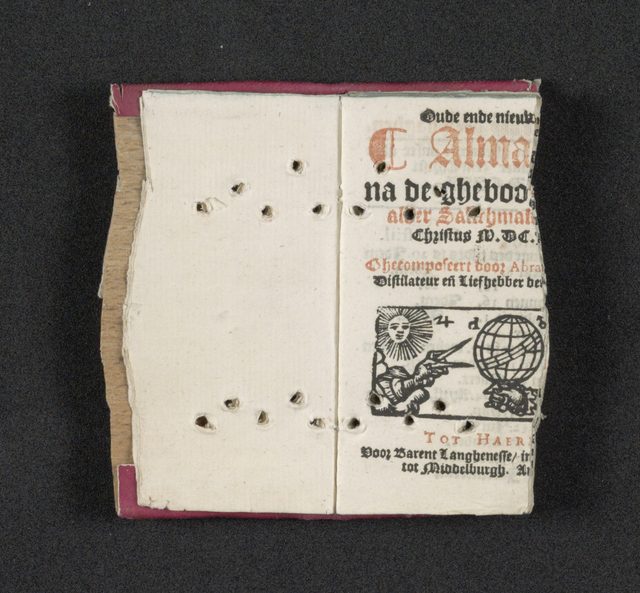
Tweede fragment, met sporen van de oorspronkelijke band — foto: Zeeuws Archief
De almanak werd uitgegeven door Barent Langenes in Middelburg, die behalve uitgever ook boekhandelaar was en een winkel had in de Gravestraat, waar hij boeken, papier en kaarten verkocht. Gedrukt werd het almanakje vermoedelijk door een bekende Haarlemse drukker: Gillis Rooman. Het almanakje zelf is gebonden in een bandje van rood, met meekrap geverfd schapenleer, met strengels (in elkaar gedraaide reepjes perkament) aan het boekblok bevestigd. Het voorplat is in goud bestempeld met het wapen van Zeeland, dat van de Eerste Edele (vertegenwoordiger van de stadhouder) en de steden Middelburg, Goes, Vlissingen en Veere; oorspronkelijk, vóór het almanakje op maat werd gehakt om in de rug te passen, stonden ook Zierikzee, Reimerswaal en Tholen erop. Op het achterplat staat het wapen van stadhouder Prins Maurits.
Naast een kalender voor 1603 bevat de almanak medische informatie over de pest en nuttige voorschriften daartegen — passend bij de astromedische traditie waarin geneeskunde en sterrenkunde nauw verweven waren. Een van deze twee gehalveerde almanakjes bleek ooit in een bijzondere, kunstig versierde band te hebben gezeten, beschreven in de tentoonstellingscatalogus Catalogus goud en velijn: Middelburgse boekbanden van de 17de tot de 19de eeuw (Zeeuwse Bibliotheek Middelburg, 1992) (De Gulden Passer, 2013).
Ik was Abraham al eerder tegengekomen in het werk van almanakhistoricus Jeroen Salman. In Populair drukwerk in de Gouden Eeuw: De almanak als lectuur en handelswaar beschrijft Salman hoe de Middelburgse Almanach van Abraham Verniers voor 1603, in weerwil van een gildeordonnantie uit 1589 die dat niet langer voorschreef, nog steeds dagelijkse medische instructies en een aderlaatkalender bevatte — een opvallend staaltje van de zogeheten astromedische traditie. Salman bespreekt deze vondst in het Zeeuws Archief ook in zijn boek Een handdruk van de tijd: De almanak en het dagelijks leven in de Nederlanden, 1500–1700, en beschreef het exemplaar in 1999 voor het eerst wetenschappelijk. Daarin staat ook een detail dat nog niet eerder op deze site stond: Abraham woonde in Haarlem en noemde zichzelf distillateur — een ongebruikelijk beroep voor een almanakberekenaar, maar een van de vele ambachten die binnen de familie voorkwamen (De Gulden Passer, 2013).
Het tweede register uit dezelfde rekeningenserie bleek een ander, jonger almanakje in de rug verstopt te hebben — en de identificatie daarvan is zelf een klein speurverhaal. Salman vermoedde in 1999 al dat het om een almanak voor 1604 ging, maar kon de auteur niet thuisbrengen en liet het exemplaar daarom buiten zijn catalogus. Pas onderzoekers van De Gulden Passer (2013) losten het raadsel op: op de titelpagina was van de achternaam alleen het fragment "manicum" leesbaar, maar bij het uit elkaar halen van het oorspronkelijk gehalveerde boekje bleek een klein stukje van diezelfde titelpagina elders bewaard — met daarop, onder de "n" van "Almanack", nog een losse "A". Dat leidde naar de in Amsterdam bekende almanakberekenaar Ambrosius Germanicus, die zichzelf "Liefhebber der Astronomie" noemde en van 1586 tot 1609 vrijwel jaarlijks een almanak liet drukken, bijna altijd bij Cornelis Claesz. Dat het specifiek om het jaar 1604 ging, werd bevestigd door een cijfer "04" op de keerzijde van de titelpagina, en nog eens dubbel gecheckt via de maanfasetabel voor april, die een nieuwe maan op 29 april voorspelt — precies de datum waarop die in 1604 daadwerkelijk viel (De Gulden Passer, 2013). Na onderzoek is de band met Abrahams almanak weer teruggebonden in de rug; de andere band is met opzet niet opnieuw dichtgemaakt, zodat het almanakje van Ambrosius Germanicus zichtbaar en raadpleegbaar blijft.
Dezelfde onderzoekers van De Gulden Passer opperen nog een vraag over Abraham zelf: zou hij een zoon kunnen zijn van Jan Verniers, "Geometrist der stede van Gendt", die tussen 1587 en 1592 enkele almanakken en prognosticaties uitbracht in Gent en Antwerpen? Die Jan Verniers is dezelfde schoolmeester en landmeter waarover een apart Verborgen Verhaal gaat. Het is een vraag die vooral terug te vinden is in oudere teksten uit het einde van de negentiende eeuw. Eigen onderzoek heeft intussen aangetoond dat Abraham wel degelijk een zoon is van onze stamvader Laurens Verniers — dat staat vast. Of er, via een andere lijn, alsnog een verwantschap bestaat tussen de Gentse schoolmeestersfamilie en de onze, blijft een vraag die verder wordt onderzocht.
De naam Verniers duikt in Salmans werk vaker op, in verband met een groep almanakschrijvers die in Gent woonden en hun almanakken vermoedelijk in Antwerpen lieten drukken. Dit sluit aan bij wat inmiddels over de bredere familie bekend is: de Verniers waren op de vlucht voor de Spaanse Inquisitie, met wortels in Gent of Antwerpen. Daarover gaat het Verborgen Verhaal over de Gentse schoolmeesters.
Voor een scherpere versie van de foto's wordt nog toestemming aan Jeroen Salman gevraagd. Lees ook: Abraham Verniers: een leven zonder erfgenamen.
In April 2016 the Dutch regional newspaper PZC reported a remarkable find: two rare almanacs turned out to have been used inside the binding of a seventeenth-century tax register from the archive of the Zeeland Chamber of Accounts (PZC, 22 April 2016). The conservator at the Zeeland Archives had been restoring the registers and discovered that the spines had been reinforced with old, cut-up almanacs — apparently unsold yearbooks that lost their value once the year had passed and were therefore reused as binding material.
I knew that Abraham Verniers had written an almanac around that same time, so at the end of 2024 I contacted the conservator. She confirmed: one of the two almanacs found was indeed Abraham's — the Middelburg Almanach for the year 1603, originally about 90 by 60 mm in size, found in the archive of the Zeeland Chamber of Accounts (Deposited Archives II, access number 512, inventory number 134). Bound in behind the almanac was also a prognostication from 1595.
In 2025, to mark its 25th anniversary, the Zeeland Archives published the magazine Een Zee van Tijd, which included an extensive description of this find (Zeeuws Archief, 2025, pp. 74–75). It shows that the two registers form part of the accounts series of the "ordinaris domeinen Bewesten Schelde" — in the Middle Ages the landholdings and rights of the Counts and Countesses of Zeeland, roughly corresponding to present-day central Zeeland. The series comes from the holdings of receiver-general Pieter van der Hooghe, who around 1600 was responsible for the financial management of these domains. The registers are bound in parchment (calfskin); normally, folded parchment or paper was used to stiffen such a spine, but for these two copies the bookbinder had cut small almanacs to size and bound them in — roughly a third of each almanac was trimmed off in the process.
Fragment of the almanac binding, recovered from the spine of a 17th-century tax register — photo: Zeeland Archives
Second fragment, with traces of the original binding — photo: Zeeland Archives
The almanac was published by Barent Langenes in Middelburg, who besides being a publisher was also a bookseller with a shop on the Gravestraat, where he sold books, paper and maps. The little almanac was presumably printed by a well-known Haarlem printer, Gillis Rooman. The little almanac itself is bound in a small red binding, sheepskin dyed with madder, with strings (twisted strips of parchment) attached to the book block. The front cover is gold-stamped with the coat of arms of Zeeland, that of the First Noble (representative of the stadholder), and the towns of Middelburg, Goes, Vlissingen and Veere; originally, before the almanac was cut to size to fit the spine, Zierikzee, Reimerswaal and Tholen also appeared on it. The back cover bears the coat of arms of stadholder Prince Maurits.
Besides a calendar for 1603, the almanac contains medical information about the plague and useful remedies against it — fitting the astro-medical tradition in which medicine and astronomy were closely intertwined. One of these two halved almanacs turns out once to have been housed in a special, artfully decorated binding, described in the exhibition catalogue Catalogus goud en velijn: Middelburgse boekbanden van de 17de tot de 19de eeuw (Zeeuwse Bibliotheek Middelburg, 1992) (De Gulden Passer, 2013).
I had already come across Abraham earlier in the work of almanac historian Jeroen Salman. In Populair drukwerk in de Gouden Eeuw: De almanak als lectuur en handelswaar, Salman describes how Abraham Verniers' Middelburg Almanach for 1603, in defiance of a 1589 guild ordinance that no longer required this, still contained daily medical instructions and a bloodletting calendar — a striking example of the so-called astro-medical tradition. Salman also discusses this find from the Zeeland Archives in his book Een handdruk van de tijd: De almanak en het dagelijks leven in de Nederlanden, 1500–1700, and first described the copy scientifically in 1999. It also contains a detail not previously on this site: Abraham lived in Haarlem and called himself a distillateur (distiller) — an unusual occupation for an almanac compiler, but one of the many trades that occurred within the family (De Gulden Passer, 2013).
The second register from the same accounts series turned out to have another, younger almanac hidden in its spine — and identifying it is itself a small piece of detective work. Salman already suspected in 1999 that it was an almanac for 1604, but could not identify the author and therefore left the copy out of his catalogue. It was only researchers at De Gulden Passer (2013) who solved the puzzle: on the title page only the fragment "manicum" of the surname was legible, but when the originally halved booklet was taken apart, a small piece of that same title page turned out to have survived elsewhere — bearing, beneath the "n" of "Almanack", a loose "A". This led to the Amsterdam-based almanac compiler Ambrosius Germanicus, who called himself "Liefhebber der Astronomie" (Lover of Astronomy) and had an almanac printed almost every year from 1586 to 1609, nearly always by Cornelis Claesz. That it specifically concerned the year 1604 was confirmed by a "04" on the back of the title page, and double-checked via the moon-phase table for April, which predicts a new moon on 29 April — precisely the date on which it actually fell in 1604 (De Gulden Passer, 2013). After research, the binding containing Abraham's almanac was rebound into the spine; the other binding was deliberately left open, so that Ambrosius Germanicus's almanac remains visible and consultable.
The same researchers at De Gulden Passer also raise a question about Abraham himself: could he be a son of Jan Verniers, "Geometrist der stede van Gendt", who between 1587 and 1592 published several almanacs and prognostications in Ghent and Antwerp? That Jan Verniers is the same schoolmaster and land surveyor discussed in a separate Hidden Story. This is a question found mainly in older texts from the late nineteenth century. Independent research has since shown that Abraham is indeed a son of our stamvader Laurens Verniers — that much is established. Whether, through some other line, a connection nevertheless exists between the Ghent schoolmasters' family and our own remains a question under further investigation.
The name Verniers crops up more often in Salman's work, in connection with a group of almanac-writers who lived in Ghent and presumably had their almanacs printed in Antwerp. This fits with what is meanwhile known about the wider family: the Verniers were fleeing the Spanish Inquisition, with roots in Ghent or Antwerp. That is the subject of the Hidden Story about the Ghent schoolmasters.
Permission for a sharper version of the photos is still being requested from Jeroen Salman. Also read: Abraham Verniers: a life without heirs.